
Once upon a time, software engineers dreamed of working at a CMMI Level 5 company.
This was the era of process maturity, improvement loops, documented discipline, and the noble belief that if we all just wrote enough things down and followed them consistently, software development might stop behaving like a raccoon loose in a server room.
Then time happened.
Now a great many people dream of working at FAANG, which is less a process philosophy and more a cultural weather system involving prestige, scale, elite hiring, giant distributed systems, and compensation packages that make ordinary salaries look like lunch money wearing business casual.
And honestly, I get it.
These two dreams are not the same dream at all.
A CMMI Level 5 workplace says, “We have studied how work gets done, measured it, improved it, and then improved the improvement.”
A FAANG-style workplace says, “We operate at absurd scale, move terrifying amounts of data, and have enough smart people per square foot to make a whiteboard nervous.”
Both are impressive.
They are just impressive in very different dialects.
If you want the official ladder for CMMI maturity levels, the overview at CMMI Levels of Capability and Performance is the cleanest place to start, and if you want the actual product ecosystem behind it, the CMMI Model Viewer is where that world gets concrete. If you want a straightforward explanation of what people usually mean when they say FAANG, this FAANG explainer is a decent shorthand map.
The funny part is that these two ideas almost feel like rival fantasies from two different centuries of tech.
The CMMI fantasy is basically this: imagine a workplace where nobody invents the release process from scratch every Thursday. Imagine bugs being analyzed systematically, risks being tracked like grown-ups, lessons being captured, and quality not being something everyone suddenly remembers to care about twelve minutes before deployment.
In that dream, the hero is repeatability.
The glamour is predictability.
The plot twist is that predictability is actually sexy once you have lived through enough nonsense.
Meanwhile, the FAANG fantasy runs on a different fuel source entirely.
Here the hero is scale.
The glamour is impact.
The story you tell your friends is not, “We improved our defect prevention practices quarter over quarter.”
It is, “I touched a system used by a number of humans large enough to qualify as a weather pattern.”
This is a powerful drug.
There is also the social layer, which should not be ignored just because engineers prefer to pretend they are immune to it while quietly updating LinkedIn at midnight.
CMMI Level 5 used to signal seriousness. It said the company was disciplined, mature, and committed to not running its engineering organization like a group project held together by caffeine and blame.
FAANG signals something different. It says you survived a famous hiring funnel, entered a high-status machine, and now live closer to the center of the industry mythos. In practical terms, that can mean harder problems, better pay, stronger resume gravity, and the occasional meeting where twelve geniuses debate a variable name as if civilization depends on it.
So which dream is better?
Like many annoying but true things in life, it depends on what kind of pain you prefer.
Because every engineering culture comes with pain. The only real question is whether the pain arrives wearing a lanyard that says process excellence or one that says hypergrowth and performance calibration.
At a strongly process-driven organization, you may get cleaner governance, clearer expectations, and fewer cowboy disasters. You may also get forms, gates, approvals, templates, review rituals, and the occasional moment when you realize the process now has a process, and that process may soon need its own commemorative plaque.
At a FAANG-style organization, you may get incredible peers, fascinating systems, and problems with enough scale to make your old production environment look like a decorative fountain. You may also get intense competition, organizational complexity, constant prioritization churn, and the subtle sensation that everyone around you was genetically engineered in a lab for whiteboard interviews.
One environment risks bureaucracy.
The other risks turning your career into an Olympic event with excellent snacks.

A CMMI Level 5 culture, at its best, says, “Let us build an organization that learns.”
A FAANG culture, at its best, says, “Let us build systems that matter at absurd magnitude.”
Those are both honorable ambitions.
But they produce different daily realities.
If you are early in your career, FAANG can feel like the bright shiny mountain. The brand is loud, the systems are huge, and the compensation is hard to ignore unless you are already independently wealthy or have achieved enlightenment.
If you are tired, seasoned, and have personally witnessed three preventable disasters caused by people treating basic engineering hygiene like an optional garnish, CMMI starts sounding a lot less like bureaucracy and a lot more like civilization.
This is where the joke flips.
Young engineers often imagine process-heavy organizations as boring.
Older engineers often realize boring is underrated.
Boring means the deployment did not become a folktale.
Boring means nobody discovered in production that the rollback plan was “Greg believes in himself.”
Boring means the postmortem contains actual learning instead of dramatic finger-pointing and one cursed screenshot from a monitoring dashboard that looks like a heart attack in graph form.
But let us also be fair: process alone does not make a place great.
You can have documented maturity and still create soul-draining work.
You can have impressive scale and still create chaos in nicer buildings.
No acronym saves you from culture.
No maturity level automatically produces wisdom.
No brand name guarantees joy.
The healthiest version of this comparison is not “old dream bad, new dream good” or vice versa.

It is more like this:
CMMI Level 5 asks whether your organization knows how to improve itself on purpose.
FAANG asks whether your organization can operate at a level of scale, ambition, and talent density that the rest of the industry cannot casually imitate.
One is organizational maturity.
The other is organizational magnetism.
One says, “We know how to run the machine.”
The other says, “Look how big the machine is.”
And if we are being really honest, the ideal workplace probably steals shamelessly from both.
Give me the disciplined learning, measured improvement, and operational sanity of mature process culture.
Then give me the technical ambition, strong engineering talent, and willingness to solve non-toy problems that made FAANG so desirable in the first place.
In other words, give me a place where adults are in charge and the problems are interesting.
This should not be a radical request, and yet here we are.
So no, the dream did not exactly change because engineers became shallow, lazy, or hypnotized by hoodies.
The dream changed because the industry changed what it publicly rewards.
There was a time when maturity and repeatability felt like the summit.
Now visibility, scale, prestige, and outsized compensation dominate the fantasy.
But deep down, most engineers still want the same old miraculous thing:
interesting work, competent coworkers, decent pay, and a very low probability that the entire release train is being coordinated through panic and vibes.
If this made you laugh, nod, or relive a process meeting you had tried to bury, follow along, leave a comment, and tell me which would tempt you more: the polished maturity machine or the glamorous giant with infinite dashboards. You can see more of my work at LumAIere and catch the video side of the chaos at TikTok.
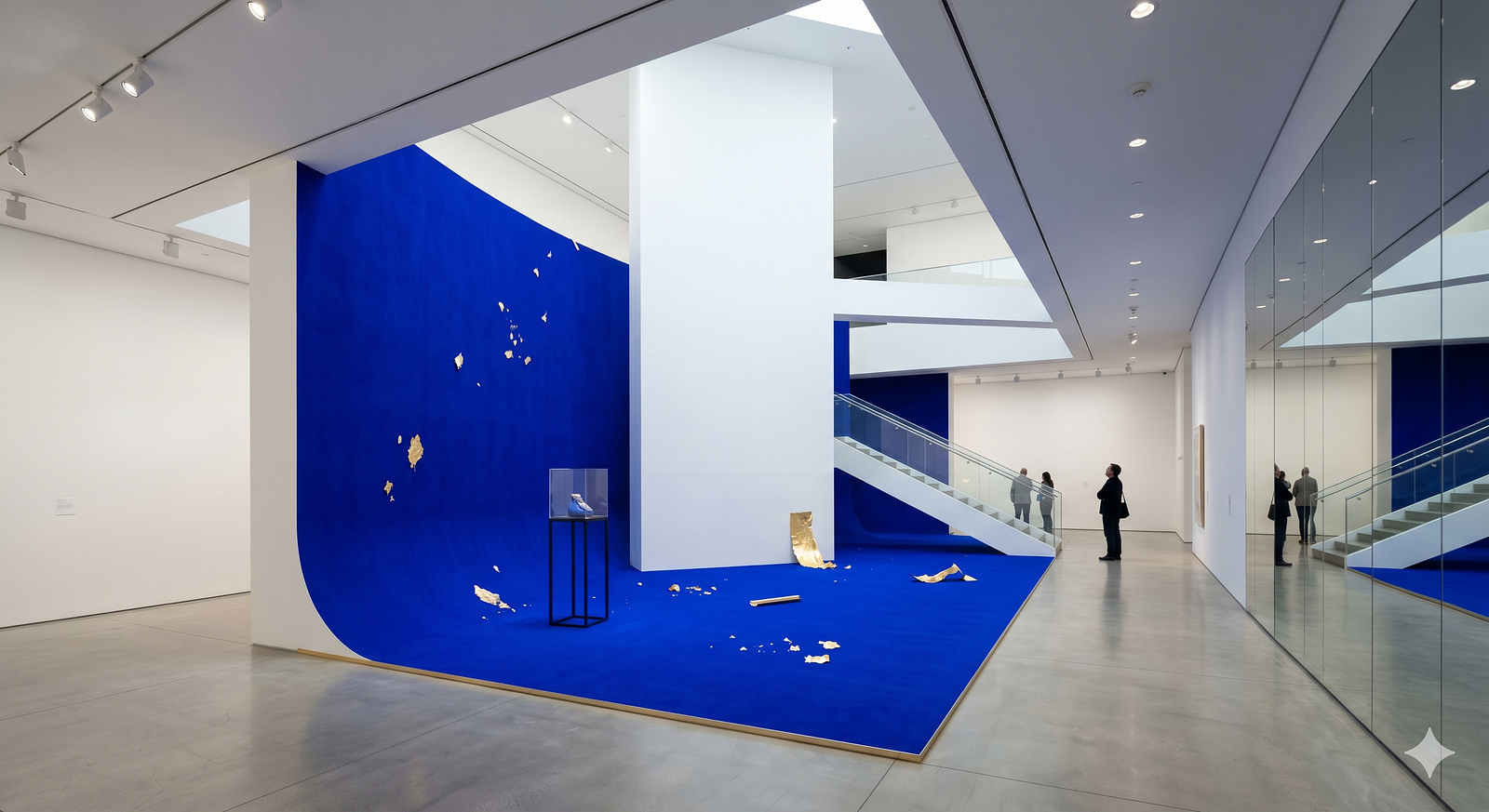
A stark, museum-like interior built around a monumental field of ultramarine so saturated it feels almost electrical, interrupted by crisp white architectural planes, mirrored surfaces, and a scattering of polished gold leaf fragments that catch the light like deliberate thoughts. The composition should feel austere yet luxurious, with strong geometric balance, immaculate negative space, and a sense that every object has been placed as part of an elegant intellectual dare. Use velvety matte blues, cool white walls, soft graphite shadows, and flashes of warm metallic brilliance. The mood should be cerebral, modern, slightly theatrical, and hypnotically refined, as if pure color has become a form of high society mischief. Keep the surfaces pristine, the lighting gallery-clean, and the atmosphere charged with quiet confidence.
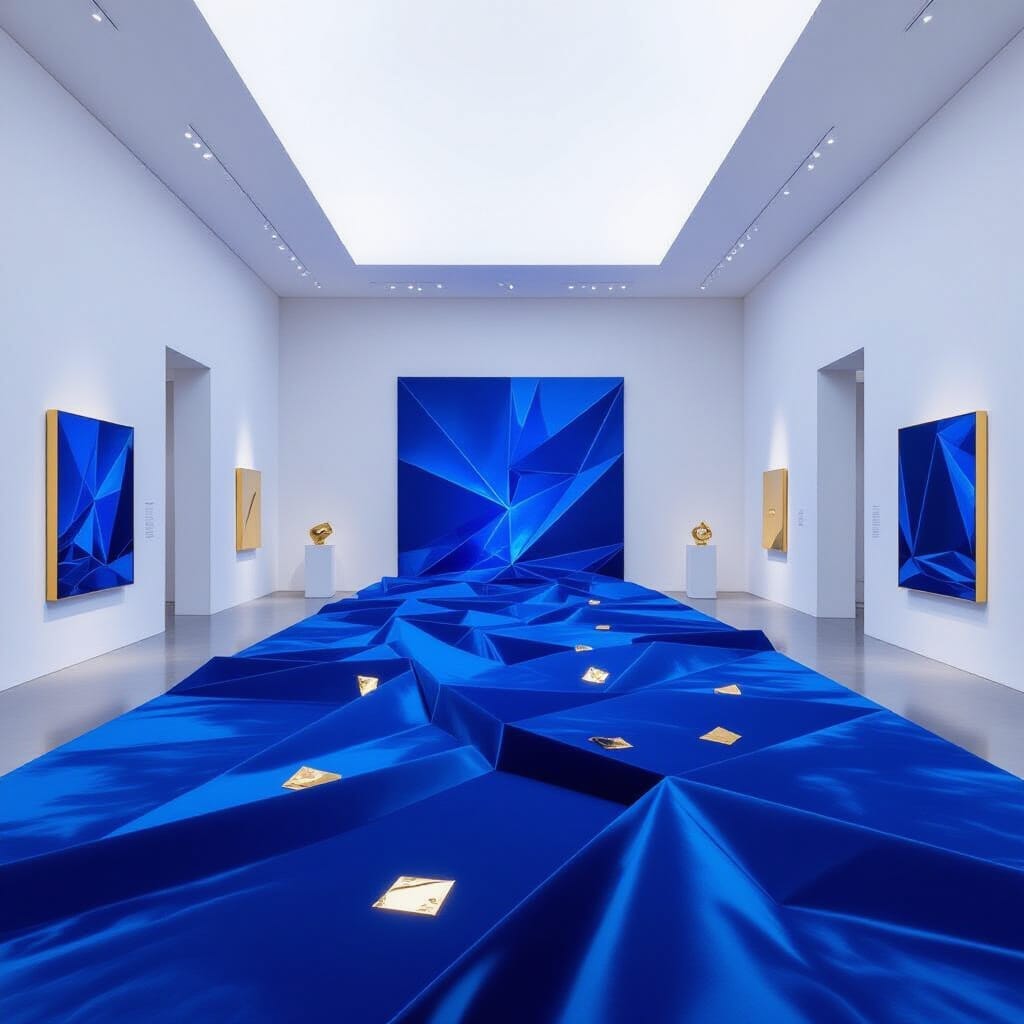
Begin with a sudden bloom of intense ultramarine flooding the frame, then let mirrored panels, white architectural forms, and gold fragments snap into place with rhythmic precision. Make the motion magnetic and stylish: reflective surfaces rotate, blue light pulses across the room, and metallic details flicker in sync like expensive secrets being revealed one beat at a time. Use sharp cuts, fast push-ins, clean geometric wipes, and moments where the camera seems to glide through negative space before colliding with a flash of gold or a wall of saturated blue. Let shadows shift subtly, reflections multiply, and the whole scene feel like a luxurious conceptual installation coming alive under perfect gallery lighting. Keep it sleek, kinetic, and impossible to scroll past.
Songs to pair with it:
- The Heinrich Maneuver — Interpol
- The Underdog — Spoon