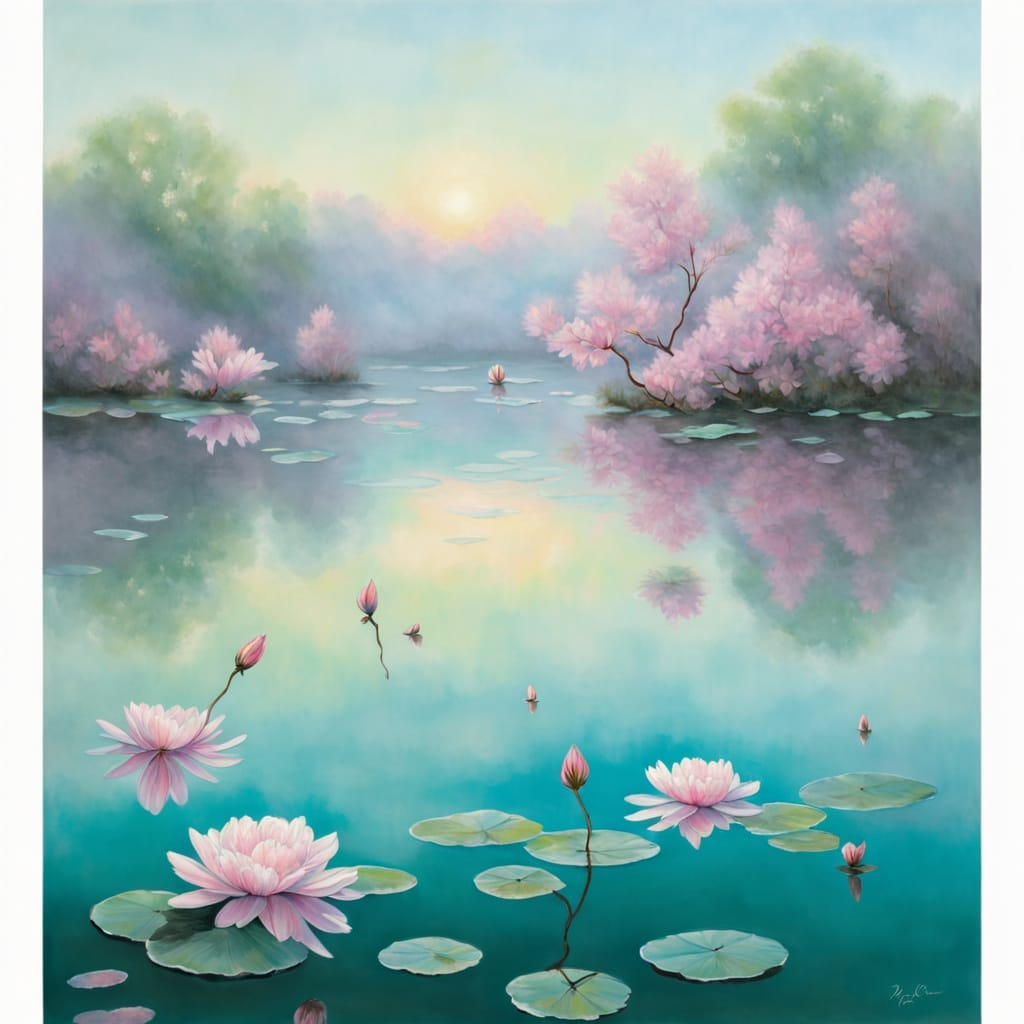

Claude Monet wasn’t just an artist — he was the guy who painted the same haystack 30 times because, apparently, the lighting changed. Born in Paris in 1840, Monet grew up in Le Havre, where his career began not with grand canvases but with selling caricatures of townsfolk. Little did they know the man doodling their oversized noses would become the father of Impressionism.
So, who was Monet? He was the brush behind the word “Impressionism” itself. When a critic sneered at his painting Impression, Sunrise (1872) and called it unfinished, Monet and his friends shrugged and said, “Fine, we’ll call ourselves Impressionists.” Boom — a movement was born out of sarcasm.
His style? Light. Color. Atmosphere. Monet painted what he saw, not what he knew. His canvases weren’t about precise lines but about shimmering perception — the way fog hangs over the Thames or lilies float like dream fragments. If you’ve ever squinted at something and thought, “Wow, that’s beautiful in a blurry kind of way,” congratulations: you’ve had a Monet moment.

Monet’s training came under Eugène Boudin, who dragged him outside to paint landscapes en plein air. This was radical — before, serious painters stayed indoors, staring at fruit bowls under controlled lighting. Monet said, “Forget fruit bowls, I want to chase clouds.” His obsession with light led to serial works: cathedrals, poplars, water lilies, all captured under shifting skies.
Any special techniques? Oh yes. Broken color, rapid brushwork, and layering translucent paints to mimic the elusive dance of sunlight. Stand too close to a Monet and it looks like a painter had a seizure. Step back, and suddenly you’re in a misty Paris morning. It’s like the world’s most refined magic eye poster.
Did he collaborate? Monet wasn’t exactly in a “band,” but his crew included Renoir, Sisley, and Bazille — together, they staged the first Impressionist exhibition in 1874. Think of it as the first indie art show that critics hated but history loved.

Wealth? Monet wasn’t born rich, and in fact, he struggled financially for years. Collectors were slow to embrace canvases that looked “unfinished.” But once Impressionism caught on, Monet’s lilies became hot property. By the end of his life, he was living comfortably in his sprawling Giverny estate, with a garden he basically designed as a paint supply chain.
When was he most popular? Monet gained serious traction in the 1880s and 1890s, especially with his series paintings. By the time he unveiled his massive water lily panels to the French state in the 1920s, he was basically the Beyoncé of brushstrokes.
Anything else left to tell? Oh yes. Monet suffered from cataracts later in life, which tinted his vision yellow-red. Instead of quitting, he leaned into it — his late works are fiery, blurry, and almost abstract. Modern critics see these as precursors to Abstract Expressionism. Turns out bad eyesight can be avant-garde.
Tidbit: Monet loved gardening almost as much as painting. His Giverny water garden wasn’t just inspiration — it was his artistic co-conspirator. Imagine painting the same lilies you grew just outside your studio door. Talk about farm-to-canvas.
In short: Monet taught us that art isn’t about capturing reality — it’s about capturing how reality feels when the light hits just right. And for that, we owe him not only countless museum visits but also every Instagram filter.
References:

Art Prompt:
A vast expanse of water glimmers beneath a pale sky, where floating blossoms scatter like delicate jewels across shifting reflections. Gentle brush strokes dissolve edges, merging greens, pinks, and blues into a luminous haze. The surface ripples softly, blurring boundaries between water and air, creating a tranquil yet infinite space of dreamlike serenity.
Video Prompt:
Slow, drifting camera movements glide over shimmering water, blossoms floating and dissolving into ripples of pink, green, and blue. Sunlight flickers, reflections shimmer, and the scene pulses gently, as if time itself has slowed to let the viewer breathe in color. Subtle zooms reveal new blossoms appearing, then melting into luminous haze.
Songs to pair with the video:
- “Pink + White” — Frank Ocean
- “We Float” — PJ Harvey
Follow for more art adventures, and drop your favorite Monet piece in the comments — I’m curious which lily pond pulls you in the deepest.