
If Picasso is the loud kid in art history who never stops raising his hand, Georges Braque is the one in the back quietly inventing a whole new visual language… and then going back to work like it’s no big deal.
Episode 32 is all about that quiet architect: the man who helped invent Cubism, glued fake wood into paintings, covered a Louvre ceiling in birds, and still somehow ended up as “Picasso’s friend” in most headlines. Let’s fix that.
Who was Georges Braque, really?
Georges Braque was born in 1882 in Argenteuil and grew up in Normandy, where he trained in his family’s trade of decorative house painting — confirmed in the excellent overview on the Georges Braque page from MoMA. Later, he studied at the École des Beaux-Arts in Le Havre and then at the Académie Humbert in Paris, where he met artists like Marie Laurencin and Francis Picabia according to this detailed biographical entry from the Tate.
He also played flute, violin, and accordion, which explains why musical instruments appear so frequently in his early Cubist works — a fact noted in the artist profile on the Centre Pompidou’s biography of Braque.

What is he known for?
Short version: Braque co-invented Cubism and quietly altered the entire trajectory of modern art.
Longer version:
- He began with Impressionism, then shifted into Fauvism after seeing the “wild beasts” in 1905 — a period described clearly on the National Gallery of Art’s Braque page.
- A 1907 Cézanne retrospective plus meeting Picasso pulled him toward radical geometry; the houses he painted at L’Estaque were the ones a critic referred to as “little cubes” — documented in this Encyclopaedia Britannica article.
- From 1908–1914, Braque and Picasso built Cubism side-by-side in Paris, their styles so intertwined that even specialists sometimes have to check labels — a point supported by the Met Museum’s introduction to Cubism.
His biggest contributions:
- Analytical Cubism — muted tones, fractured planes, multiple viewpoints at once.
- Papier collé (collage) — invented when he glued faux wood-grain wallpaper into a drawing, explained beautifully in the MoMA article on papier collé.
- Birds and studios — his late-life bird motif became iconic, including his enormous ceiling for the Louvre, covered on the Louvre’s page about Braque’s ceiling.
What does a “Braque style” look like?
Think disciplined chaos with excellent taste in neutrals.
Signature qualities:
- Muted, earthy palette — browns, greys, olives, dusty blues.
- Still life focus — pipes, bottles, sheet music, guitars, newspapers.
- Fractured but stable forms — everything splintered into planes, yet surprisingly calm.
- Stenciled text — letters and numbers floating across the surface.
- Late birds & studios — simplified silhouettes in softly glowing light.
A great summary appears in the stylistic analysis on the Guggenheim’s Braque resource.

Who taught him?
Braque’s education was a blend of:
- Traditional training from his family’s decorative painting workshop.
- Formal studies at the École des Beaux-Arts in Le Havre.
- Advanced study at the Académie Humbert in Paris, where he met Laurencin and Picabia.
A clear breakdown of these early influences is provided by the Tate’s biography of Braque.
His major inspirations:
- Paul Cézanne — structure, geometry.
- Henri Matisse & the Fauves — color freedom.
- Picasso — creative sparring partner.
Did he use any special techniques?
Absolutely — Braque is one of the great experimenters.
Papier collé
He invented collage by gluing wallpaper directly into his artwork — a turning point detailed on the MoMA papier collé page.
Stenciled text
Letters and numbers appear in works like The Portuguese, a technique noted in the analysis on the Met Museum’s Cubism page.
Surface wizardry
Braque often manipulated surface textures, adding sand and using matte/gloss contrasts, discussed on the Guggenheim’s material analysis of Braque.
Who did he work with?
Primarily Picasso, and intensely. Their collaboration is legendary — described by Kahnweiler, their dealer, and summarized well in the Britannica section on Braque’s Cubist period.
He also associated with Othon Friesz, Raoul Dufy, Laurencin, and Picabia early in his career, as documented in the NGA biography.
Was he wealthy?
Not extravagantly — but comfortable. He came from steady means and later had strong gallery representation under Daniel-Henry Kahnweiler. His works steadily climbed in value over his lifetime, and modern auction sales reach millions, as shown in the pricing records on the Sotheby’s auction results page for Braque.
When was he most popular?
Three major peaks:
- 1908–1914 Cubist era — the revolutionary years with Picasso.
- Mid-century recognition — retrospectives and his Louvre ceiling commission.
- Late bird period — beloved by collectors and museums.
The evolution of his reputation is outlined in the Britannica retrospective section.

Tell me more. (Yes, there’s more.)
- His lifelong musicianship made instruments natural Cubist subjects — mentioned on the Centre Pompidou biography.
- He boxed recreationally, which explains his compact, powerful presence.
- A severe WWI head injury temporarily blinded him in one eye and changed his artistic pace — described clearly in the NGA biography.
- He delivered iconic quotes such as “Art is a wound turned into light,” widely cited on the Wikiquote page for Georges Braque.
Any last tidbits?
- He went from painting houses… to painting a Louvre ceiling.
- Hitchcock installed a mosaic inspired by Braque’s birds at his home.
- He never stopped experimenting with printmaking and sculpture.
Braque is what happens when the quiet guy in the room turns out to be the one rewriting the rulebook.
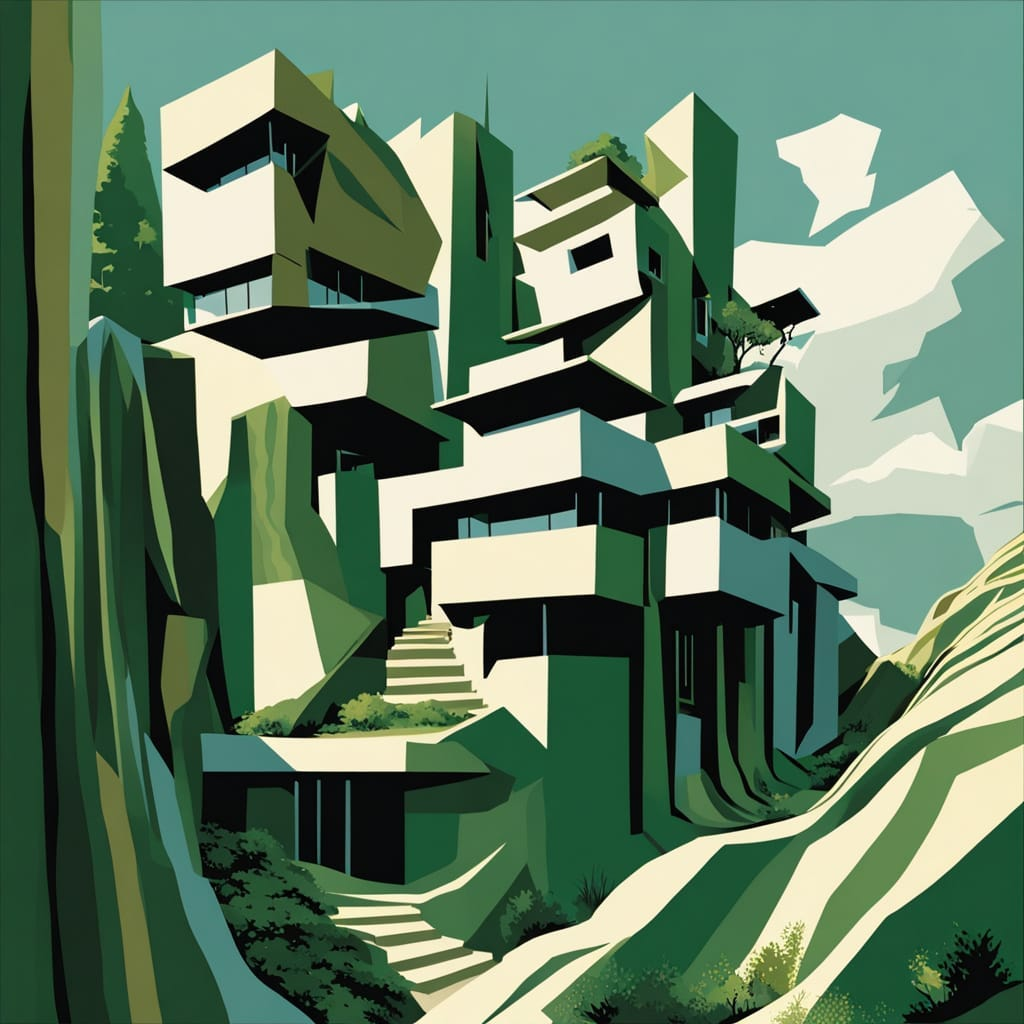
Art Prompt (Cubist Landscape):
A steep hillside village unfolds as a mosaic of interlocking planes, houses stacked like sturdy geometric blocks climbing toward a shimmering sky. Sun-warmed facades dissolve into faceted slabs of ochre, sage green, and weathered stone, their windows reduced to dark, rectangular slivers that hint at life inside. Slanted roofs tilt at improbable angles, compressing depth so that foreground and distance slide into the same shallow, vertical picture space. Trees become chunky, angular bursts of deep green, almost sculpted from light rather than leaves. Above it all, a pale blue sky splinters into subtle facets, as if the air itself were carved into planes of color, echoing the quiet, structural rhythm of an early 20th-century avant-garde landscape.

Video Prompt:
Start with a slow push-in over a hillside of stacked, cubist-style houses, their walls and roofs shifting gently as if made of hinged, painted panels. As the camera glides forward, faceted planes of ochre, green, and stone subtly pivot and re-lock, rearranging the village in time with the beat. Trees snap into place as chunky, angular bursts, then flatten into silhouettes before unfolding again into fractured volumes. The sky above flickers through soft blue facets, tiny shifts of tone rippling like light across carved glass. Cut to swooping lateral moves that skim along the facades, letting windows and doors appear and vanish as the geometry reconfigures itself. Occasionally, the camera tilts upward and the entire village seems to compress into a nearly abstract tapestry of shapes, before gently expanding back into a recognizable hillside at the drop. Finish on a slow, drifting pull-back where the scene freezes into a single, harmonized composition — a calm, crystalline landscape frozen in mid-rearrangement.
Two songs to soundtrack your video
To give that video some emotional lift while the planes of color slide around:
- Rivers and Roads — The Head and the Heart
Warm, nostalgic, slow build; perfect for the long, gliding camera moves and that final pull-back freeze frame.
- The Wolves (Act I and II) — Bon Iver
Starts intimate, then swells into something raw and expansive — a great pairing for the moment when the village shifts from calm geometry into full emotional crescendo.
Your turn
If this helped you see Braque as more than just “Picasso’s sidekick,” drop a comment with:
- Your favorite Braque era (early Fauve, hardcore Cubist, or bird-ceiling mystic).
- Or a question you still have about Cubism that you’d love to see unpacked in a future episode.
And if you want more deep-dive art nerdery with a side of AI-powered visuals, you can:
- Browse more posts at blog.lumaiere.com
- Wander through the galleries at lumaiere.com
- Or follow along on X at x.com/DaveLumAI for new art, prompts, and videos in the wild.
Tap follow, say hi in the replies, and tell me which artist you want to see in a future Artist Series episode.