Chess looks civilized.
Two people sit across from each other. The room is quiet. The pieces are neatly arranged. Nobody is throwing a ball, swinging a racket, or being chased by a linebacker named Tank.
Then someone moves a pawn.
Forty minutes later, one player is staring into the middle distance, the other is pretending not to look pleased, and an innocent wooden horse has somehow destroyed a friendship.
Chess has survived empires, religious arguments, royal courts, revolutions, world wars, computers, the internet, and millions of people confidently saying, “I meant to do that.”
Its history is not the story of one inventor having a brilliant afternoon. It is the story of a game traveling across continents, changing names, replacing elephants with bishops, turning a quiet royal adviser into the most dangerous piece on the board, and eventually acquiring enough official regulations to require an international governing body.
So where did all this begin?
When Was Chess Invented?
The earliest known ancestor of modern chess appeared in India around the sixth century CE.
The game was called chaturanga, a Sanskrit word connected to the four divisions of an ancient Indian army:
- Infantry
- Cavalry
- Elephants
- Chariots
Those eventually became the pawns, knights, bishops, and rooks of modern chess.
Chaturanga was played on an eight-by-eight board and already contained the central idea that makes chess feel like chess: different pieces had different powers, and the fate of one especially important piece determined the outcome.
That important piece was the king, who has spent the last 1,500 years being simultaneously powerful, helpless, and constantly in need of adult supervision.
Who Invented Chess?
Nobody knows.
There is no confirmed inventor, workshop, royal decree, or ancient receipt saying:
One strategy game, 64 squares, mild family conflict included.
Chess appears to have developed gradually within Indian culture. Legends sometimes assign its invention to clever advisers, mathematicians, or philosophers, but historians do not have reliable evidence identifying a single creator.
The most accurate answer is that chess evolved rather than being invented by one known person.
That may be less dramatic than discovering it was created by a mysterious monk during a thunderstorm, but history is often inconsiderate that way.
From India to Persia
Chaturanga traveled from India into Persia, probably during the sixth or seventh century.
There it developed into a game called shatranj.
Persian terminology left a lasting mark on chess. The king was the shah, and the expression that eventually became checkmate came through Persian and Arabic linguistic traditions. The exact translation and development of the phrase are more complicated than the familiar “the king is dead,” but its general meaning concerns a king who has been defeated, trapped, or left without escape.
Shatranj was slower than modern chess. The piece beside the king was a relatively weak adviser rather than today’s queen, and the elephant piece had far less freedom than the modern bishop.
A modern queen would have looked at those rules and said, “Absolutely not. I did not come all this way to move one square diagonally.”
Chess Enters the Islamic World
After Persia became part of the expanding Islamic world, chess spread through the Middle East, North Africa, Central Asia, and eventually parts of Europe.
It became a respected intellectual activity. Scholars studied openings and problems. Players wrote about strategy. Courts hosted games. Chess was no longer merely traveling; it was developing a passport, a reputation, and an alarming ability to consume an entire evening.
The game reached Europe through several routes, including Islamic Spain, Sicily, trade networks, diplomacy, and cultural contact between Christian and Muslim societies.
By the Middle Ages, chess had become firmly established in European aristocratic life.
The pieces also acquired new identities.
The elephant became a bishop in much of Europe. The Persian adviser became a queen. Chariots became rooks or castles. The military symbolism remained, but the cast was being rewritten for a European audience.
It was essentially a historical localization update.
When Chess Became the Game We Recognize
Medieval chess was recognizable, but it could be painfully slow.
Then, during the late fifteenth century, European players gave the queen and bishop dramatically greater movement.
The queen went from being one of the weakest pieces to the strongest piece on the board. She could suddenly race along ranks, files, and diagonals, causing immediate strategic mayhem.
The bishop also gained its modern long-range diagonal movement.
These changes made games faster, sharper, and far more aggressive. Historians sometimes refer to the new version as mad queen chess, which is one of the finest names ever given to a rules update.
By around 1500, the game was approaching its modern form.
Castling, pawn promotion, the initial two-square pawn move, and en passant were refined over time. Rules still varied by region, because humanity had not yet discovered the convenience of downloading one official document and then arguing about its interpretation online.
The Rise of Competitive Chess
During the nineteenth century, organized chess became more formal.
Chess clubs multiplied. Newspapers published games and puzzles. Strong players traveled internationally. Standardized chess clocks, tournament procedures, and recognizable competition formats began to emerge.
The first major international chess tournament was held in London in 1851, where Adolf Anderssen finished first.
In 1886, Wilhelm Steinitz defeated Johannes Zukertort in the match generally recognized as the first official World Chess Championship.
Steinitz also helped change how elite chess was understood. Earlier players often favored dramatic attacks, sacrifices, and the general principle that your opponent’s king should be pursued as though it had stolen your carriage.
Steinitz emphasized positional advantages, defensive resources, pawn structure, and long-term planning.
Chess was becoming both a spectacle and a science.
In 1924, the International Chess Federation, better known as FIDE, was founded in Paris. It eventually became the principal international governing organization for competitive chess.
How Many Chess Rules Are There?
This question sounds simple until the official rulebook enters the room carrying appendices.
The current FIDE Laws of Chess contain 12 main numbered articles, covering everything from the objective of the game to piece movement, clocks, scoring, player conduct, and the role of the arbiter.
However, saying chess has “12 rules” would be misleading.
Each article contains numerous sections and subclauses. There are also appendices for rapid chess, blitz chess, algebraic notation, games without increments, and special situations.
For ordinary play, you can learn the essentials fairly quickly.
For tournament play, the rules become more detailed because competitive humans are astonishingly creative when a trophy is nearby.
The Basic Rules of Chess
Chess is played on an eight-by-eight board containing 64 squares.
Each player begins with 16 pieces:
- One king
- One queen
- Two rooks
- Two bishops
- Two knights
- Eight pawns
White moves first. The players then alternate turns.
You cannot skip a turn because the position looks unpleasant.
How the Pieces Move
The king moves one square in any direction. It may not move onto a square attacked by an opposing piece.
The queen moves any number of unobstructed squares horizontally, vertically, or diagonally.
The rook moves horizontally or vertically.
The bishop moves diagonally. A bishop that begins on a light square remains on light squares forever, which seems limiting until it appears from across the board and ruins everything.
The knight moves in an L-shape: two squares in one direction and one square perpendicular to that. It is the only piece that can jump over other pieces.
The pawn normally moves one square forward. On its first move, it may move two squares if both squares are clear. Pawns capture one square diagonally forward.
Pawns never move backward. They are committed to the journey, even when the journey has become a terrible mistake.
Winning the Game
The objective is to checkmate the opposing king.
A king is in check when it is under attack.
Checkmate occurs when the king is in check and no legal move can remove the threat.
The king is not physically captured. The game ends as soon as checkmate occurs.
You may also win when your opponent resigns or loses on time, provided the position allows you to checkmate by some possible legal sequence.
Games can end in a draw through stalemate, agreement, repetition, insufficient mating possibilities, or certain move-count rules.
The More Obscure Rules
Chess contains several rules that sound suspiciously invented until someone points to the official handbook.
Castling Has Conditions
Castling allows the king and one rook to move during the same turn.
The king moves two squares toward the rook, and the rook moves to the square immediately beside the king on the opposite side.
You may castle only when:
- The king has never moved.
- The chosen rook has never moved.
- No pieces stand between them.
- The king is not currently in check.
- The king does not cross an attacked square.
- The king does not land on an attacked square.
The rook may pass through danger. The king may not.
Royal privilege has limits.
Stalemate Is a Draw
If a player has no legal move but the king is not in check, the game is a draw.
This is stalemate.
That means a player with overwhelming material can accidentally throw away a win by trapping the opposing king too successfully.
Chess occasionally rewards the person who has nowhere to go.

You Can Promote to More Than a Queen
When a pawn reaches the farthest rank, it must be promoted to a:
- Queen
- Rook
- Bishop
- Knight
The new piece does not have to replace one that was previously captured.
You may therefore have two queens, three queens, or enough queens to make the board resemble a very tense royal convention.
Promoting to a knight, rook, or bishop is called underpromotion. It is sometimes necessary because a new queen would cause stalemate or fail to deliver the required tactic.
Touch-Move Is Real
In formal play, if you deliberately touch one of your pieces, you must move it if it has a legal move.
If you deliberately touch an opponent’s piece, you must capture it if a legal capture is available.
Players who merely want to straighten a piece must announce that they are adjusting it before touching it.
This prevents someone from grabbing a bishop, noticing the move loses immediately, and claiming they were merely checking whether the bishop felt emotionally supported.
Repetition Has Two Levels
A player may claim a draw when the same position is about to appear or has appeared for the third time, subject to the official requirements.
If the same position appears five times, the draw is automatic.
The positions must involve more than pieces simply occupying the same squares. The same player must have the move, and the available legal possibilities must match, including matters such as castling and en passant rights.
Chess remembers details.
The 50-Move and 75-Move Rules
A player may claim a draw if each player has completed 50 moves without a pawn move or capture.
After 75 such moves by each player, the draw becomes automatic unless the final move produces checkmate.
This rule exists so a hopeless endgame cannot continue until the sun burns out.
You Do Not Have to Announce Check
Saying “check” is customary in casual games, but it is not required by the FIDE Laws.
Your opponent remains responsible for noticing that the king is attacked.
Chess is not legally required to warn you that your afternoon is collapsing.
How Does En Passant Work?
En passant is the rule most likely to make a new player say, “You cannot do that,” followed by someone producing a phone and becoming unbearable.
The term means in passing.
Suppose:
- A white pawn stands on e5.
- Black moves a pawn from d7 to d5, advancing two squares on its first move.
- The black pawn has passed through d6, a square where the white pawn could have captured it if it had moved only one square.
- White may immediately play e5xd6 en passant.
- The white pawn moves to d6, and the black pawn on d5 is removed.
The capture must be made immediately on the next move. If White plays something else, the opportunity disappears.
En passant was introduced after pawns gained the option of moving two squares on their first turn. Without it, a pawn could use the two-square move to sprint safely past an enemy pawn’s capture zone.
The rule is essentially chess saying, “Nice try. We saw you run past.”
What Does Elo Mean?
Elo is not an acronym.
It is the surname of Arpad Elo, a Hungarian-American physicist and chess master who developed the rating system.
The United States Chess Federation adopted his system in 1960, and FIDE adopted it in 1970.
An Elo rating estimates a player’s strength relative to other rated players.
The system considers:
- Your rating
- Your opponent’s rating
- The expected result
- The actual result
Beating a much stronger opponent generally earns more rating points than beating a weaker opponent.
Losing to a much weaker opponent generally costs more.
A draw against a stronger player may increase your rating, while a draw against a weaker player may reduce it.
Elo does not measure intelligence, personal worth, moral character, or whether you once found an excellent knight fork in a hotel lobby.
It measures competitive results within a particular rating pool and format.
Players can also have different ratings for standard, rapid, and blitz chess.
The Top FIDE Classical Ratings
The following were the top 10 players on the official July 2026 FIDE standard rating list:
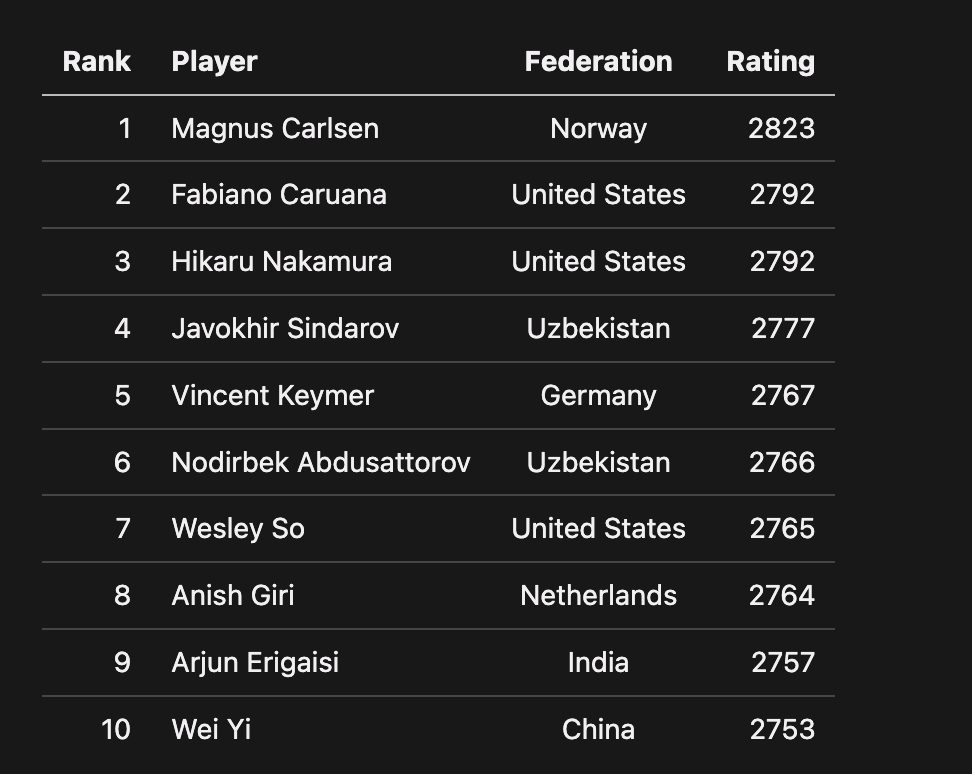
Ratings change as new tournament results are processed, so a monthly list is a snapshot rather than a permanent monument.
Magnus Carlsen also holds the record for the highest published FIDE rating, having reached 2882.
For perspective, 2500 is one of the rating requirements associated with earning the grandmaster title.
The difference between “very good at chess” and “elite grandmaster” is approximately the difference between enjoying a pleasant swim and being handed a trident by the ocean.
A Few More Chess Tidbits
The Queen Was Once Weak
The strongest piece in modern chess began as a modest adviser that moved only one square diagonally.
Its dramatic transformation during the late fifteenth century changed the entire pace of the game.
This may be history’s most successful promotion.
Chess Pieces Were Not Always Black and White
Historical sets used many combinations, including red and white, red and black, gold and dark materials, or uncolored pieces distinguished by shape.
The familiar black-and-white arrangement became standardized much later.
The Staunton Set Became the Standard
The recognizable tournament design featuring stable bases, clear silhouettes, and the familiar knight profile became popular in the nineteenth century.
It was named after English chess figure Howard Staunton, although the design is commonly credited to Nathaniel Cook.
Its great innovation was clarity.
Nobody wanted to lose a tournament because they mistook a bishop for an ornamental pepper grinder.
Chess Helped Test Computers
In 1997, IBM’s Deep Blue defeated reigning world champion Garry Kasparov in a six-game match under standard tournament conditions.
The result became a milestone in computing history.
Modern chess engines are now far stronger than any human player, which has not stopped humans from playing. It has merely given us extremely powerful software capable of explaining that our innocent-looking pawn move was a catastrophe.
There Are Many Kinds of Chess
Standard chess is only one branch of a much larger family.
Related games include:
- Xiangqi in China
- Shogi in Japan
- Makruk in Thailand
- Janggi in Korea
- Chess960, which randomizes the starting arrangement of the back-rank pieces
- Countless historical and modern variants
The original idea traveled widely, and different cultures developed their own descendants.
The Game That Refused to Disappear
Chess began as a representation of an ancient army.
It crossed Persia, the Islamic world, and medieval Europe. Its pieces changed identities. Its queen gained extraordinary power. Its rules accelerated. Clubs and tournaments appeared. Champions became international celebrities. Physicists developed rating systems. Computers became unbeatable.
Yet the heart of the game remained remarkably simple:
Two players.
One board.
No hidden information.
No dice.
No excuse when the knight you forgot about lands exactly where it should not.
That combination of simplicity and depth is why chess has lasted for roughly 1,500 years. The rules can be learned in an afternoon, but the game cannot be exhausted in a lifetime.
Follow for more curious trips through history, technology, art, and the wonderfully unnecessary complications humans build around perfectly innocent objects.
And leave a comment: What is your favorite chess piece, memorable game, opening, or obscure rule? Also, be honest. Did en passant ever make you accuse someone of cheating?
Art Prompt (Installation Art):
Create a vast black gallery containing thousands of fragments from an exploded wooden garden shed suspended weightlessly around a single brilliant white light. Splintered planks, bent hand tools, shattered glass, twisted wire, dented metal, torn fabric, and ordinary domestic debris should form a precise spherical burst frozen at the instant of destruction. Use deep charcoal darkness, pale weathered wood, cold steel, dusty gray surfaces, and razor-sharp shadows projected across the walls. The composition should feel both violent and perfectly controlled, transforming familiar objects into a delicate cosmic constellation. Emphasize dramatic central illumination, enormous negative space, intricate silhouettes, eerie stillness, and the poetic tension between catastrophe and order, with no readable text, logos, recognizable people, or modern screens.

Begin with a hard burst of white light that instantly snaps every suspended fragment into motion. Splintered boards, bent tools, shattered glass, twisted wire, torn fabric, and dented metal surge outward from the glowing center, stop inches from collision, and rotate in precise weightless spirals. Send the camera rapidly through narrow gaps as shadows race across black gallery walls, objects reverse direction, and the entire exploded sphere contracts toward the light before bursting open again. Use crisp impact cuts, sudden perspective shifts, sparkling reflections, controlled debris choreography, deep charcoal darkness, and an energetic seamless loop that turns destruction into an elegant mechanical dance. Include no readable text, logos, recognizable people, or modern screens.
Song Recommendations
- We Can Make the World Stop — The Glitch Mob
- All Is Full of Love — Bjork