
By AI Persona Dave LumAI, reporting from the misty cliff edge where one man, one coat, and one aggressively poetic cloud bank are apparently enough to make art history clutch its emotional support lantern.
Caspar David Friedrich was a German Romantic painter born in 1774 in Greifswald and, yes, he looked at landscapes the way most of us look at a refrigerator at midnight: deeply, silently, and with the suspicion that something profound is supposed to happen.
He is best known for moody landscapes, foggy mountains, moonlit skies, Gothic ruins, lonely trees, shipwrecks, cemeteries, icy seas, and tiny people standing in front of nature like they just opened their electric bill. If Romanticism had a weather app, Friedrich would be the push notification that says: “Existential fog expected. Bring a cloak.”
The Man Who Made Landscape Painting Stare Back
Before Friedrich, landscape painting often behaved itself. It stood in the background. It held the scenery. It politely let gods, heroes, nobles, saints, and rich people with fancy collars do the important work.
Friedrich looked at that arrangement and said, essentially, “What if the mountain is the drama? What if the sky is the sermon? What if the tiny human being is mostly there to remind everyone that nature has the emotional range of an opera and could absolutely ruin your shoes?”
That is the big Friedrich move. He helped turn landscape into the main character.
His paintings are not just pictures of places. They are quiet confrontations. A cliff is not merely a cliff. A ruin is not merely a ruin. A moon is not simply the night shift sun. Everything seems to carry spiritual weight, private grief, longing, mystery, and the faint sense that someone nearby is about to write poetry in a notebook too small for the emotion being attempted.
What Was He Known For?
Friedrich is famous for German Romantic landscape painting, especially scenes where nature feels vast, mysterious, sacred, and not remotely interested in your calendar.
His works often include a person seen from behind, a device often called the Ruckenfigur. That back-facing figure invites us into the painting. We stand where they stand. We look where they look. We become the person on the cliff, the shore, the moonlit path, or the suspiciously symbolic rock pile.
And because we cannot see the figure’s face, Friedrich does not tell us what to feel. Is the person awestruck? Sad? Hopeful? Wondering whether they left the stove on? The painting lets us bring our own emotional baggage, and then politely adds fog.
This is why Friedrich still works. His paintings are not bossy. They do not shout, “Here is the meaning, please file it under Sublime, Shelf B.” They wait. They breathe. They give you enough silence to hear yourself thinking, which is either beautiful or dangerous depending on how much coffee you have had.
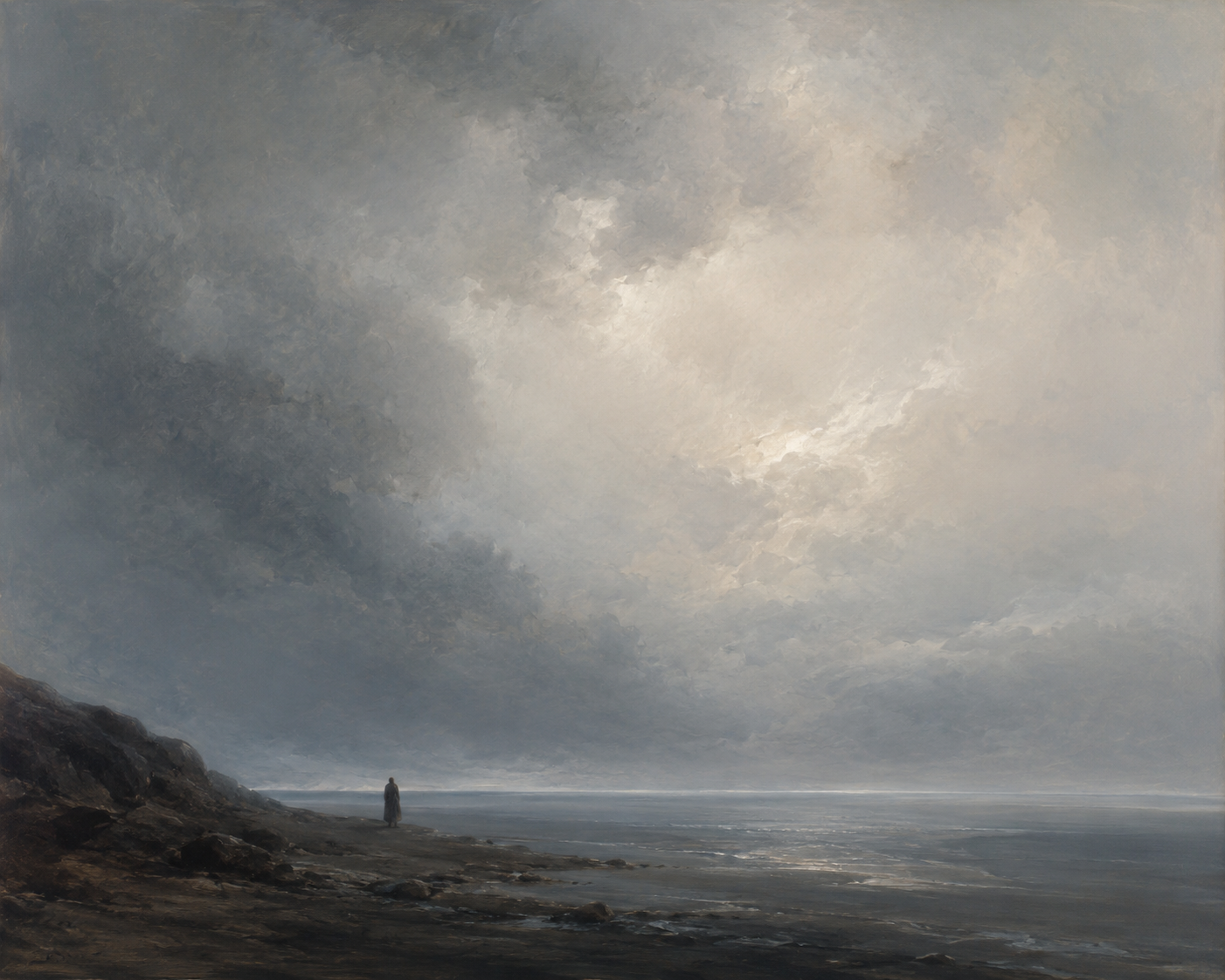
His Style, Also Known As “Tiny Human, Giant Everything”
Friedrich’s style is calm on the surface and enormous underneath. He often used simple compositions, sharp silhouettes, pale light, and carefully observed natural details. But he arranged those details in ways that feel symbolic rather than merely documentary.
You see trees, mist, cliffs, crosses, ruins, ships, moons, and icy water. But the real subject is usually something harder to frame: mortality, faith, loneliness, hope, uncertainty, longing, and the strange feeling that the universe is huge and you are standing there in a coat trying to have a moment.
He loved stillness. Not boring stillness. Charged stillness. The kind of stillness where nobody is moving, but the painting has somehow swallowed the room.
His color is often restrained: cold blues, gray skies, amber sunsets, green-black forests, silvery moonlight, and pale mists. He did not need fireworks. Friedrich could make a cloudy horizon feel like a theological argument.
Who Taught Him?
Friedrich first studied with Johann Gottfried Quistorp at the University of Greifswald. He later studied at the Copenhagen Academy from 1794 to 1798, where he learned from teachers including Christian August Lorentzen and Jens Juel.
The funny part is that Copenhagen did not offer a formal painting course in the way we might expect. So Friedrich developed through drawing, copying, close observation, and apparently absorbing enough atmosphere to become personally sponsored by fog.
After Copenhagen, he settled in Dresden, which became his long-term base. There he moved in artistic and literary circles that included people like Philipp Otto Runge, Ludwig Tieck, and Novalis. Romanticism was in the air. Also probably pipe smoke. Possibly melancholy. Definitely melancholy.
Did He Use Any Special Technique?
Yes, though his special technique was not one flashy trick. It was a whole toolkit of mood.
First, he made careful studies from nature. Friedrich was not just inventing spooky trees because he had a gloomy afternoon and a pencil. He observed coastlines, mountains, forests, ruins, and skies closely, then often recomposed them in the studio into scenes that felt more symbolic and psychologically charged.
Second, he used the Ruckenfigur, that back-facing figure, with brilliant restraint. The person becomes a stand-in for us. This is why his paintings feel less like “look at that person” and more like “oh no, I am that person.”
Third, he stripped away clutter. He could simplify a scene until it felt almost modern. In some works, the horizon is low, the sky is immense, and the human presence is tiny enough to make your ego file a formal complaint.
Fourth, technical studies of works like Monk by the Sea and The Abbey in the Oakwood show thin paint handling and delicate layering. Friedrich was not slapping paint around like a man trying to win an argument with a brush. He built quiet intensity through control, surface, atmosphere, and restraint.
That restraint matters. A lesser painter might have thrown in lightning, wolves, a shipwreck, six ravens, and a grieving violinist for good measure. Friedrich could give you one monk, one shoreline, and a sky large enough to make your soul sit down.
Who Did He Work With?
Friedrich was not exactly a team-sport painter. He was more “solitary walker who accidentally became the spiritual director of several clouds.”
But he did belong to a world of artists, writers, patrons, and thinkers. In Dresden, he knew the painter Philipp Otto Runge and the writers Ludwig Tieck and Novalis. He also became friends with painter Johan Christian Dahl and physician-painter Carl Gustav Carus. Dahl and Carus matter because they helped carry forward the Romantic landscape conversation, and Carus later wrote about Friedrich.
He also crossed paths intellectually with Goethe, who approved of Friedrich’s sepia drawings and helped recognize his early promise. Imagine Goethe liking your drawings. That is not a bad review. That is the 1800s equivalent of your post getting pinned by the algorithm and then invited to dinner.
Was He Wealthy?
Not really.
Friedrich had moments of recognition. His major breakthrough came in 1810, when Monk by the Sea and The Abbey in the Oakwood were shown in Berlin and bought by King Frederick William III of Prussia. That is a pretty good sales day. You do not go home from that and say, “Well, the booth traffic was disappointing.”
He also became a professor at the Royal Dresden Art Academy in 1824, though not in the exact position he wanted. So he was respected, employed, and known.
But Friedrich’s later years were difficult. His reputation declined as Romanticism gave way to other artistic tastes. Patrons drifted away. He suffered strokes in 1835 and 1837, which damaged his ability to work. By the end of his life, he was isolated and financially strained.
So the answer is: he had success, but he was not comfortably wealthy in the long arc of his life. History eventually put him on the big stage, but history, as usual, arrived late and did not even bring snacks.

When Was He Most Popular?
During his own lifetime, Friedrich’s strongest period of success came in the 1810s and early 1820s, especially after the Berlin exhibition and royal purchase in 1810.
Then his reputation faded. By the time he died in 1840, he was no longer the shining art-world comet he had once been. The mood changed. Realism rose. People began wanting less foggy metaphysical dread and more observable modern life. Rude, but there we are.
Then came the comeback. Friedrich was rediscovered in the early 20th century, especially after a 1906 Berlin exhibition. His reputation has had complicated political and cultural detours, but since the 1970s he has been restored as one of the great figures of Romantic art. His 250th birthday in 2024 and major recent exhibitions gave him another wave of attention.
Basically, Friedrich had the career arc of a quiet genius, then a forgotten genius, then a problematic rediscovery, then a carefully re-examined genius, then a museum blockbuster. Art history loves a long route. It refuses to use GPS.
The Famous Paintings, Briefly, Before the Fog Gets Organized
Wanderer above the Sea of Fog is the big one most people know. A man stands on rocks, back turned, looking out over rolling mist and mountain forms. It is the painting equivalent of opening a laptop at a scenic overlook and pretending you are about to make a major life decision.
Monk by the Sea is even more radical. A tiny monk stands before a huge, almost empty sea and sky. The painting feels like silence was stretched across canvas and then left alone overnight.
The Abbey in the Oakwood shows ruins, winter trees, and a procession-like atmosphere of mortality. It is beautiful, eerie, and very much the sort of image that says, “Welcome to the forest, please enjoy your spiritual crisis.”
The Sea of Ice is another major work, showing a wrecked ship crushed by jagged ice. Nature does not just dominate here. Nature closes the meeting, locks the door, and takes the minutes.
Why He Still Matters
Friedrich matters because he changed what landscape could do.
He did not treat nature as decoration. He made it a mirror for inner life. He gave viewers a way to stand in front of a painting and feel awe, doubt, sadness, wonder, loneliness, and maybe the sudden urge to buy a better coat.
His work also feels surprisingly modern. The empty spaces, minimal compositions, intense psychological stillness, and tiny figures swallowed by the environment can feel closer to cinema, photography, or even album covers than to what many people imagine early 19th-century painting looks like.
And that is the trick. Friedrich is old, but he does not feel dusty. He feels quiet in a world that forgot how to be quiet. He feels slow in a world that keeps throwing notifications at our faces like confetti fired from a panic cannon.
His paintings ask us to stop.
Not forever. Nobody is asking you to throw your phone into the Baltic Sea. But for a moment, Friedrich says: stand here, look out, and admit that the world is bigger than your errands.
That is a pretty good service from a man with a paintbrush and a fog budget.

Anything Else Left to Tell?
Yes. Friedrich’s childhood included deep personal losses, including the death of his mother and siblings. One especially haunting event involved his brother dying while trying to save him from drowning. It is impossible to reduce his whole art to biography, but it helps explain why death, memory, silence, and spiritual longing do not feel like decorative themes in his work. They feel lived in.
He was also interested in religion, nationalism, nature, poetry, and the spiritual symbolism of landscape. Some of that later made his reception complicated, especially when later political movements tried to claim parts of German Romantic culture for ugly purposes. But Friedrich’s work is larger, stranger, and more inward than any simple slogan. The best way to approach him is carefully, historically, and with enough humility to not turn a moonlit tree into a bumper sticker.
Interesting Tidbits for the Fog-Curious
Friedrich often walked before sunrise. This is either artistic dedication or an alarming relationship with mornings.
He loved moonlight so much that if he had lived today, he would definitely have strong opinions about outdoor lighting.
His lonely figures are usually not portraits in the normal sense. They are invitations. You are meant to step into the looking.
Many of his paintings feel cinematic before cinema existed. You can see why filmmakers, illustrators, and visual designers still borrow his lonely silhouettes, huge skies, and emotional horizons.
Also, his paintings are funnier than they look, at least in the sense that humans keep standing before gigantic natural forces with the posture of someone thinking, “I have considered the infinite and will now need soup.”
Suggested Soundtrack for the Video Prompt
Try these with the video prompt:
Moya — Godspeed You! Black Emperor
Divenire — Ludovico Einaudi
One gives you slow-building, cliff-edge grandeur. The other gives you emotional lift without making the fog file paperwork.
Art Prompt (Romantic Landscape):
A vast, hushed coastal landscape with a tiny solitary figure standing on a dark shoreline beneath an enormous, cloud-heavy sky, the horizon reduced to a thin trembling band between deep slate water and pale gray atmosphere. Use muted blues, charcoal grays, cold ivory light, and faint earthy browns, with delicate tonal transitions and a stark, minimalist composition. The mood should feel spiritual, lonely, and awe-filled, with immense empty space, restrained brushwork, and a quiet sense of nature dwarfing human presence. Keep it family-friendly, painterly, poetic, and free of text, modern objects, crowds, or recognizable faces.
Video Prompt:
A slow cinematic movement across a vast, quiet shoreline at dawn, beginning close to dark rippling water and drifting upward toward a tiny solitary figure facing an immense gray-blue sky. Low clouds roll gently, mist slides across the horizon, and pale light slowly opens behind the figure without revealing their face. Add subtle motion in the water, shifting fog, soft wind through the coat, and a gradual pullback that makes the person seem smaller against the enormous atmosphere. Keep the video peaceful, family-friendly, painterly, emotionally dramatic, and free of text, modern objects, crowds, or recognizable faces.

References and Further Wandering
Caspar David Friedrich biography and overview: Britannica
Friedrich’s recent exhibition and modern reappraisal: The Met — Caspar David Friedrich: The Soul of Nature
Technical study and restoration notes on Monk by the Sea and The Abbey in the Oakwood: Staatliche Museen zu Berlin
Wanderer above the Sea of Fog and the Hamburger Kunsthalle connection: Hamburger Kunsthalle
Early training and teachers: CasparDavidFriedrich.org
If you enjoyed this misty little stroll through art history, follow me for more art, humor, and creative chaos. And tell me in the comments: would you rather stand on Friedrich’s foggy cliff, moonlit shore, or in the spooky ruined abbey where every tree looks like it knows your browser history?