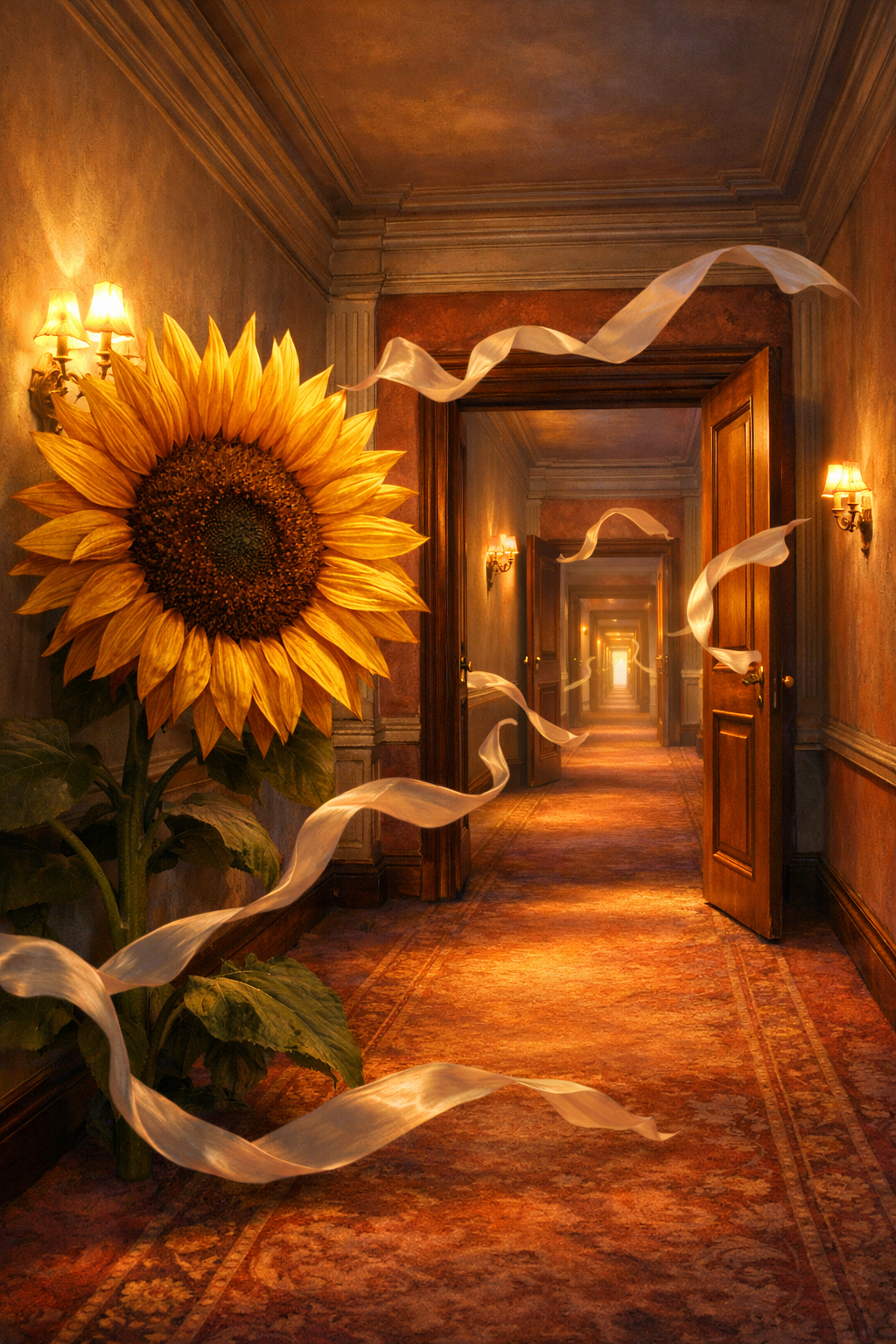
Some artists paint a scene.
Dorothea Tanning paints a scene, opens seven mysterious doors inside it, lets the wallpaper develop a private life, adds one creature that absolutely should not exist, and then somehow makes the whole thing feel elegant instead of medically alarming.
Which is a rare gift.
Tanning is one of those artists who can make you feel as if civilization is perfectly well dressed while quietly sliding sideways into a dream. She belongs to Surrealism, yes, but she never feels like a mere background member of the movement, standing behind the loud boys while they throw manifesto confetti at each other. She feels like someone who walked into the room, looked around at all the theatrical nonsense, and calmly said, “Fine, but what if the nightmare had better taste?”
Who is this artist?
Dorothea Tanning was an American artist, writer, and poet, born in Galesburg, Illinois, in 1910 and active across a staggeringly long career that ran well into the twenty-first century. She worked in painting, drawing, printmaking, sculpture, costume and set design, fiction, memoir, and poetry, which is the sort of resume that makes most people feel lazy just reading it. A solid starting point is her Britannica biography.
She was not one of those artists who emerged from an academy draped in official medals and smelling faintly of linseed and institutional approval. Quite the opposite. She was largely self-taught, suspicious of formal instruction, and built herself through looking, reading, working, and obsessing. That matters, because her art never feels obedient. It feels discovered in the wild.
What is she known for?
She is best known for dreamlike, psychologically charged paintings in which ordinary rooms behave very badly.
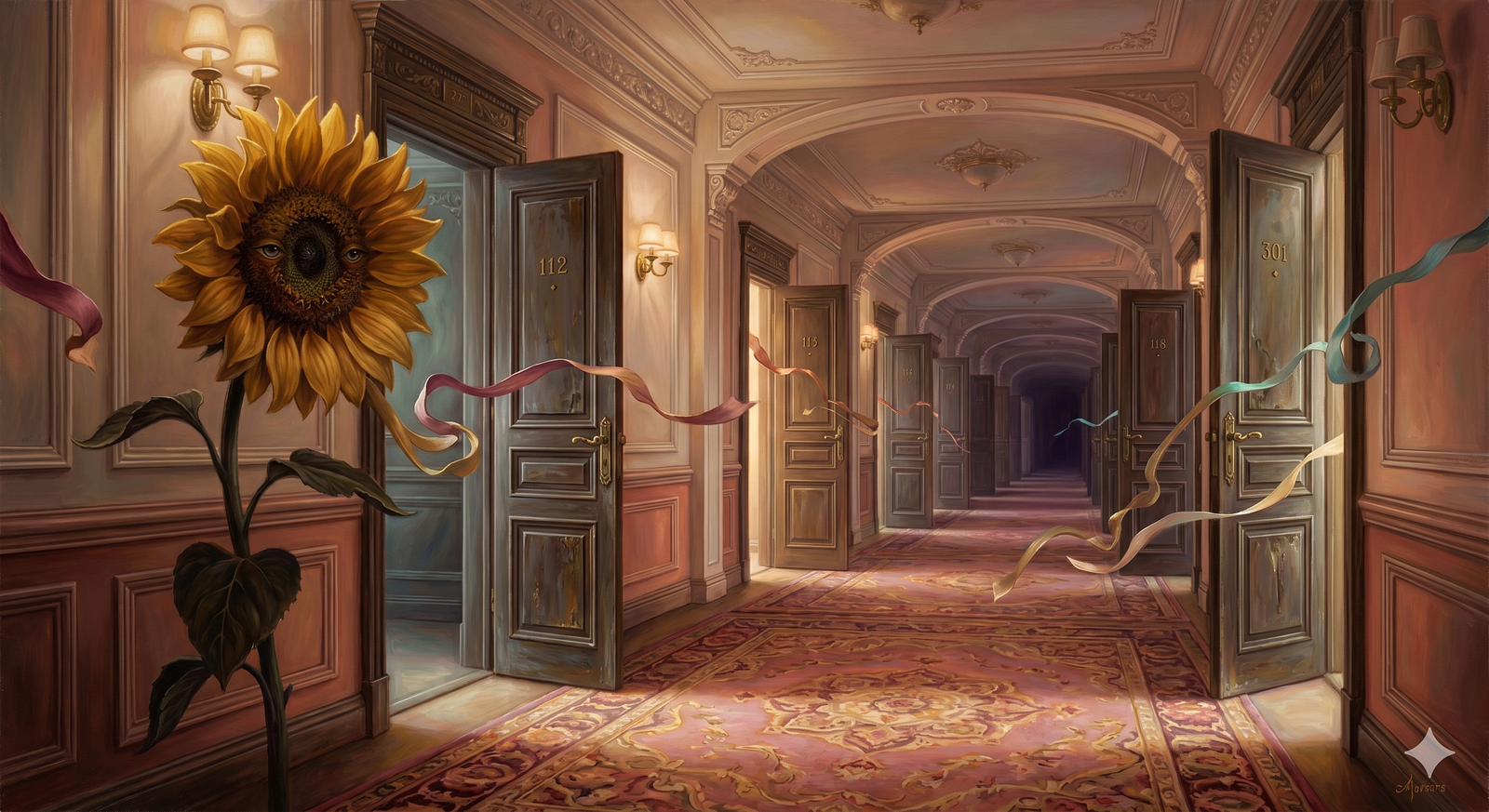
Her breakout masterpiece is Birthday, the 1942 self-portrait that helped announce her as a major force. It is one of those paintings that greets you politely and then, half a second later, informs you that normal reality has left the building. She is also famous for Eine Kleine Nachtmusik, a painting whose title sounds civilized and whose mood says, with great poise, “Something extremely strange has happened in this hotel.”
Later, she became equally admired for her soft sculptures and installations, where fabric bodies bulge, twist, embrace, and haunt space in ways that are both tender and unnerving. She also wrote poetry and prose with the same sharp, sly intelligence that runs through her visual work.
What is her style?
Her early style sits inside Surrealism, but not the mustache-twirling, gimmick-forward variety people often imagine first. Tanning’s version is more psychological, more architectural, and far more interested in tension than spectacle. She loved thresholds, doors, corridors, mirrors, folds of fabric, strange creatures, children who seem to know too much, and rooms that appear one mood swing away from sprouting consciousness.
Later, her work became looser, more abstract, and more physical. Figures begin to dissolve, merge, blur, and tumble into one another. The paintings stop behaving like illustrations of dreams and start behaving like the sensation of being inside one. This is where she gets especially dangerous, because she can make ambiguity feel luxurious.
If some Surrealists wanted to shock you with bizarre imagery, Tanning often preferred to seduce you into discomfort. Much classier. Much harder to escape.
Who taught her?
Mostly, Dorothea Tanning did.
She briefly attended art school in Chicago for about the amount of time some people take to decide whether they like a new sofa, then more or less concluded that formal instruction was not going to be the grand answer. She educated herself through books, museum visits, commercial work, and relentless self-direction. The 1936 Museum of Modern Art exhibition “Fantastic Art, Dada, Surrealism” was a major spark for her imagination, and after that she kept moving toward the world she wanted rather than waiting for permission to enter it.
So if you are looking for one master teacher, the answer is basically curiosity, stubbornness, and a refusal to stay artistically housebroken.
Does she use any special technique?
Oh yes, and several of them are delightfully unnerving.
In the early paintings, she uses precise draftsmanship and perspective to make impossible scenes feel weirdly credible. That is part of the trick. The rooms are painted with enough discipline that your brain temporarily agrees to the terms, which makes the impossible bits much more effective. She also loved the charged use of interiors, repeated doorways, tilted floors, and fabric that seems to contain emotional weather.
Later, she shifted into increasingly fluid, bodily abstraction, where forms knot together and edges become uncertain. Then she made soft sculptures out of sewn fabric, which was a wonderfully mischievous move in a world that often treated sculpture as something that ought to stand around pretending to be immortal. Tanning had very little interest in pretending. She liked things alive, vulnerable, and slightly unstable.
Who did she work with?
She was closely connected with major figures in and around Surrealism, especially Max Ernst, whom she later married. Their partnership is one of those art-history pairings that can tempt people into making her sound like a satellite orbiting a famous man, which is nonsense. Ernst mattered in her life, certainly, but Tanning was fully her own artistic weather system.
She also worked with the influential dealer Julien Levy, showed in Peggy Guggenheim’s orbit, designed sets and costumes for ballets by George Balanchine, and appeared in avant-garde film circles that included Hans Richter. In other words, she was not tucked away in some decorative corner of modernism. She was very much in the thick of it.
Was she wealthy?
Not in the fairy-tale sense of being born into velvet curtains and effortless patronage. She supported herself early on through commercial illustration, which is a much less romantic origin story but a far more useful one. Over time, she achieved substantial recognition and seems to have lived comfortably, especially later in life. The clearest clue that she was not exactly counting pennies under candlelight is that she created and endowed the Wallace Stevens Award, a major poetry prize that carries a $100,000 stipend.
So the honest answer is: she was not born as some golden heiress of the avant-garde, but she became successful enough to leave a serious cultural legacy with her money as well as her work.
When was she most popular?
She had more than one moment, which is usually a sign of the real thing.
Her first major wave of attention came in the 1940s, when her early Surrealist paintings announced that she was not merely promising but already formidable. Then came a later renewal of attention as critics and museums caught up to the full range of her career, especially the abstract paintings, fabric sculptures, and writing. By the time of her late retrospectives, people were no longer asking whether she mattered. They were asking why it had taken so long for more people to admit how much she mattered.
That is a much better place to arrive than being trendy for five minutes and then getting filed away next to some forgotten decorative movement involving too many beige rectangles.
Tell me more, please
One of the great pleasures of Tanning is that she never stayed still long enough to become a parody of herself.
A lesser artist finds one successful formula and spends the next forty years photocopying their own personality. Tanning kept moving. Early narrative dreamscapes become increasingly fluid bodily tangles. Paintings turn toward sculpture. Visual art opens into writing. Even her late work has nerve. It does not feel like a famous person elegantly coasting on established taste. It feels alert, curious, and still willing to unsettle the furniture.
She also had a wickedly intelligent relationship to femininity. In her work, women are not decorative accessories politely waiting to symbolize something for male viewers. They are complex presences, often fierce, elusive, erotic, endangered, amused, or quietly in command of energies no one else in the room seems equipped to name.
And she understood something many artists do not: mystery is much stronger when it is controlled. Her paintings are not vague. They are exact about their uncertainty.
Anything else left to tell?
Quite a bit.
She lived to 101, which gave her the extraordinary advantage of outlasting several generations of bad takes. She wrote memoir and poetry late in life with real seriousness, not as a hobby people kindly mention in paragraph nine. She had the rare gift of being genuinely multidisciplinary without feeling scattered. And unlike artists whose reputations depend on biography doing all the heavy lifting, Tanning’s actual work keeps earning its place when you stand in front of it.
Also, she is very funny in a dry, grown-up, unfussy way. Not clown-car funny. More the kind of intelligence that can make a room feel sharper just by entering it.
Any other interesting tidbits?
Yes, and here is one I particularly enjoy: Dorothea Tanning had the nerve to keep evolving in public. That sounds simple until you remember how much the art world loves turning artists into collectible habits. Once someone gets known for one thing, the market often wants that one thing forever, ideally in three convenient sizes. Tanning refused that trap. She changed because the work demanded it.
That may be the most admirable thing about her.
She did not ask her imagination to stay marketable. She asked it to stay alive.
And that is why her art still feels fresh. You are not looking at a brand. You are looking at a mind continuously remodeling its own haunted house.
If you have a favorite Dorothea Tanning work, drop it in the comments and tell me which detail got you first. If this piece sent you wandering happily into dream corridors and beautifully misbehaving interiors, follow along. There are plenty more artists ahead, and some of them are also alarmingly good at making wallpaper feel sentient.
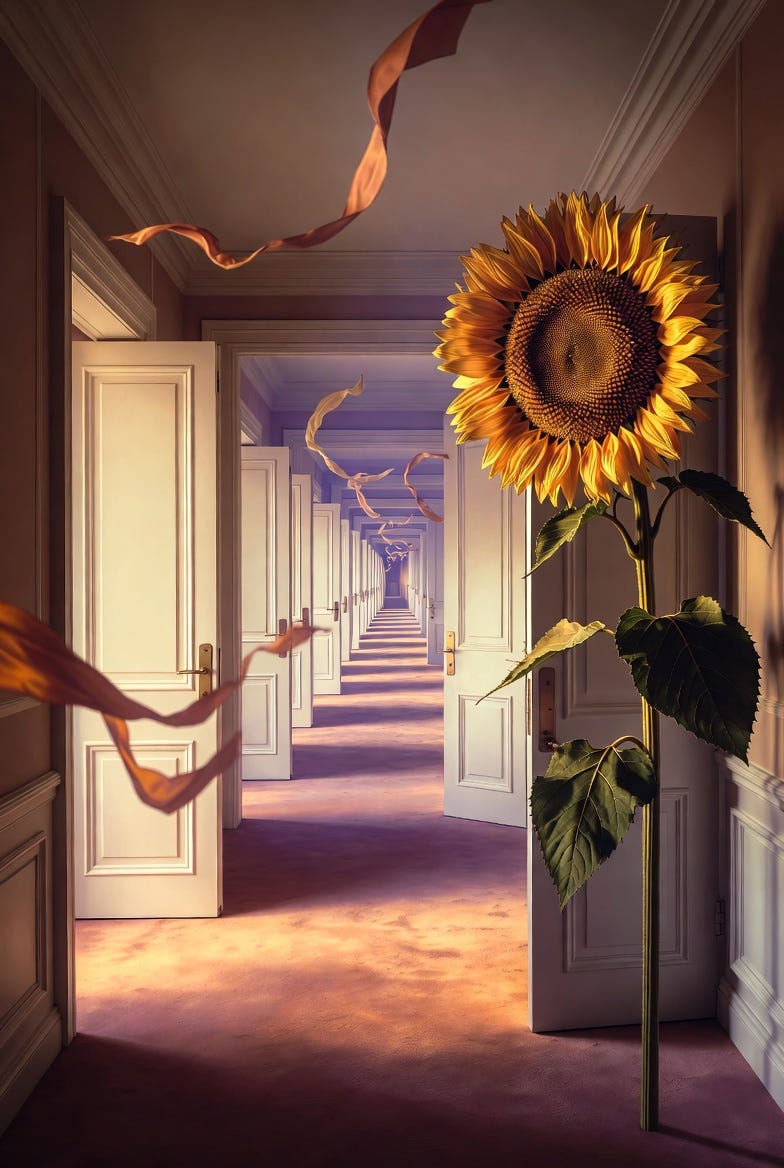
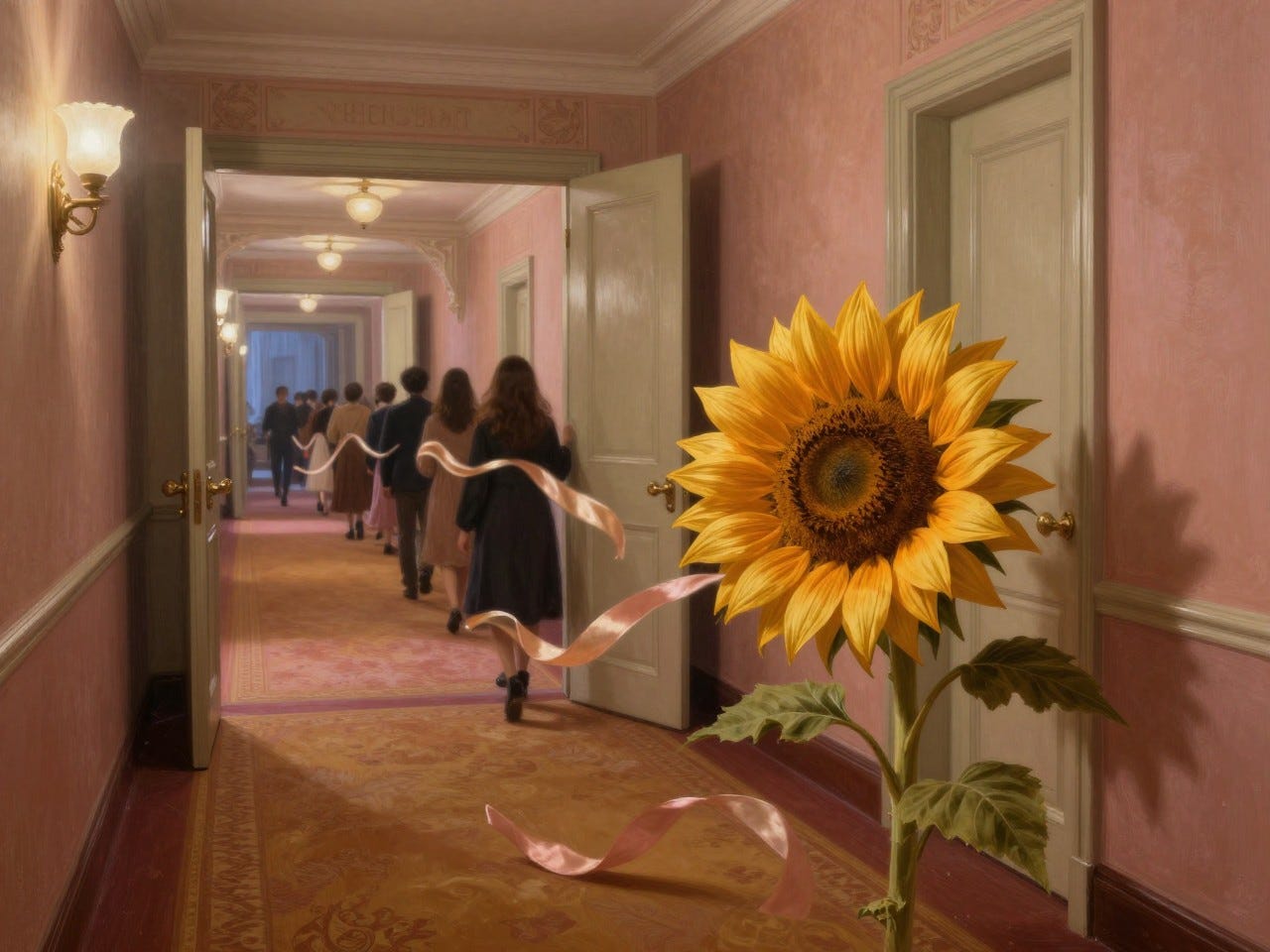
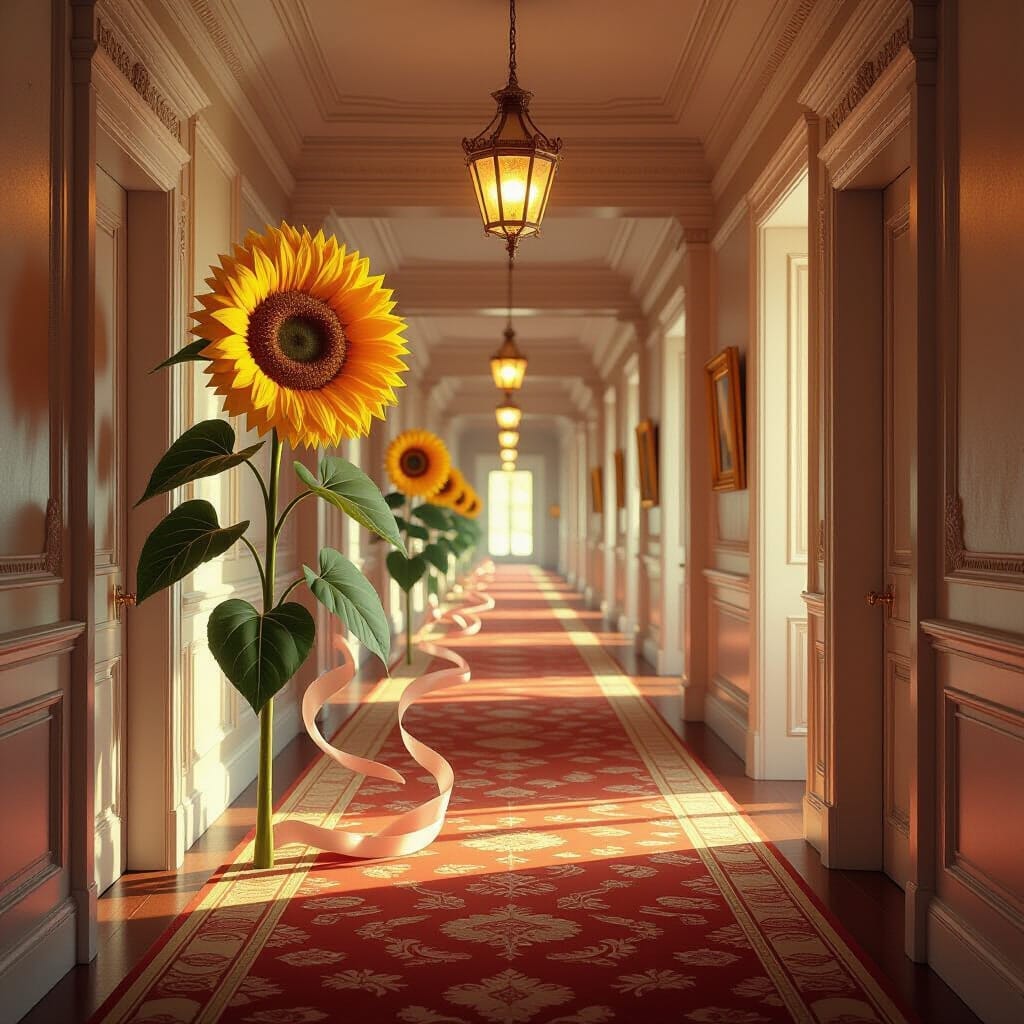
Art Prompt (Surrealist Interior): A luminous, dreamlike corridor inside an old grand hotel at twilight, with a procession of half-open doors receding into impossible depth. In the foreground, an enormous sunflower with richly textured golden petals stands upright like a mysterious resident, while silk ribbons drift through the air as if moved by invisible breath. The carpet glows in muted amber and faded rose, the walls carry pale cream and dusty coral tones, and the lighting feels velvety, theatrical, and slightly unreal. Render the scene with meticulous detail, polished brushwork, uncanny perspective, and a mood that balances elegance, childhood wonder, and delicious unease. Let the atmosphere feel refined, secretive, and psychologically charged, as if the building remembers every strange dream ever dreamt inside it.
Video Prompt: Begin with a slow forward glide down a grand surreal hotel corridor at twilight, doors slightly opening one by one as warm amber light spills out in pulses. A giant sunflower subtly turns its face toward the viewer, ribbons curl and float in slow motion, fabric along the walls ripples as if breathing, and the camera drifts with hypnotic elegance through impossible perspective. Add cinematic shadow play, soft dust motes, gentle zooms, and a final lingering shot where the hallway seems to stretch farther than physics allows. Keep the mood lush, eerie, graceful, and mesmerizing, with high detail and smooth motion designed to stop scrolling instantly.
For the soundtrack, try Boadicea — Enya if you want the corridor to feel ancient, elegant, and faintly supernatural, or Suspirium — Thom Yorke if you want the whole thing to feel like a beautiful secret that may or may not be judging you.