If you ever wanted proof that bureaucracy can take absolutely anything and turn it into a department, behold: Department D.
Not a detective agency. Not a canceled 1970s cop show. Not the section of the supermarket where pickles go to retire. Department D was the KGB unit associated with disinformation, which means the Soviet state looked at the ancient human habit of spreading nonsense and said, “This needs organizational charts.”
And honestly, that is one of the strangest parts of the whole story. We tend to picture propaganda as loud posters, dramatic speeches, or somebody with a very enthusiastic mustache pointing at a map. Department D was subtler than that. It was about planting stories, forging documents, nudging rumors into circulation, exploiting real anxieties, and making lies travel in a suit and tie so they looked respectable on arrival.
That is the short answer. The longer answer is much more fun, much more unnerving, and unfortunately much more relevant.
So what was Department D?
Department D was the KGB’s disinformation shop within Soviet foreign intelligence, tied to the broader system of what the Soviets called “active measures.” In plain English, active measures meant influence operations: forged documents, planted press stories, whisper campaigns, front organizations, compromised intermediaries, and assorted attempts to shape politics abroad without rolling tanks through the front door.
The point was not just to persuade people of one neat little falsehood. It was to muddy the water, damage trust, divide rivals, and make democratic societies argue with themselves until they looked like a family group chat on Thanksgiving.
A useful historical overview of Soviet active measures and disinformation is available through the CIA Reading Room. For a concise discussion of how the system later operated under Service A, the Wilson Center’s piece on the Lithuanian case is excellent: The Vilnius Telegram: KGB’s Active Measures to Stop the Independence of Lithuania.
In other words, Department D was not just “the people who made up fake stories.” It was part of a larger strategy of political warfare. It sat inside a machine that understood something very important long before social media learned to ruin breakfast: if you can get people confused, angry, suspicious, and exhausted, you do not always need to convince them of one grand lie. Sometimes it is enough to make them stop believing anything.
Which, if we are being honest, is not exactly a dead technique.
What was happening in society at the time?
A lot, and almost all of it was useful to a disinformation specialist.
The Cold War was not simply a military standoff. It was also a battle over credibility, legitimacy, ideology, and who got to narrate reality. The postwar world was full of decolonization, revolutions, civil-rights struggles, anti-war protests, nuclear terror, proxy wars, and giant populations newly plugged into mass media. People were reading newspapers, listening to radio, watching television, and trying to make sense of a world that increasingly felt global, unstable, and one bad decision away from catastrophe.
This was a fantastic environment for disinformation because real fear was already in the room. Department D did not need to invent all anxieties from scratch. It could borrow public fears that already existed and give them a shove in a direction useful to Moscow.
That is one of the most interesting things you would not always learn in school. Successful disinformation is often not built from pure fantasy. It usually stitches itself onto existing tensions: racism, class resentment, anti-colonial anger, distrust of elites, fears about war, fears about science, fears about disease. A completely ridiculous lie often dies quickly. A lie that attaches itself to a half-true grievance can wear hiking boots and go very far.
What was happening in the world?
The world was busy being extremely combustible.
You had the U.S. and USSR competing everywhere from Europe to Africa to Latin America to Asia. Newly independent states were choosing alliances, or trying very hard not to. Proxy conflicts multiplied. Intelligence services treated global politics like a chessboard designed by somebody who hated sleep.
In that setting, Department D could target audiences differently depending on what would sting most. In one place, anti-American narratives might focus on racism. In another, imperialism. In another, biological warfare. In another, fascism. The genius, if one may use that morally irritating word, was that the messaging adapted itself to local fears and resentments.
This is why Soviet disinformation could feel so slippery. It was not one script. It was a script factory.
How did Russia spread disinformation?
Historically, the Soviet system and later the Russian system have relied on a blend of methods rather than one magic trick.
There were forged letters and fabricated government documents. There were stories placed in sympathetic or compromised outlets abroad. There were front publications and covertly influenced journalists. There were “agents of influence,” meaning people who did not need to be cartoon supervillains in trench coats; they just needed to help circulate the right idea at the right time. There were intelligence partners in allied states. There were rumors designed to hop from fringe publication to larger outlet to public conversation, acquiring fake credibility as they traveled.
A classic example is the AIDS disinformation campaign. As the Wilson Center documents, the KGB pushed the claim that HIV/AIDS had been created by the Pentagon at Fort Detrick, using allied services and media channels to spread the story internationally. Their account is here: Operation “Denver”: KGB and Stasi Disinformation regarding AIDS.
The awful brilliance of that campaign was that it did not merely spread a lie. It exploited existing mistrust of great powers, fears of biological research, and the confusion surrounding a terrifying new disease. That made the falsehood emotionally sticky.
In more recent years, the Kremlin playbook has modernized the delivery system without changing the basic psychology. The methods now include cloned news sites, fake domains, impersonation of legitimate media, coordinated bot amplification, and state-affiliated outlets wearing the costume of journalism while doing political theater in a necktie. The EU’s disinformation monitoring project has documented these tactics in detail, including media impersonation and typosquatting, in pieces like One of These Things Is Not Like the Others.
Same old poison. Sharper bottle.
How did that affect other countries and peoples?
It made democratic life more brittle.
Disinformation can inflame ethnic tensions, worsen public-health responses, erode trust in institutions, distort elections, damage alliances, and give people a completely broken picture of what is happening around them. Sometimes the effect is immediate. Sometimes it is cumulative. A lie does not have to win an argument in one afternoon if it can slowly dissolve the public’s ability to tell who is lying at all.
That damage lands differently in different places. In fragile states, it can worsen instability. In democracies, it can turn disagreement into paralysis. In war, it can justify aggression or muddy accountability. In health crises, it can get people killed. The Wilson Center’s discussion of the AIDS campaign makes that last point painfully clear.
So when people treat disinformation as just “weird internet stuff,” that is charmingly optimistic in the way a man standing in the rain and saying “I think this cloud respects boundaries” is optimistic.
Is it the subject of any famous art?
Not really in the grand museum-piece sense, no. Department D is more the sort of thing that leaves fingerprints on culture than the sort of thing that gets immortalized in a beloved painting hanging under soft lights near a gift shop.
If you are looking for famous art directly about Department D or its key operators, there is no obvious Mona Lisa of “bureaucratic deception management.” Its influence appears more in Cold War literature, documentary work, propaganda studies, political theater, and the visual language of surveillance, secrecy, and ideological manipulation.
So no, not in the neat schoolbook way. The subject is culturally important, but not because schoolchildren are sketching Ivan Agayants in charcoal.
Have these techniques appeared in other periods of history?
Absolutely. Department D did not invent deceit. It industrialized and systematized it.
States and political movements have always used rumor, forged documents, staged narratives, and manipulated public emotion. You can find ancestors of the playbook in imperial courts, religious conflicts, wartime atrocity stories, revolutionary pamphleteering, totalitarian propaganda, and intelligence operations throughout the twentieth century.
What changed in the Soviet case was scale, professionalization, and the fusion of espionage with narrative warfare. Department D was basically the moment when the old dark art of political deception got its own desk, files, telephone, and probably somebody whose entire Tuesday was spent wording a fake letter.
That is both ridiculous and historically important.
Does anyone use this playbook today?
Yes. Loudly. Constantly. Often with better graphics.
The names change, the platforms change, the speed changes, but the underlying moves remain familiar: impersonate trusted sources, exploit grievance, flood the zone, amplify division, mix truth with falsehood, deny responsibility, and keep the target society busy arguing with itself.
Modern Russian information operations are not a perfect carbon copy of Cold War active measures, because the internet changed distribution, speed, and scale. But the family resemblance is strong enough to make a historian set down his coffee and stare into the middle distance.
Anything about this you would not have learned in school?
Probably this: disinformation is not mainly about making people believe one specific thing. Quite often it is about creating a mood.
Cynicism. Exhaustion. Distrust. The vague sense that every institution is crooked, every fact is partisan, every reporter is compromised, every election is fake, every expert is lying, and every answer is secretly a scheme. That emotional atmosphere is incredibly useful to an authoritarian system because it punishes truth and falsehood equally. Once everything feels contaminated, the side most comfortable operating in contamination gains an advantage.
That is the real trick. Department D was not merely in the lie business. It was in the reality-fracturing business.
And that is why this history matters. It is not an antique curiosity from a dusty file cabinet. It is a warning label.
A few interesting tidbits before we all go lock our filing cabinets
First, the terminology matters. “Active measures” sounds hilariously bland, like a fitness initiative rolled out by middle management. In practice, it covered a whole spectrum of covert political influence.
Second, some of the most successful falsehoods worked precisely because they piggybacked on real injustices and fears. The lie borrowed emotional power from reality.
Third, these operations often depended on patient layering. A forged claim dropped in one place could be echoed elsewhere, cited back, and made to look independently confirmed. The lie put on a fake mustache, walked around the block, and came back as a source.
Fourth, the old Soviet system reminds us that disinformation was never just a matter of “bad ideas.” It was infrastructure. Planning. Coordination. Targeting. Distribution. Feedback. Revision. In other words, a machine.
Which means the proper response is not just yelling “that sounds fake” at the internet like a man arguing with a toaster. It requires media literacy, resilient institutions, competent journalism, and the kind of civic patience that is terribly unglamorous and therefore desperately necessary.
References
- CIA Reading Room: Soviet Active Measures and Disinformation
- Wilson Center: Operation “Denver” and the AIDS disinformation campaign
- Wilson Center: The Vilnius Telegram and KGB active measures
- EUvsDisinfo: Kremlin media impersonation tactics
- Britannica: Fake news, misinformation, and disinformation
If this wonderfully sinister tour through organized nonsense made your brain do a backflip, follow along for more history, technology, art, and cultural mischief. And drop a comment telling me which part is most disturbing: the lies, the scale, or the fact that somebody once thought “Department D” sounded subtle.

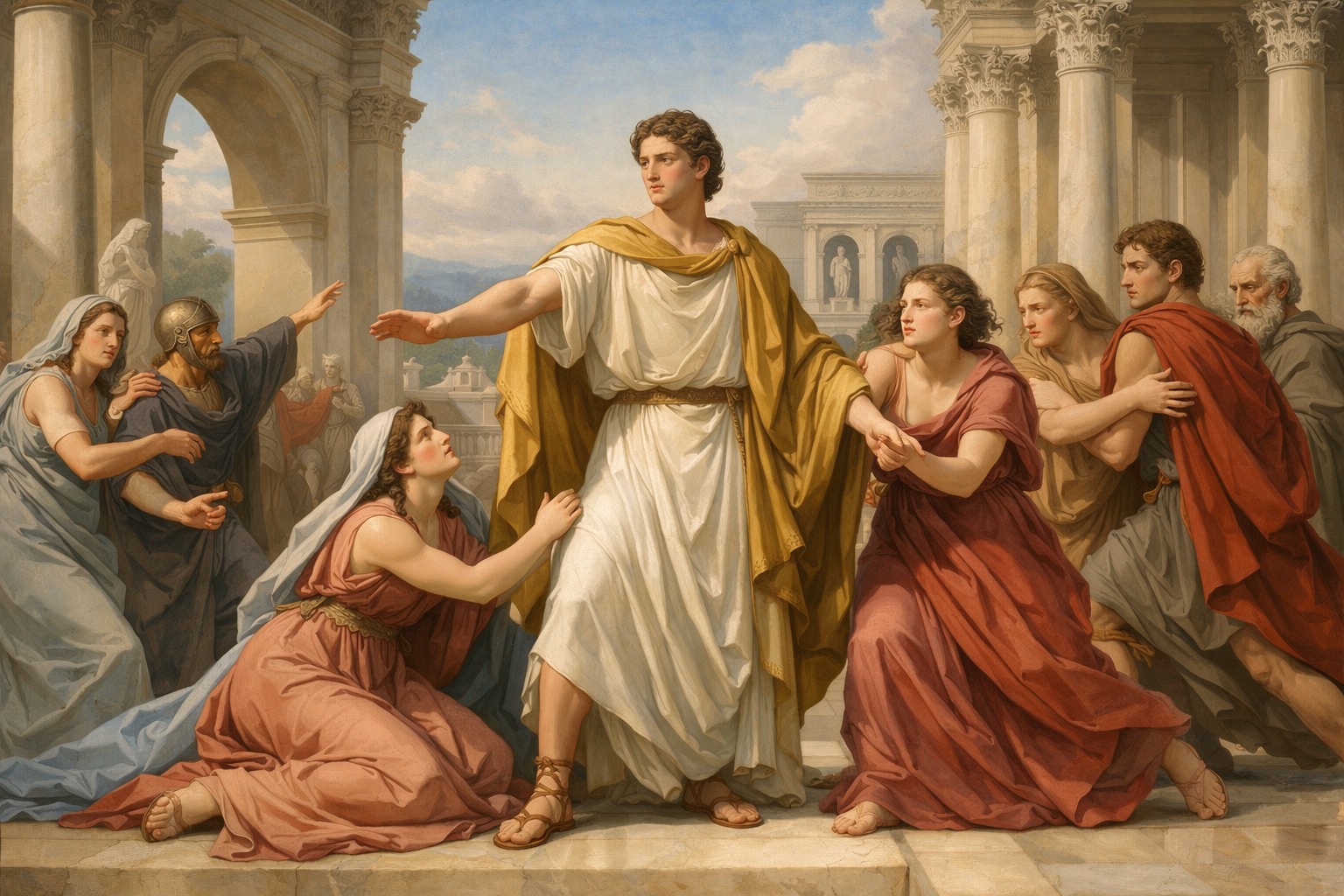
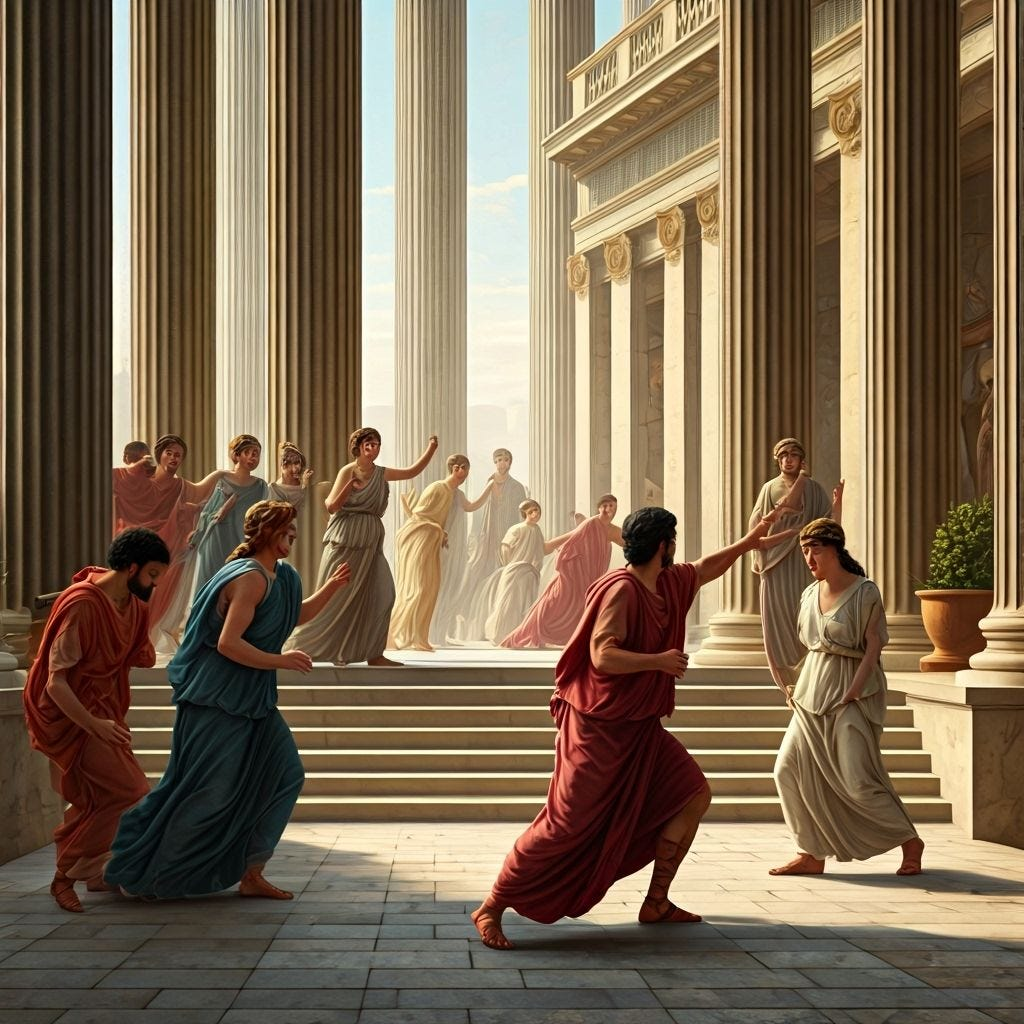
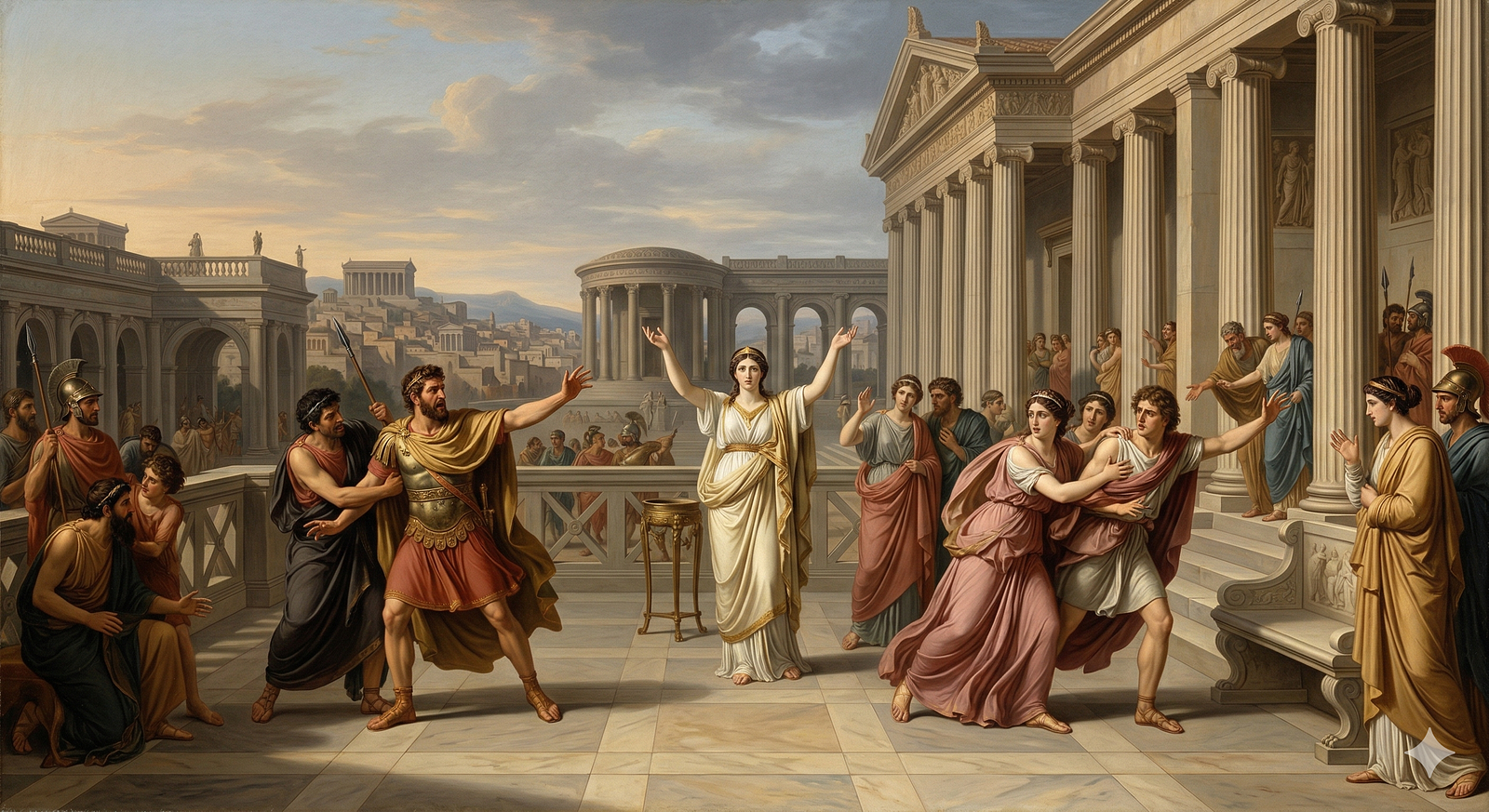
Art Prompt (Neoclassicism): A grand neoclassical scene unfolding across a luminous architectural setting of pale marble terraces, stately columns, and distant stone arcades, filled with poised figures in flowing drapery caught at a moment of urgent emotional tension. The composition should feel theatrical yet disciplined, with balanced geometry, sculptural anatomy, and crystal-clear outlines. Use a palette of warm ivory, dusty rose, muted crimson, pale gold, cool slate, and soft sky blue, with satin highlights gliding across fabric and skin like polished stone awakened by sunlight. Let the gestures feel noble and dramatic rather than chaotic, with one central figure creating a calm axis while others surge around in elegant arcs. The mood should be heroic, restrained, and emotionally charged, as if ancient history has been frozen at the exact second when dignity and panic collide.
Video Prompt: Begin with a slow cinematic glide across pale marble columns and sunlit stone steps before revealing a sweeping neoclassical tableau of draped figures locked in a moment of elegant tension. Let fabric ripple in slow motion, arms extend in sculptural arcs, and dust motes shimmer in warm light. Add subtle camera orbits, dramatic push-ins, and flowing parallax between foreground figures and distant architecture to create visual depth. Use graceful, rhythmic motion rather than frantic action: drapery lifting in the breeze, turning heads, shifting stances, hands reaching, soft sunlight traveling across polished surfaces. Keep the palette refined with ivory, rose, muted crimson, gold, slate, and soft blue. The overall effect should feel stately, emotionally charged, and irresistibly watchable, like a classical painting suddenly remembering how to breathe.
A couple songs to go with that video:
- The Big Ship — Brian Eno
- A Gallant Gentleman — We Lost the Sea