If you came here for the grand civilized overview, excellent news: you can scroll down to the full Season One table of contents, then keep going to see what is coming in Season Two, all of which now lives together in this handy reading list.
This whole adventure began with a simple problem and the sort of optimism that usually precedes mild suffering.
I had 53 episodes in the Artist Series.
Fifty-three.
That is no longer a “cute little sequence.” That is a proper hallway. A corridor. A respectable museum wing. At that point, people should not have to wander around bumping into metaphorical walls asking, “Wait, where was the one about Magritte?” or “Did I imagine the Basquiat episode, or did that happen during a caffeine event?”
Naturally, the obvious solution was a table of contents.
Naturally, the platform acted like I had asked it to help me assemble a cathedral out of soup.
So here is how I pulled it off.
The first step was the least glamorous one: realizing that the links were scattered everywhere. Some were living in old prompts. Some were embedded in social posts. Some were easy to find. Some were apparently hiding under floorboards with the house spirits. If you have ever tried reconstructing a long-running series from bits and pieces across the internet, you already know the vibe. It is less “organized archive” and more “Victorian detective with index cards.”
At first, I worked from project prompts. That helped, but only partially. It was enough to prove the series existed in one coherent universe and not as a fever dream, but not enough to build a clean, complete index with confidence.
Then came the next layer: public traces. Search results gave me a bigger slice of the map. Better, yes. Complete, no. A few entries turned up immediately, others behaved like raccoons in a crawlspace. Visible enough to confirm they were real, elusive enough to make me reconsider my life choices.
Then came the very useful clue that many of the links had also been posted on X. That helped confirm the path, but social platforms are not always eager to behave like tidy archives. They are more like giant digital coat closets where everything is technically somewhere, but good luck finding the blue scarf before winter ends.
The missing leap in this whole process was wonderfully practical: I went into Medium itself and asked it to hand over my account history. Specifically, I clicked my profile picture, went to Settings, opened the Security and apps section, clicked Download your information, and confirmed the export request. Medium then prepared a .zip archive of my account data and emailed me a download link once it was ready. Which, honestly, felt much better than continuing to hunt for 53 separate posts like a Victorian detective armed only with caffeine and mild resentment.
Once I had the export, I didn’t even unpack the archive, but uploaded it into ChatGPT so it could help me inspect the underlying post data directly.
That changed everything.
Instead of trying to infer which post matched which episode from public fragments, I could inspect the actual underlying filenames, slugs, and unique story hashes. Suddenly the missing episodes were not “maybe somewhere in the fog.” They were right there, wearing nametags.
And that is the exact moment this stopped being a scavenger hunt and became a proper reconstruction.
From there, the job was gloriously nerdy: line everything up episode by episode, compare the recovered links against the canonical artist list, make sure the numbering matched, make sure the names matched, and make sure no episode had quietly shape-shifted into the wrong slot.
The good news: the structure held.
The better news: all 53 entries lined up correctly.
The only weirdness was cosmetic. A few names with accents got mildly roughed up by slug formatting, as if the URL generator had been educated near a radiator. But those were surface-level quirks, not actual mismatches. The articles were the correct ones.
So the path, in plain English, went like this:
Project prompts gave me a partial map.
Public search filled in more territory.
Social posts confirmed the trail.
The export files supplied the real source of truth.
And the final comparison against the episode master list turned the whole thing from “pretty sure” into “yes, this is the actual table of contents.”
Which, if we are being honest, is deeply satisfying.
There is also something charmingly ridiculous about the whole process. A table of contents is supposed to be the thing you make before a series gets huge and unruly. Doing it at Episode 53 feels a bit like installing labeled drawers after you have already spent a year throwing socks into the oven and tax documents into the freezer.
Still, better late than never. And now the series has what it deserved all along: one place where people can actually navigate it like civilized readers instead of foraging for links in the wilderness.
That also makes Season Two much easier to launch, because now there is a visible bridge between what already exists and what is coming next. Which means the Artist Series can keep expanding without turning into one of those libraries where you need a secret handshake just to find the Impressionists.
A few fun tidbits from the process:
The hardest part was not finding the obvious entries. It was finding the stubborn ones that refused to show themselves until the underlying export data forced them into the daylight.
The most reassuring part was seeing the whole list line up cleanly once the evidence was in one place.
And the funniest part is that building a table of contents for an art series somehow required a tiny detective novel, a digital paper trail, and the patience of a person trying to untangle Christmas lights underwater.
Anyway: it exists now. It is real. It is organized. Miracles happen.
Before you dive into the list, take a quick wander through LumAIere.com if you want more art, and if you feel like wearing or hanging the chaos, there is more work waiting over at Redbubble.
And now, at long last, the full Season One table of contents.
Season One: The Artist Series Table of Contents
- Episode 1: Yves Tanguy
- Episode 2: Rene Magritte
- Episode 3: Frida Kahlo
- Episode 4: Marc Chagall
- Episode 5: Leonora Carrington
- Episode 6: Max Ernst
- Episode 7: Giorgio de Chirico
- Episode 8: Salvador Dali
- Episode 9: M.C. Escher
- Episode 10: Claude Monet
- Episode 11: Edgar Degas
- Episode 12: Pierre-Auguste Renoir
- Episode 13: Mary Cassatt
- Episode 14: Berthe Morisot
- Episode 15: Camille Pissarro
- Episode 16: Alfred Sisley
- Episode 17: Edouard Manet
- Episode 18: Johannes Vermeer
- Episode 19: Gustav Klimt
- Episode 20: Jean-Michel Basquiat
- Episode 21: Caravaggio
- Episode 22: Georgia O’Keeffe
- Episode 23: Andre Breton
- Episode 24: Kay Sage
- Episode 25: Joan Miro
- Episode 26: Roberto Matta
- Episode 27: Mark Rothko
- Episode 28: Paul Eluard
- Episode 29: Vincent van Gogh
- Episode 30: Paul Cezanne
- Episode 31: Pablo Picasso
- Episode 32: Georges Braque
- Episode 33: Andy Warhol
- Episode 34: Roy Lichtenstein
- Episode 35: Hilma af Klint
- Episode 36: Artemisia Gentileschi
- Episode 37: Henri Matisse
- Episode 38: Andre Derain
- Episode 39: Maurice de Vlaminck
- Episode 40: Kees van Dongen
- Episode 41: Raoul Dufy
- Episode 42: Othon Friesz
- Episode 43: Albert Marquet
- Episode 44: Charles Camoin
- Episode 45: Emilie Charmy
- Episode 46: Egon Schiele
- Episode 47: Edvard Munch
- Episode 48: Yayoi Kusama
- Episode 49: Bridget Riley
- Episode 50: Keith Haring
- Episode 51: Kazimir Malevich
- Episode 52: Jean Arp
- Episode 53: Barbara Kruger
Season Two: What Is Coming Next
- Episode 54: Remedios Varo (Surrealism / Mystical Machines and Alchemical Dream Logic)
- Episode 55: Leonor Fini (Surrealism / Sphinxes, Theatrical Glamour, and Defiant Myth)
- Episode 56: Dorothea Tanning (Surrealism / Psychological Interiors and Wild Elegance)
- Episode 57: Yves Klein (Monochrome / Blue as Theology and Performance)
- Episode 58: Sonia Delaunay (Orphism / Color Rhythm and Modern Motion)
- Episode 59: Robert Delaunay (Orphism / Circular Light and Urban Vibration)
- Episode 60: Wassily Kandinsky (Abstract Art / Spiritual Geometry and Color Music)
- Episode 61: Paul Klee (Modernism / Playful Symbols and Musical Intelligence)
- Episode 62: Piet Mondrian (De Stijl / Grids, Balance, and Pure Reduction)
- Episode 63: Theo van Doesburg (De Stijl / Diagonals, Design, and Constructive Rebellion)
- Episode 64: Gustav Moreau (Symbolism / Jeweled Visions and Mythic Excess)
- Episode 65: Odilon Redon (Symbolism / Dream Blossoms and Floating Eyes)
- Episode 66: William Blake (Romantic Visionary / Poetry, Prophecy, and Illuminated Imagination)
- Episode 67: J.M.W. Turner (Romanticism / Storm Light and Dissolving Atmosphere)
- Episode 68: Caspar David Friedrich (Romanticism / Solitude, Silence, and the Sublime)
- Episode 69: John Singer Sargent (Portraiture / Velvet Swagger and Liquid Brushwork)
- Episode 70: James McNeill Whistler (Aestheticism / Tonal Mood and Elegant Restraint)
- Episode 71: Edward Hopper (American Realism / Loneliness, Light, and Quiet Tension)
- Episode 72: Grant Wood (Regionalism / Sharp Precision and American Mythmaking)
- Episode 73: Thomas Hart Benton (Regionalism / Rolling Forms and American Murals in Motion)
- Episode 74: Diego Rivera (Muralism / Monumental Labor and Public History)
- Episode 75: Jose Clemente Orozco (Muralism / Fire, Fury, and Human Upheaval)
- Episode 76: David Alfaro Siqueiros (Muralism / Political Dynamite and Experimental Scale)
- Episode 77: Amedeo Modigliani (Modernism / Elongated Faces and Melancholy Grace)
- Episode 78: Tamara de Lempicka (Art Deco / Chrome Glamour and Sculpted Elegance)
- Episode 79: Edward Burne-Jones (Pre-Raphaelite / Medieval Reverie and Dreamy Precision)
- Episode 80: Dante Gabriel Rossetti (Pre-Raphaelite / Lush Symbolism and Poetic Seduction)
- Episode 81: John William Waterhouse (Pre-Raphaelite / Mythic Drama and Liquid Enchantment)
- Episode 82: Alphonse Mucha (Art Nouveau / Floral Theater and Decorative Radiance)
- Episode 83: Aubrey Beardsley (Art Nouveau / Decadent Ink and Wicked Linework)
- Episode 84: Kathe Kollwitz (Expressionism / Grief, Labor, and Human Weight)
- Episode 85: Ernst Ludwig Kirchner (German Expressionism / Urban Anxiety and Jagged Color)
- Episode 86: Emil Nolde (Expressionism / Feverish Color and Spiritual Ferocity)
- Episode 87: Franz Marc (Expressionism / Animal Souls and Electric Color)
- Episode 88: Paul Gauguin (Post-Impressionism / Symbolic Color and Troubled Paradise)
- Episode 89: Henri Rousseau (Naive Modernism / Jungle Dreams and Earnest Enchantment)
- Episode 90: Georges Seurat (Pointillism / Dots, Discipline, and Optical Patience)
- Episode 91: Paul Signac (Neo-Impressionism / Pointillist Light and Maritime Joy)
- Episode 92: Lucian Freud (Figuration / Flesh, Scrutiny, and Relentless Honesty)
- Episode 93: Francis Bacon (Figuration / Distortion, Dread, and Screaming Space)
- Episode 94: Anselm Kiefer (Neo-Expressionism / Ashes, History, and Monumental Memory)
- Episode 95: Jean Dubuffet (Art Brut / Raw Surfaces and Anti-Polish Rebellion)
- Episode 96: Louise Bourgeois (Sculpture / Memory, Cells, and the Architecture of Feeling)
- Episode 97: Barbara Hepworth (Modern Sculpture / Carved Space and Quiet Abstraction)
- Episode 98: Constantin Brancusi (Modern Sculpture / Essential Form and Polished Silence)
- Episode 99: Niki de Saint Phalle (Nouveau Realisme / Joyful Bombast and Riotous Color)
- Episode 100: Ansel Adams (Photography / Monumental Landscapes and Precision Drama)
The nice thing about all this is that the series finally has a front door.
No more guessing. No more link archaeology. No more rummaging around like an under-caffeinated art historian in a digital attic.
Just one clean table of contents, one growing reading list, and one much easier way to move from Yves Tanguy all the way to Barbara Kruger without needing a search party.
If you made it this far, hit follow, drop a comment, and tell me which upcoming Season Two artist you want to see arrive first. Personally, I am looking forward to the moment this series becomes so large it requires its own emotional support librarian.
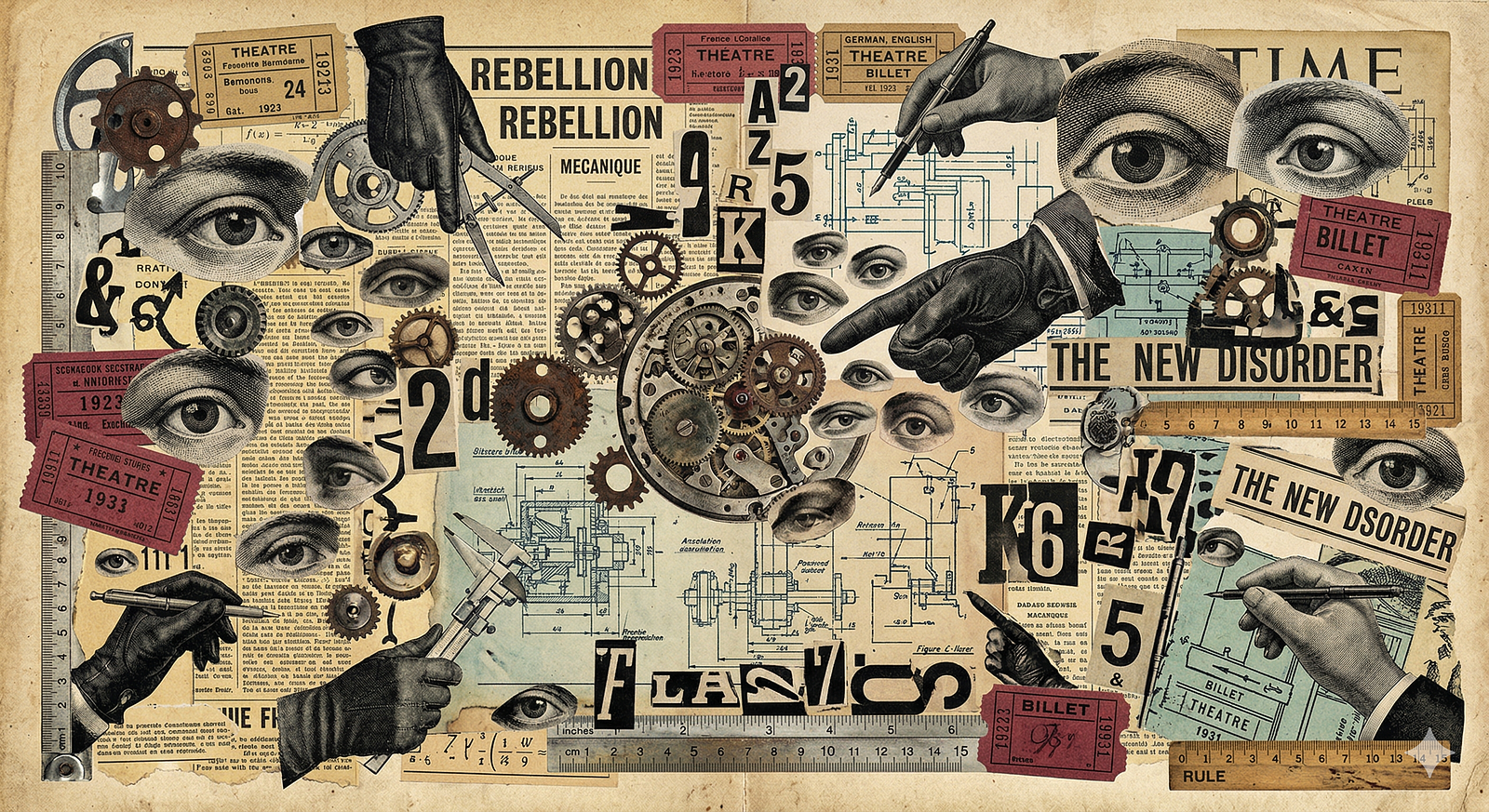
Art Prompt (Dadaism): A sharply cut photomontage bursting with clipped eyes, gloved hands, gears, ticket stubs, newspaper columns, rulers, type fragments, and elegant machine diagrams, arranged in a deliberately chaotic but beautifully balanced composition. Use a palette of yellowed paper, smoky black, tarnished silver, muted crimson, and hints of oxidized blue-green. Let the scene feel witty, rebellious, and intellectually unruly, with crisp torn edges, layered textures, abrupt shifts in scale, and the sensation that every object has been pulled from a different argument and forced into the same dazzling frame.
Video Prompt: Explode the photomontage into motion with pieces snapping, spinning, and colliding into place in rhythmic bursts. Newspaper strips flutter across the frame, mechanical diagrams rotate like restless thoughts, gloved hands slide in and out of view, and clipped eyes blink from unexpected corners. Use whip-fast cuts, jittery stop-motion energy, layered paper shadows, and punchy zooms that keep the composition feeling mischievous, stylish, and gloriously unstable from the first second to the last.
Songs to Pair With It:
- Only Shallow — My Bloody Valentine
- Roads — Portishead
Follow for more art, more beautifully unnecessary creative detours, and more heroic attempts to organize chaos. And definitely leave a comment if you have ever had to build a table of contents after the series had already become a minor continent.