
Before we step into this one, here is the doorway into the wider series: The Modern Religion Series: Many Paths, One Curious Human.
Islam is one of those traditions that is so globally present, so historically influential, and so internally diverse that trying to summarize it in one sitting feels a little like trying to describe the ocean with a coffee mug. You can do it, but you should stay humble about the mug.
At the most basic level, Islam is a monotheistic religion centered on the worship of God, known in Arabic as Allah, and on the teachings associated with the Prophet Muhammad. Historically, Islam emerged in 7th century Arabia. Standard historical references place its beginnings in the early 600s CE, with Muhammad receiving the revelations that became the Quran beginning around 610 CE, and the formation of the early Muslim community taking decisive shape after the Hijra, the migration to Medina, in 622 CE. For a solid historical overview, Britannica’s overview of how Islam was founded is a useful starting point, and The Religion of Islam provides a broad faith-centered reference.
That answers the “when” and “by whom” question in the most direct way: early 7th century, through the prophetic mission of Muhammad.
Now for the growth question, which is not quite the same as the popularity question, and this is where people often mix apples, oranges, and internet arguments. In sheer numbers of adherents, Islam is growing. Pew Research reported in 2025 that Islam was the world’s fastest-growing major religion from 2010 to 2020, reaching about 2.0 billion people, or 25.6% of the global population. That is the demographic question. Popularity is fuzzier. It can mean public favorability, cultural influence, online curiosity, conversion interest, media attention, or simple visibility. Those do not always move together. A religion can grow in headcount while facing hostility in public discourse. It can also become more visible in global culture without everyone suddenly agreeing about it over brunch.
So, what are the tenets? A common summary begins with the Five Pillars of Islam: declaration of faith, prayer, almsgiving, fasting in Ramadan, and pilgrimage to Mecca if one is able. This overview of the Five Pillars lays them out clearly. Alongside practice, many Muslims also speak of core beliefs such as belief in God, angels, revealed books, prophets, the Day of Judgment, and divine decree. If that sounds both practical and cosmic, that is because it is. Islam is not merely a mood board of vague spirituality. It is a disciplined religious life with devotion, ethics, law, ritual, memory, and community all braided together.
Two Quranic verses often quoted in discussions of Islam’s moral and social vision are worth including carefully and exactly.
From the Quran, 2:256, translated by Abdullah Yusuf Ali in the Quranic Arabic Corpus:
“Let there be no compulsion in religion: Truth stands out clear from Error: whoever rejects evil and believes in Allah hath grasped the most trustworthy hand-hold, that never breaks. And Allah heareth and knoweth all things.”
From the Quran, 49:13, translated by Sahih International in the Quranic Arabic Corpus:
“O mankind, indeed We have created you from male and female and made you peoples and tribes that you may know one another. Indeed, the most noble of you in the sight of Allah is the most righteous of you. Indeed, Allah is Knowing and Acquainted.”
Those verses do not explain everything, because no two verses could, but they do show something important: Islam speaks in the language of submission to God, moral accountability, and human community.
How has Islam benefited individuals? The answer usually given by believers is that it offers structure, meaning, discipline, and nearness to God. Daily prayer creates rhythm. Fasting creates restraint. Charity creates obligation beyond the self. The Quran gives a textual center. The wider tradition gives continuity. For many people, that combination produces moral clarity, inner steadiness, and a sense that life is not random confetti fired from a broken cannon.
How has Islam benefited families? Historically and socially, Islamic teaching places strong emphasis on family life, mutual obligation, hospitality, care for parents, generosity toward kin, and the moral formation of children. Of course, Muslim families are families, which means they are capable of tenderness, chaos, wisdom, miscommunication, excellent cooking, and the occasional dramatic group text just like everyone else. But at the level of principle, family solidarity is not treated as optional decorative trim. It is central.
What benefits has Islam created in society? Here the record gets broad very quickly. Muslim civilizations contributed enormously to law, philosophy, architecture, mathematics, medicine, trade networks, manuscript culture, charitable endowments, and systems of learning. Even if you bracket theology entirely, the civilizational footprint is enormous. Britannica’s discussion of Islam and its survey of Islamic arts are useful places to start. The institution of zakat, obligatory almsgiving, also reflects a social ethic in which wealth is not supposed to sit around wearing a monocle and pretending other people do not exist.
How has Islam benefited the human race? That depends on whether one means spiritually, intellectually, materially, or historically. Spiritually, Muslims would say it calls humanity back to the worship of one God. Intellectually, Islamic civilization preserved, debated, extended, and transmitted major bodies of knowledge. Socially, it developed enduring models of charity, scholarship, and communal belonging. Historically, it connected regions across Africa, Asia, Europe, and beyond through trade, law, language, scholarship, and art.
How has Islam benefited all living things? That one requires a little care. Islamic teaching includes ideas of stewardship, mercy, restraint, and responsibility toward animals and the natural world. That is meaningful. Whether one can prove that Islam has benefited all living things everywhere is another matter entirely, and one should not fake certainty just because certainty sounds neat in a paragraph.
The same caution applies to the physical universe. Has Islam benefited the physical universe? That is not really a measurable historical question. It is a theological or metaphysical one. A believer may answer yes by saying that right worship, right conduct, and gratitude align the human person with the created order. A historian, however, will need a quieter chair and a different set of tools.
How has Islam benefited man spiritually? In Islamic understanding, spiritual benefit comes through submission to God, remembrance, repentance, worship, humility, and moral discipline. The goal is not merely self-expression. It is alignment with divine reality. That is a very different ambition from modern consumer culture, which tends to say, “Become your truest self,” often while trying to sell you a scented candle.
How does Islam portray God, the divine, divinity, the infinite? In classical Islamic teaching, God is one, incomparable, uncreated, sovereign, merciful, just, and beyond all rivals. Islam is uncompromisingly monotheistic. God is not one being among many. God is not part of the universe. God is the creator of it. Muhammad is not divine in Islam; he is the Prophet. The Quran is revered as revelation, not as a secondary mascot for the main event.
What conflict has resulted in all the categories above? Like every major world religion, Islam has existed inside human history, and human history is not exactly a spa treatment. There have been political conflicts, military conflicts, sectarian conflicts, colonial entanglements, reform movements, state power struggles, and modern ideological weaponization from both inside and outside Muslim communities. Some conflicts have been directly religious. Many have been political, ethnic, territorial, or imperial conflicts carrying religious language on top like a very serious hat. Untangling those layers matters.
Has Islam undergone persecution or discrimination? Yes, historically and in the present. Early Muslims faced persecution in Mecca. Across later centuries, Muslim populations have also faced conquest, expulsion, repression, and discrimination in various regions. In the modern world, anti-Muslim hatred remains a real issue. The United Nations page for the International Day to Combat Islamophobia and related UN materials reflect that this is not an imaginary problem invented by bored academics with good stationery.
What are some famous works of art related to Islam? Quite a lot, and much of it is architectural, calligraphic, and decorative rather than focused on figural religious imagery. Think of the Dome of the Rock, the Great Mosque of Cordoba, the Blue Mosque, Quranic calligraphy, geometric tilework, arabesque design, manuscript illumination, and the great traditions of Persian and Ottoman book arts. Britannica’s article on Islamic arts is especially useful here. If Christianity often gives you frescoes and crucifixes, Islam often gives you architecture that feels like geometry learned how to pray.
Any other interesting tidbits? Plenty. Islam is not monolithic. It is a global tradition lived across languages, legal schools, cultures, and histories. The word “Islam” is commonly associated with submission to God, while “Muslim” refers to one who submits. Arabic is central to the Quran, but Muslims are astonishingly global and linguistically diverse. Also, if you want a quick reminder that religions are never just private beliefs floating in a jar, look at Islam’s influence on calendars, law, food, literature, music, charity, architecture, and daily routines. This is not a hobby. It is a civilization-sized reality.
And maybe that is the most helpful ending point. Islam is not important only because it is large. It is important because it has shaped lives, families, cities, empires, arguments, beauty, memory, devotion, and moral imagination for centuries. Whether one studies it as a believer, a neighbor, a historian, or a curious passerby, it deserves seriousness, accuracy, and a little humility from the person doing the describing.
If this series is your kind of rabbit hole, follow along and drop a comment. Which religion, tradition, or offbeat spiritual movement should be next on the table?
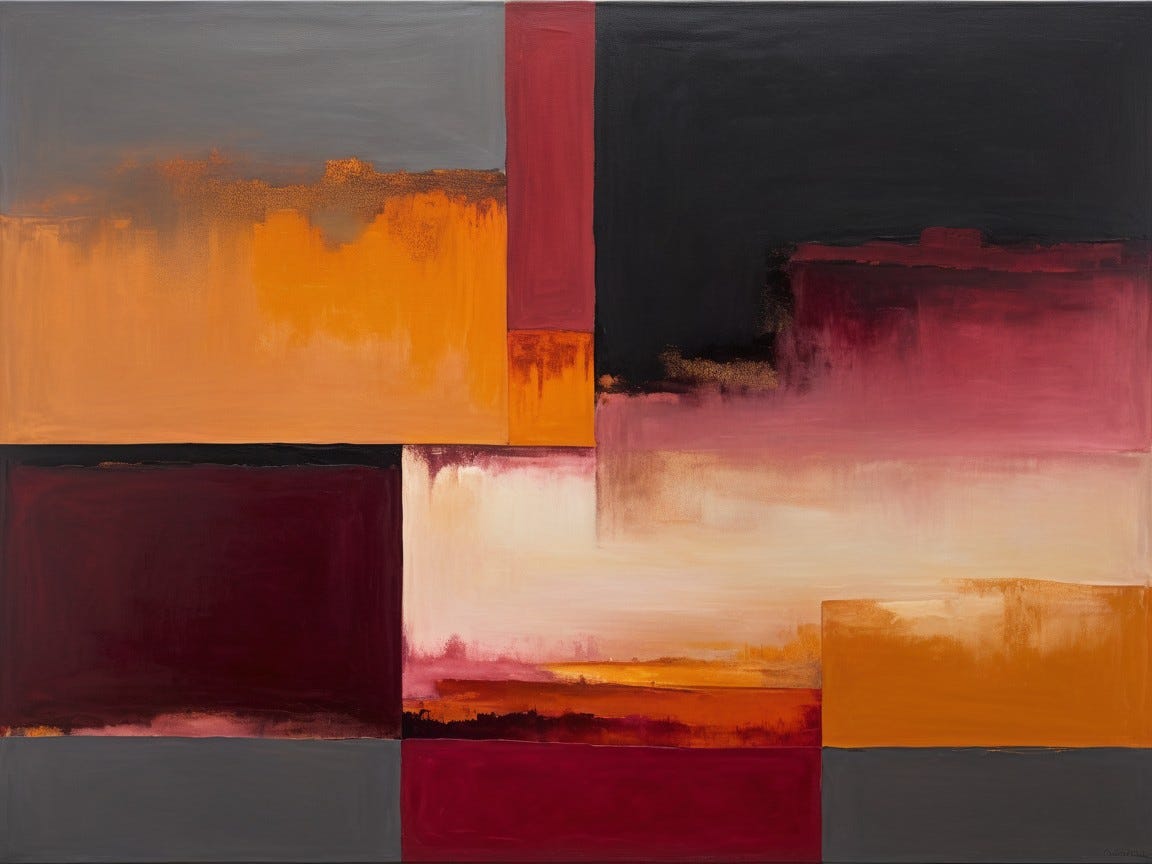
Art Prompt (Contemporary Art): A towering abstract canvas composed of vast, luminous rectangles hovering one above another, their edges feathered and breathing softly into the surrounding space. The upper field glows with warm amber and muted rose, while the lower mass deepens into velvety crimson and burnt umber, all suspended against a quiet, hazy ground washed in smoke-gray light. The surface should feel hand-built and atmospheric, with translucent layers, delicate stains, softened boundaries, and a solemn stillness that turns color into emotion. The composition is simple but monumental, meditative rather than decorative, with a chapel-like hush and a slow-burning intensity that invites prolonged looking.
Video Prompt: A vertical slow-cinema sequence built from monumental floating color fields that gently pulse, bloom, and drift at their edges as if the paint itself is breathing. Warm amber and dusty rose expand and recede against deeper crimson and umber planes, with fine film grain, soft light leaks, subtle texture shimmer, and almost imperceptible camera push-ins that create emotional gravity. Let the colors dissolve into one another in waves, with occasional suspended particles and luminous haze, creating a hypnotic sense of stillness in motion, elegant, modern, immersive, and instantly arresting.
Songs to Pair With It:
- A Walk — Tycho
- Svefn-g-englar — Sigur Ros