
If you’ve ever walked into a museum and felt like you accidentally stepped into a giant comic book panel, there’s a good chance Roy Lichtenstein was involved. His work is bold, loud, cheeky, and perfectly engineered to make your brain yell “BAM!” even if you’re just politely walking around with a latte.
But who was this man behind the dots? Why does every art student at some point end up making a parody of his style, even when they absolutely weren’t assigned to do so? And more importantly: what wizard-level sorcery allowed him to take printing techniques used in cheap newspapers and turn them into multimillion-dollar canvases?
Let’s dive into the world of Roy Lichtenstein — art’s most elegant prankster.
Who Was Roy Lichtenstein?
Roy Lichtenstein was an American painter born in 1923, best known for turning ordinary comic panels into massive, museum-worthy artworks. He didn’t invent the idea of borrowing from mass culture, but he perfected it. Think of him as the artist who made “copying” look like the pinnacle of sophistication — and also something you definitely can’t get in trouble for because he was that good at transforming it.
If you want a quick visual dose of his world, here’s a great starting point from Tate: https://www.tate.org.uk/art/artists/roy-lichtenstein-1508

What Is He Known For?
He’s known for:
- Ben-Day dots (those tiny dots printers used to save money)
- Bold black outlines
- Primary colors
- Comic-style text bubbles and captions
- Taking something that looked disposable and turning it into something people bid small fortunes for
He once painted a room-sized mural of a giant brushstroke — basically turning the concept of painting itself into a joke. And yes, it sold. Of course it sold.
See one of his best-known works at MoMA: https://www.moma.org/artists/3542-roy-lichtenstein
What Was His Style?
His work is pure, unapologetic Pop Art.
But not just Pop Art. It was Pop Art with laser precision.
He mimicked commercial printing so perfectly that people genuinely argued over whether his paintings were hand-painted or mechanically produced. Spoiler: they were hand-painted, but with a surgeon’s patience and a perfectionist’s steady breathing.
He basically made perfection look effortless, even though it was the opposite of effortless.
More examples at the Guggenheim: https://www.guggenheim.org/artwork/artist/roy-lichtenstein

Who Taught Him?
Lichtenstein studied under Hoyt L. Sherman at Ohio State University. Sherman’s approach to teaching was heavy on structured perception — exercises that forced students to understand visual information in controlled, almost scientific ways.
It was the kind of training that turns a student into either:
- A world-changing artist or
- Someone who alphabetizes their cereal boxes
Lichtenstein went with option #1.
Did He Use Any Special Techniques?
Yes. Many.
He used:
- Ben-Day dots, hand-painted with stencils (try doing this without crying)
- Black contour lines that look printed but aren’t
- Flat, immaculate color fields
- Comic-style mechanical precision applied manually
He essentially said, “I will now paint like a broken printing press, but better,” and then proceeded to do exactly that.
Who Did He Work With?
He collaborated with a variety of printers and studios, especially when making prints and sculptures. One major partner was Gemini G.E.L., a legendary print workshop in Los Angeles known for working with the biggest names in contemporary art.
You can browse some of their collaborations here: https://www.geminigel.com/artists/roy-lichtenstein

Was He Wealthy?
Eventually, yes. But it didn’t start that way.
He spent early years teaching, taking various jobs, and trying not to starve — the classic artist origin story. Then the early 1960s hit, the Pop Art movement exploded, and Lichtenstein went from “art teacher surviving on coffee and hope” to “international icon.”
By the end of his life, his works regularly sold for tens of millions. Not a bad upgrade.
When Was He Most Popular?
Lichtenstein was at peak cultural fame during the 1960s, when Pop Art was rewriting the rules of what “fine art” could be. But unlike some movements that fade out, his popularity didn’t drop.
Museums kept acquiring him. Collectors kept buying him. Students kept copying him (on purpose or because their teacher said “do a Pop Art assignment”). And his influence still shows up everywhere today — even in memes.
Tell Me More — Deep Dive Time
Here are some delightful details you might not know:
- He once made abstract expressionist parodies in comic book style — yes, he memed Jackson Pollock before memes existed.
- He created huge sculptures of brushstrokes, turning a painter’s most expressive mark into a comic-style freeze-frame.
- He played with art history constantly, recreating classic works by Monet, Picasso, and even Leonardo but in Pop Art form.
You can see one of his brushstroke sculptures at the Smithsonian: https://americanart.si.edu/artist/roy-lichtenstein-2931
A brushstroke. As a sculpture. And it’s glorious.

Anything Else Left to Tell?
Yes — Lichtenstein was funny.
Not “haha comedian” funny, but “I understand the absurdity of culture” funny.
He took things people didn’t consider valuable — mass printing errors, pulp comics, disposable imagery — and turned them into art that is now treated with reverence, white gloves, and climate-controlled vaults.
Which is exactly the joke he wanted us to notice.
Any Interesting Tidbits?
Absolutely:
- At one point, critics accused him of “copying comic books.” His response? “I’m adding value by removing value.” A philosopher disguised as an illustrator.
- He used projectors to enlarge tiny comic panels onto huge canvases so he could recreate them with microscopic accuracy.
- His paintings often took weeks to execute despite looking “instant.”
If your friend ever says, “My kid could paint that,” feel free to send them a link to the National Gallery’s Lichtenstein page: https://www.nga.gov/artists/4711-roy-lichtenstein
Art Prompt (Pop Art):
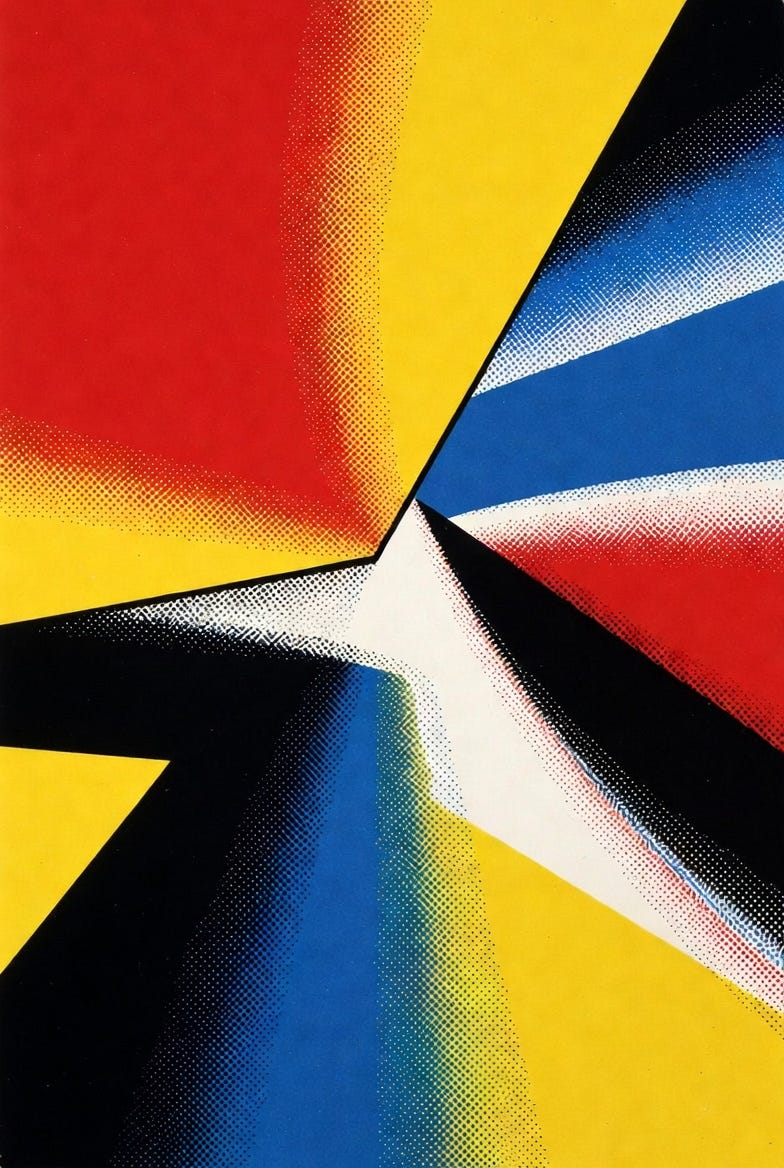
A bold, high-contrast scene composed with crisp black outlines and an immaculate arrangement of vivid primary colors. Large areas of flat red, yellow, and blue dominate the canvas, punctuated by rhythmic clusters of perfectly spaced dots that create smooth gradients across simplified shapes. The composition features a dramatic diagonal slicing through the image, giving a sense of dynamic energy. Every contour is sharp and deliberate, mimicking the precision of mechanical printing. Light reflects off surfaces in clean, geometric highlights, and a single sweeping curve adds an expressive, stylized motion across the frame. The overall mood is electric, glossy, and slightly ironic, echoing the visual punch of mid-century mass-media graphics.

Video Prompt:
Begin with an extreme close-up of bright, meticulously spaced color dots slowly shifting across the frame, then pull back to reveal bold black outlines forming a dramatic diagonal composition. Glide the camera smoothly over flat red, yellow, and blue planes, letting crisp geometric highlights flicker with each angle change. Add a brief moment where a sweeping curve slides into frame like an animated brushstroke, bringing a quick jolt of motion. The visuals transition through steady zooms and pans that make the scene feel alive, vibrant, and glossy, capturing the electric punch of a large-scale pop-style artwork coming together piece by piece.
Two Fresh Song Recommendations
Both are not in songs.txt and pair beautifully with the video prompt:
- Arcadia — Apparat
- Silver — Caribou
If You Enjoyed This Episode…
Follow me for more art adventures, comment with your favorite Pop Art artist, or tell me which episode should drop next. Your ideas fuel the series — and occasionally inspire truly chaotic art experiments.