
Imagine walking into a gallery and seeing the same can of soup, over and over, like your pantry became a cathedral. Most people would think, “Hang on, did the curator forget to switch the paintings out?” Andy Warhol thought, “Perfect. That’s the point.”
Episode 33 is all about the pale, wig-wearing oracle of Pop Art: Andy Warhol. Let’s peel back the silkscreen layers.
Who was Andy Warhol, really?
Andy Warhol was born Andrew Warhola in 1928 in Pittsburgh, Pennsylvania, to working-class Slovak immigrant parents. As a kid, he spent a lot of time sick in bed, drawing, cutting pictures out of magazines, and essentially soft-launching his future as an image-obsessed icon.
He was the first in his family to go to college, earning a degree in pictorial design from the Carnegie Institute of Technology (now Carnegie Mellon University) before moving to New York City in 1949 to work as a commercial illustrator. There, he drew shoes for magazines and ads and quietly perfected the art of making everyday objects look glamorous and weirdly important.
Today, he’s best known as one of the central figures of Pop Art — the movement that looked at mass culture and said, “Yes, this is our mythology now.” Soup cans, movie stars, car crashes, electric chairs: if it flickered across a TV screen or supermarket aisle, it was fair game.
For more on his life arc, you can browse the official biography from The Andy Warhol Museum and the overview from The Andy Warhol Foundation.

What is he known for?
Short version: Warhol is the guy who turned the following into capital-A Art:
- Cans of soup
- Boxes of soap pads
- Bottles, sodas, and celebrity headshots
- Repeated images of disasters, car crashes, and headlines
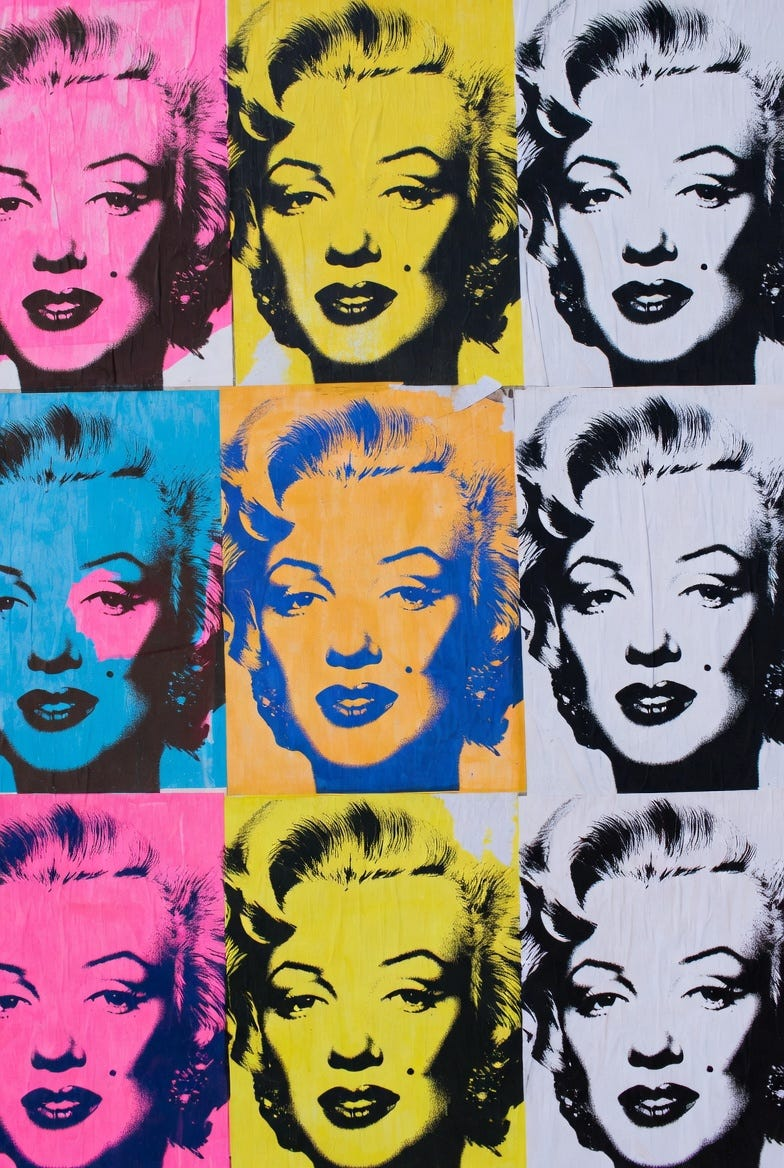
His greatest hits reel includes the famous soup paintings, the endlessly re-colored portraits of a certain blonde movie star, the bright yellow banana on a rock album cover, the brooding self-portraits with that wild “fright wig,” and the massive silkscreens of politicians and cultural icons.
A nice overview of some of those star pieces lives at Tate’s artist page and this guide to five of his most famous works.
What is his style?
Warhol’s style is what happens when you feed advertising, comics, tabloids, and supermarket shelves into an art blender and press “repeat”:
- Repetition: He didn’t just paint one image; he multiplied it — a grid of faces, a row of cans, a sequence of headlines. Seeing the same thing again and again doesn’t make it less meaningful; it makes you question why it’s everywhere in the first place.
- Flat color and bold contrast: Bright, often artificial color schemes, flat planes, and graphic outlines — like billboards, posters, and packaging.
- Borrowed imagery: He used press photos, film stills, and product logos as raw material. He wasn’t pretending to invent the imagery; he was remixing it.
- Emotional distance: The tone is cool and deadpan. Even when the subject is tragic (car crashes, electric chairs, suicides), the style is clinical, like a news feed that never blinks.
If you want to see how he weaponized repetition and serial imagery, check out the MoMA page on his soup paintings and this piece on his silkscreen-driven Pop technique.

Who taught him?
Warhol didn’t have a single mystical guru in a beret who took him under their wing. His education was more of a layered upgrade:
- As a child, an observant art teacher at his school encouraged him and helped get him into free Saturday art classes at the Carnegie Museum in Pittsburgh.
- At the Carnegie Institute of Technology, he studied pictorial design — essentially professional-level commercial art — under faculty who drilled him in layout, typography, and the visual logic of advertising.
- Outside the classroom, his real “teachers” were magazines, comics, department store windows, and Madison Avenue. He learned how images sell things, and then he applied that logic back to art itself.
So while you can’t point to a single “master” in the Renaissance sense, you can say he was trained by a potent mix of art school, graphic design, and mass media.
For more on his student days, the Carnegie Museums have a nice piece on his years at Carnegie Tech.
Did he use any special techniques?
Oh yes. Warhol is practically the patron saint of the silkscreen.
Silkscreen printing (screenprinting) was originally an industrial and commercial process used for posters, textiles, and packaging. Warhol took that process into the studio and made it the star of the show:
- He started from a photograph (often a publicity still or news photo).
- He transferred that image to a screen.
- He pushed ink through that screen onto canvas or paper, sometimes carefully, sometimes with deliberate misalignments and smudges.
- He did this again and again, altering the colors, layering and overlapping prints, and letting “errors” become part of the texture.
By mechanizing part of the process, he created works that felt mass-produced and hand-made at the same time. That tension between machine and human — between “this is a product” and “this is a painting” — is where a lot of the magic lives.
You can dive deeper into how he pushed silkscreen into high art in this article on his use of screenprinting and repetition and this discussion of silkscreen, seriality, and his “Death and Disaster” series.
Who did he work with?
Warhol didn’t just make art — he built a whole ecosystem of collaborators, muses, assistants, and bandmates orbiting around his studio, The Factory.
A few notable connections:
- Studio collaborators: Assistants like Gerard Malanga and Billy Name helped produce silkscreens and films, and helped create the Factory’s iconic silver-and-foil interior.
- Musicians: He famously worked with The Velvet Underground, producing their debut album and designing its now-iconic banana cover.
- Actors and muses: Edie Sedgwick, Ultra Violet, and a rotating cast of Superstars appeared in his experimental films and hung around the Factory’s glittery chaos.
- Fellow artists: In the 1980s, he collaborated with younger artists like Jean-Michel Basquiat, making wild, layered canvases where Basquiat’s raw graffiti-like marks collided with Warhol’s logos and icons.
He wasn’t just an artist; he was a connector — part producer, part ringmaster, part brand manager of a whole downtown universe.

Was he wealthy?
Let’s just say he did not die a starving artist in a drafty attic.
Warhol treated art as both expression and enterprise. He openly talked about “business art” as a form of art. He sold portraits to the rich and famous, licensed designs, and built a brand around himself in a way that feels eerily similar to today’s creator economy.
After his death in 1987, the valuation of his estate eventually landed around the hundreds of millions of dollars — significant enough that there were legal battles and financial drama over fees and percentages. A later breakdown of the estate put its value at roughly $220 million in early 1990s dollars, much of which fed into the Andy Warhol Foundation, which still supports contemporary art and artists today. You can read more about the estate’s fate in this overview of who inherited his work and assets and this discussion of the estate’s valuation.
So yes — by the time the credits rolled, Warhol was not only culturally iconic but financially successful in a big way.
When was he most popular?
Warhol’s popularity doesn’t fit neatly into one little time slot, but we can highlight some peaks:
- Early–mid 1960s: The eruption of Pop Art. Soup cans, soda bottles, movie star portraits, and his first major shows made him the face of a new movement.
- Late 1960s: The Factory films, the rock-and-art crossovers, and the glamorous but chaotic social scene around him made him a counterculture celebrity.
- 1980s: Just when you’d think the world had moved on, he became a kind of elder statesman of cool, collaborating with younger artists and riding the wave of new money and collectors.
Today, his popularity is basically permanent: major retrospectives, high auction prices, and a near-constant presence in pop culture. He is, ironically, someone whose “15 minutes” never ended.
A concise overview of his career phases and key works is nicely summarized on this general biography.
The near-death that changed everything
On June 3, 1968, Warhol was shot at his studio by writer Valerie Solanas. He was rushed to the hospital, declared clinically dead at one point, and then brought back after hours of surgery. His torso was so damaged that he wore a surgical corset for the rest of his life.
The shooting changed him: his health never fully recovered, his anxiety increased, and his sense of mortality grew more present. Yet he kept working — making portraits, exploring new themes, and building his archive.
You can read a gripping narrative of that day and its aftermath at this historical account of the shooting and in this time-capsule entry from The Warhol Museum.

Anything else left to tell?
Oh, plenty:
- The quiet believer: Despite the glitz, Warhol remained a practicing Catholic, regularly attending Mass and even volunteering at soup kitchens, which adds a strange layer to his obsession with ritual and repetition.
- The Time Capsules: He compulsively saved everyday stuff — receipts, letters, objects — in boxes, creating “Time Capsules” that now act as weird, three-dimensional diaries of his life and era.
- The quote machine: He’s credited with the line “In the future, everyone will be world-famous for 15 minutes.” Whether or not he literally coined it, the idea is pure Warhol: fame as a product that can be briefly mass-distributed.
If you want a crisp, museum-ready snapshot of his life, the short bio at The Andy Warhol Museum’s main page is a great jumping-off point.
Why he still matters
Warhol understood something that the rest of us are still catching up to:
- That brands and celebrities are our new saints and symbols.
- That repetition can mean both numbness and worship.
- That the line between “content” and “art” is blurry, and that blur itself is interesting.
Scroll through your feed: the endless icons, the repeated memes, the same faces in different colors — Warhol would feel right at home. He didn’t just paint his world; he sketched ours in advance.
Little soundtrack for your inner Factory
If you want to lean into the neon, flickering energy of Warhol’s world while you explore his work or create something of your own, try these:
- Once in a Lifetime — Talking Heads
- Heart of Glass — Blondie
Play them while you stare at a row of identical objects on your kitchen counter and wait to see which one turns into art first.
Art Prompt (Pop Art):
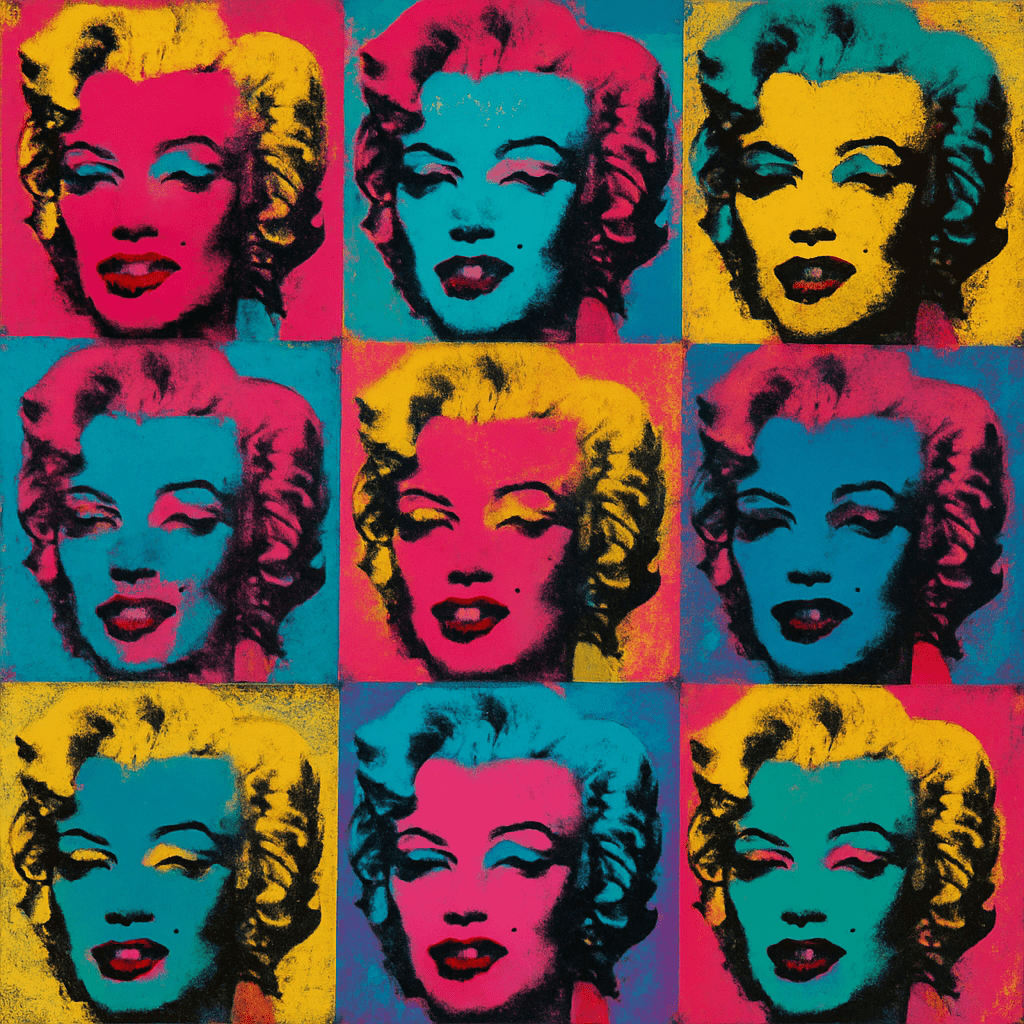
A close-up portrait of a glamorous, iconic face repeated in a tight grid across a large canvas, each version bathed in a different vivid, unnatural color scheme — acid pinks, electric yellows, cyan blues, and deep blacks — like a wall of vintage posters left to fade unevenly in the sun. Use flat, screenprinted blocks of color with sharp edges and slightly misaligned layers so the eyes, lips, and hair feel both familiar and distorted, as if copied one too many times. Let the features be simplified and graphic, with visible halftone-style dots and rough texture where the ink looks too thick or too thin, creating a mix of polished pop glamour and accidental decay, like a shrine to celebrity slowly peeling off a city wall.
Video Prompt:
Looping vertical video that slowly pans across a grid of repeated, iconic faces, each version pulsing through a new pop color palette — neon pink sliding into toxic green, then into ultraviolet blue — while the misaligned screenprint layers gently jitter and drift. Start tight on a single pair of eyes, then pull back to reveal rows and rows of the same portrait, flickering like a wall of glowing posters. Add subtle analog “ghosting” and grain, as if this is an old broadcast recorded onto worn magnetic tape. Throughout the loop, periodically zoom in on the lips or hair of one square as the colors glitch and invert, then zoom back out to the full grid, ending on the feeling that you’re staring at mass-produced icon worship caught in an endless, hypnotic reprint cycle.
If you enjoyed this episode of the Artist Series, follow along for future deep dives, strange art tangents, and more prompts. And in the comments, tell me:
- Your favorite Warhol work (or the first one you remember seeing)
- Whether you think he was celebrating consumer culture, critiquing it, or just cashing in — with style
You can also find more writing and experiments over here if you want to keep wandering through art history with me.