
Vincent van Gogh wasn’t born with a paintbrush in his hand — he picked one up seriously at 27, sprinted like a comet for a decade, and burned a whole new groove into art history. If you want the short biography with the long feels, the museum dedicated to him has a terrific timeline: Vincent’s Life (Van Gogh Museum).
Who is this artist? A Dutch painter (1853–1890) whose letters read like a diary set to color theory. He bounced through jobs (art dealer, teacher, preacher) before committing to painting. He moved from the Netherlands to Antwerp, then Paris, then to the southern sun of Arles and the quieter fields of Saint-Rémy and Auvers. The official hub for his story and works lives here: Vincent van Gogh (Van Gogh Museum).
What is he known for? Those sky-swirls that look like the weather got into a conversation with music. Wheat fields that hum. Sunflowers that have opinions. Portraits that feel like they’re thinking about you back. His nine weeks of chaotic co-living with Paul Gauguin in the “Yellow House” are also legendary: The Yellow House.

What is his style? Post-Impressionism with a voltage spike. He pushed color beyond polite behavior, used visible brushwork like handwriting, and stacked paint so thick it basically became sculpture. Want a crisp dive into how he bent color (and kept it musical rather than garish)? Try this wonderfully nerdy read: Computer analysis of Van Gogh’s complementary colours (Berezhnoy, Postma, Herik).
Who taught him? Mostly himself, plus a crucial early boost from cousin-in-law and Hague-School star Anton Mauve, who got him going in watercolor and oils. The museum’s own write-up nails this period: First Steps as an Artist (Van Gogh Museum). He also did a stint at the Antwerp Academy and took classes in Paris at Cormon’s studio — handy context here: Van Gogh (The Met Essay).
Does he use any special technique? Yes: impasto (paint applied thick enough to cast tiny shadows), directional strokes that map the wind, and razor-smart complementary color pairings (think vibrating blues vs. oranges, reds vs. greens). For a wonderful example of his intentional color “duets,” read this: Vincent’s Colours (Van Gogh Museum).
Who has he worked with? Paul Gauguin — briefly, intensely, and explosively — in Arles. They dreamed of an artist house, argued about everything (including whether art should come from memory or observation), and parted ways after a now-infamous December 1888 crisis. A great short read on those nine weeks: Van Gogh & Gauguin’s Nine Turbulent Weeks (Artsy).

Was he wealthy? Not remotely. He relied heavily on his brother Theo. The “sold only one painting” line is oversimplified, but sales were indeed scarce while he lived. The museum’s FAQ explains what’s actually known: How many paintings did Vincent sell during his lifetime? (Van Gogh Museum).
When was he most popular? After his death in 1890. The engine of that posthumous fame? Theo’s widow, Johanna van Gogh-Bonger, who organized exhibitions, placed works strategically, and turned Vincent’s legacy into a global chorus. Read her playbook here: The Woman Who Made Vincent Famous (Van Gogh Museum).
Tell me more, please The letters! They’re luminous — half shop manual, half soul-search. You can read them all, beautifully annotated, at this fantastic resource: Van Gogh: The Letters. You’ll find sketches tucked between paragraphs, color notes scribbled in margins, and working thoughts that feel startlingly present a century later.
Anything else left to tell? Japan matters. He studied ukiyo-e prints, borrowed their bold outlines and flat color harmonies, and remixed them into his own visual grammar. Paris matters. Neo-Impressionists lightened his palette. The south matters. Arles handed him a sun that turned yellow into a symphony.
Any other interesting tidbits? He sometimes used a perspective frame — a literal wooden viewfinder — to wrestle space into order; once you know that, certain compositions click into place. If you’re the process-curious type, this museum primer on his life also traces those shifts in drawing and composition over time: Vincent’s Life (Van Gogh Museum).

If this swirly ride made you smile, follow for more episodes and drop a comment: which Van Gogh hits you hardest — skies, fields, or faces?
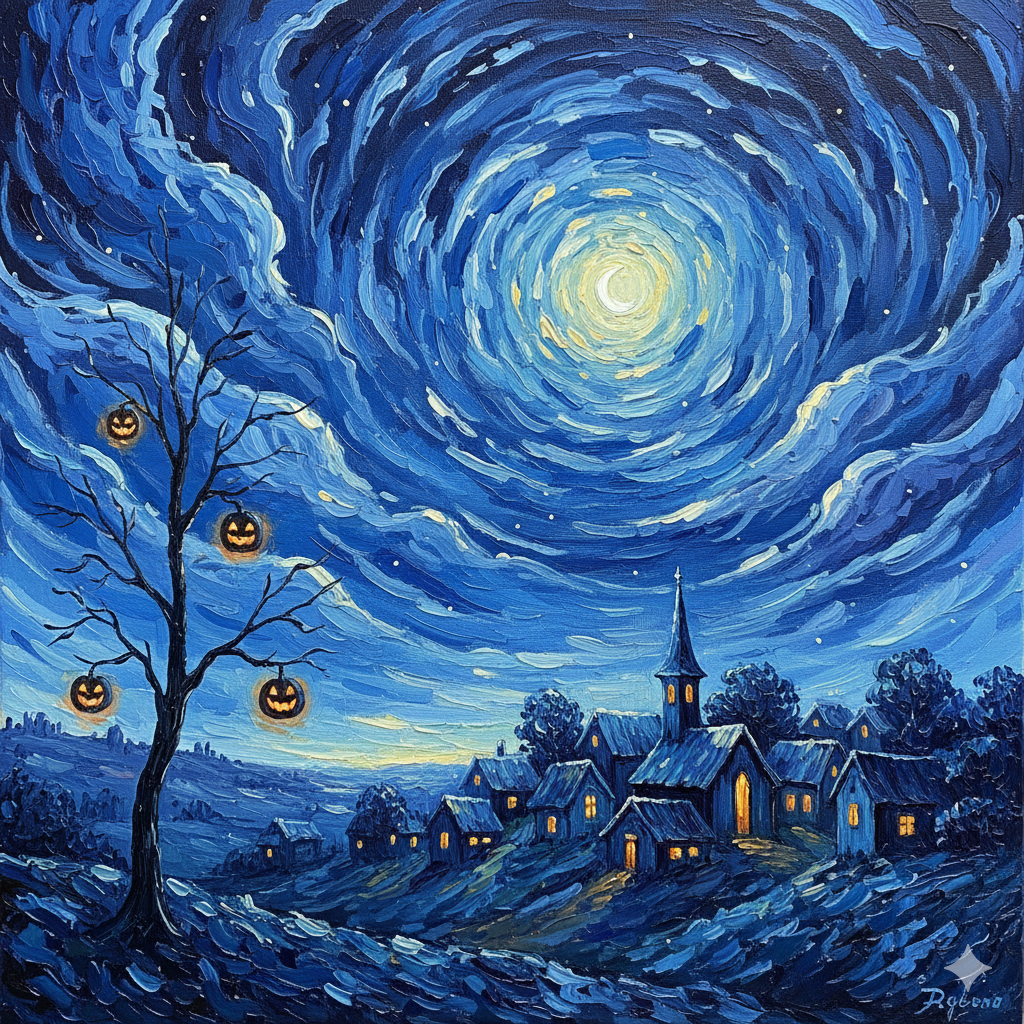
Art Prompt (Post-Impressionist): At midnight, a small hillside village dozes under a sky that’s alive — whorls of moonlit vapor drift like slow fireworks, thick impasto strokes carving currents across deep ultramarine. A solitary, tapering tree anchors the left foreground, its dark silhouette flickering with tiny lanterns carved into grinning pumpkins. Rooflines and a church spire nestle in the middle distance, their edges softened by velvety blues and bruised violets. Windows glow amber, echoing the crescent moon’s pale gold halo. Brushwork is assertive and rhythmic, each stroke a heartbeat; cool nocturne blues harmonize with hot yellows and ember-orange pinpoints. The mood is ecstatic yet tender, as if the night itself is humming. Subtle texture on the canvas catches starlight, and gentle gradients guide the eye in spirals toward the horizon where the wind seems to breathe.

Video Prompt: A moonlit village breathes under a living sky of swirling nocturne clouds; start with a slow push-in from a distant hillside, parallaxing the tapering tree studded with glowing jack-o’-lanterns against the rolling sky. Animate thick, painterly strokes so they ripple subtly, stars pulsing with warm gold flares as windows blink on in the village below. Track forward over rooflines to a church spire, then tilt up to let the spiraling clouds carry us in a gentle orbit before drifting back to the lantern-lit tree. Keep textures tactile — visible brush ridges catching light — while color grades glide between deep blues, violets, and candlelit ambers. Add soft wind audio cues and distant village murmurs. 12–15 seconds, smooth easing, 24fps, shallow-depth vibe, final beat on the moon’s halo brightening as the pumpkins flicker.
Songs to pair with the video:
- Bury a Friend — Billie Eilish
- Season of the Witch — Donovan