
Let’s be honest — humans have always had a weird relationship with knowledge. We crave it, chase it, build libraries full of it… and then, just as often, panic and try to light those libraries on fire. It’s like we’re on an eternal first date with wisdom: things start out great, but the moment it challenges us, we’re suddenly “just not ready for that kind of commitment.”
Take Galileo Galilei. The man points a telescope up, sees that the Earth is not the center of the universe, and suddenly everyone’s clutching their rosaries like he just invented disco. “Heretic!” they shout. “How dare you suggest we’re not special!” Galileo’s real mistake wasn’t the science — it was underestimating humanity’s fragile ego. We’d rather orbit our own self-importance than the sun.

Or Socrates, the OG philosopher who made the fatal mistake of asking too many questions. The Athenian government eventually said, “You know what? Enough of this logic stuff — here, have some hemlock.” Imagine being executed for critical thinking. It’s like being banned from Twitter for proper punctuation.
And then there’s book burning, history’s favorite group therapy for insecure regimes. From Qin Shi Huang’s “delete all inconvenient scrolls” campaign in 213 BCE to the Nazis’ literary bonfire parties, the pattern’s clear: nothing says “we’re confident in our ideas” quite like incinerating the competition. Even today, “banning” a book usually means boosting its sales on Amazon. (There’s probably a marketing team somewhere whispering, “please, somebody, just ban us in Texas.”)

What’s wild is how consistent this is across time. Every generation produces new heretics, and every one of them eventually gets a statue or a Netflix documentary. The cycle goes: ridicule → persecution → reluctant acceptance → high school textbook chapter. Galileo, Darwin, Ada Lovelace, Alan Turing — all went from “dangerous radicals” to “geniuses your teacher loves to quote.”
Our intolerance of knowledge isn’t just historical, though. It’s alive and well on the internet. Post a nuanced explanation of climate data and you’ll be accused of working for Big Thermometer. Try to explain quantum physics on YouTube, and someone in the comments will yell, “fake news, atoms don’t exist.” Modern heresy trials just use comment sections instead of courtrooms.
But maybe — just maybe — this is what makes human progress so uniquely dramatic. Every step forward involves a bit of yelling, a touch of denial, and the occasional burnt manuscript. We fear what we don’t understand, and yet we can’t stop chasing understanding. Knowledge, it turns out, is the world’s most irresistible forbidden fruit — and no amount of fire, poison, or one-star reviews can make us stop taking a bite.

So here’s to the thinkers who got shushed, silenced, and side-eyed — the troublemakers who refused to stay comfortably ignorant. History proves that when everyone says, “you can’t say that,” someone absolutely should.
If you enjoy truth served with a side of chaos, follow for more. And drop a comment — who’s your favorite historical troublemaker?

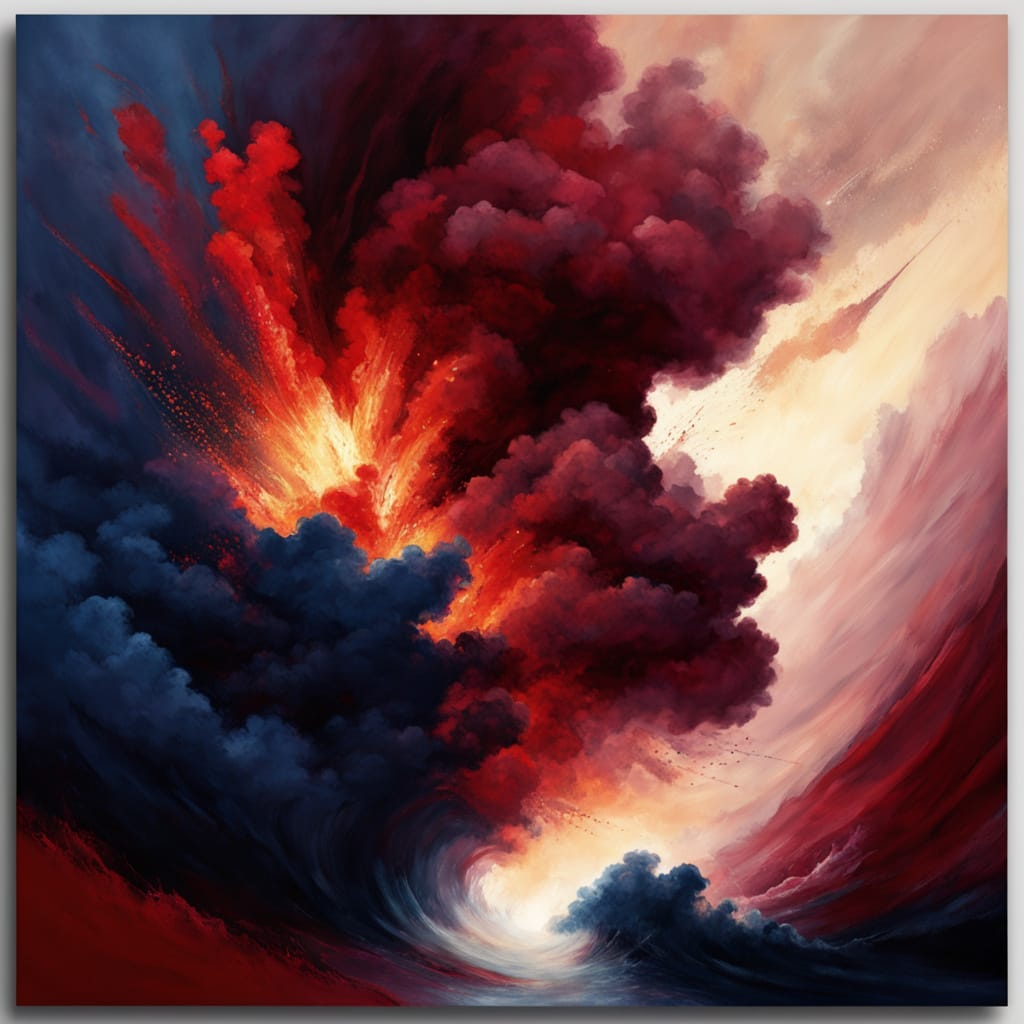
Art Prompt (Abstract Expressionism): A vast canvas splashed with bold, sweeping arcs of crimson and indigo, layered with impulsive strokes of ochre that dance like emotion itself. A field of vibrating color where boundaries dissolve, the surface alive with texture — thick paint ridges catching the light like veins of raw thought. The energy feels spontaneous, almost musical, as if every gesture was both an explosion and a whisper, suspended between fury and grace.
Video Prompt: A dynamic time-lapse of color evolving across canvas — crimson and indigo rippling into being, ochre flashes pulsing like the beat of a living idea. Each brushstroke lands to rhythm, paint merging and separating in hypnotic flow, building toward an emotional crescendo where chaos organizes into fleeting harmony before melting again into abstraction.

Songs to go with it:
- Weight of Love — The Black Keys
- Luminous Beings — Floating Points
- Signal Drift — Tycho