
There’s a special kind of quiet that arrives after 9 p.m. — the inbox goes from “firehose” to “dripping faucet,” Slack transforms into a museum, and suddenly the thing that eluded you all day starts… cooperating. It’s not magic. It’s math, psychology, and a dash of snacks.
Let’s talk about how to work late without becoming a wearable cautionary tale.
Why Late Works (Sometimes)
After hours, your distractions shrink. The meetings are gone. The calendar stops yelling. That “ahhhh” you feel is focus — helped along by the disappearance of context switching. Also, little behavioral quirks help you: Parkinson’s Law notes that work expands to fill the time you give it, which is why a looming midnight gives your brain the decisive energy it denied you at noon (hello, Parkinson’s Law).
The goal isn’t to glorify insomnia; it’s to use the quiet wisely when the day refuses to cooperate.

The Late-Shift Mini-Playbook
1) Define the one win. Put a single, unambiguous outcome at the top of a sticky note: “Ship the draft,” “Finish the spreadsheet pivot,” “Fix the flaky test.” One. Not twelve. If you finish early, you may choose a sequel.
2) Try a tomato (really). Set a 25-minute focus sprint, 5-minute break. Repeat 3–4 times, then take a longer break. This simple pattern is the famous Pomodoro Technique — a surprisingly effective way to fence off wandering thoughts.
3) Time-block the night like a tiny heist. Block 9:15–10:00 “draft,” 10:00–10:10 “stretch,” 10:10–10:45 “revise,” 10:45–11:00 “commit/push.” Pre-commit the finish line. For a deeper dive on why assigning every minute a job helps, here’s Cal Newport on time blocking.
4) Respect the light. Screens can mess with sleep timing, especially late. Blue-heavy light keeps your brain perked up — use warmer settings and dim the brightness near bedtime (see the Sleep Foundation on blue light and sleep). If you’re night-owl’ing, add a short cool-down routine before bed — paper book, quiet music, or tomorrow-plan-in-two-minutes.
5) Build a “done” ritual. Close your loops: commit code, archive the draft, jot three lines of “what I solved / what’s next / where to start.” This spares you the 2 a.m. “did I push that?” panic and gives future-you a launchpad.

Late-Night Pitfalls (and Escapes)
- The “I’ll just keep going” trap. If you’re dragging your cursor like a canoe through molasses, stop. That’s not grit; that’s diminishing returns. Cap the session and plan a crisp restart.
- Snack regret. Late-night productivity is not a license to invent a nacho lasagna. Hydrate; pick non-chaotic snacks. (Crunchy veggies count. So do almonds. So does “nothing.”)
- Scope creep in pajamas. Keep a parking lot file. Ideas go there; tonight’s goal stays narrow.
When You Shouldn’t Work Late
- When the task needs collaboration (no teammates = no blockers removed).
- When you’re stacking late nights like Jenga — sleep debt will hand you wobbly logic tomorrow.
- When the “quiet” is really procrastination wearing a hoodie. Be honest: sometimes daytime discomfort (hard email, gnarly decision) masquerades as “I focus better at night.” If so, schedule a daylight ambush and end it.

Micro-Framework: The 90-Minute Nightcap
- 5 min — Write the one outcome and a three-step path.
- 25 min — Sprint 1.
- 5 min — Move, stretch, blink at the horizon like you’re in a nature documentary.
- 25 min — Sprint 2.
- 5 min — Break.
- 20 min — Finish line push.
- 5 min — “Done” ritual + tomorrow’s first step.
That’s 90 minutes — enough to turn “ugh” into “shipped,” and still leave room for a reasonable bedtime.
Bonus: Make It Fun
- Soundtrack the sprint (two recs below).
- Use a silly timer name (“Operation: Finish Him”).
- Promise Future You a reward (the good tea, the comfy socks, the guilt-free morning scroll).
If this helped, follow for more friendly productivity mischief — and drop your favorite late-shift hack in the comments. Did you conquer something yesterday after dark? Tell us exactly what worked (and what didn’t). Your tip might save someone’s Tuesday.

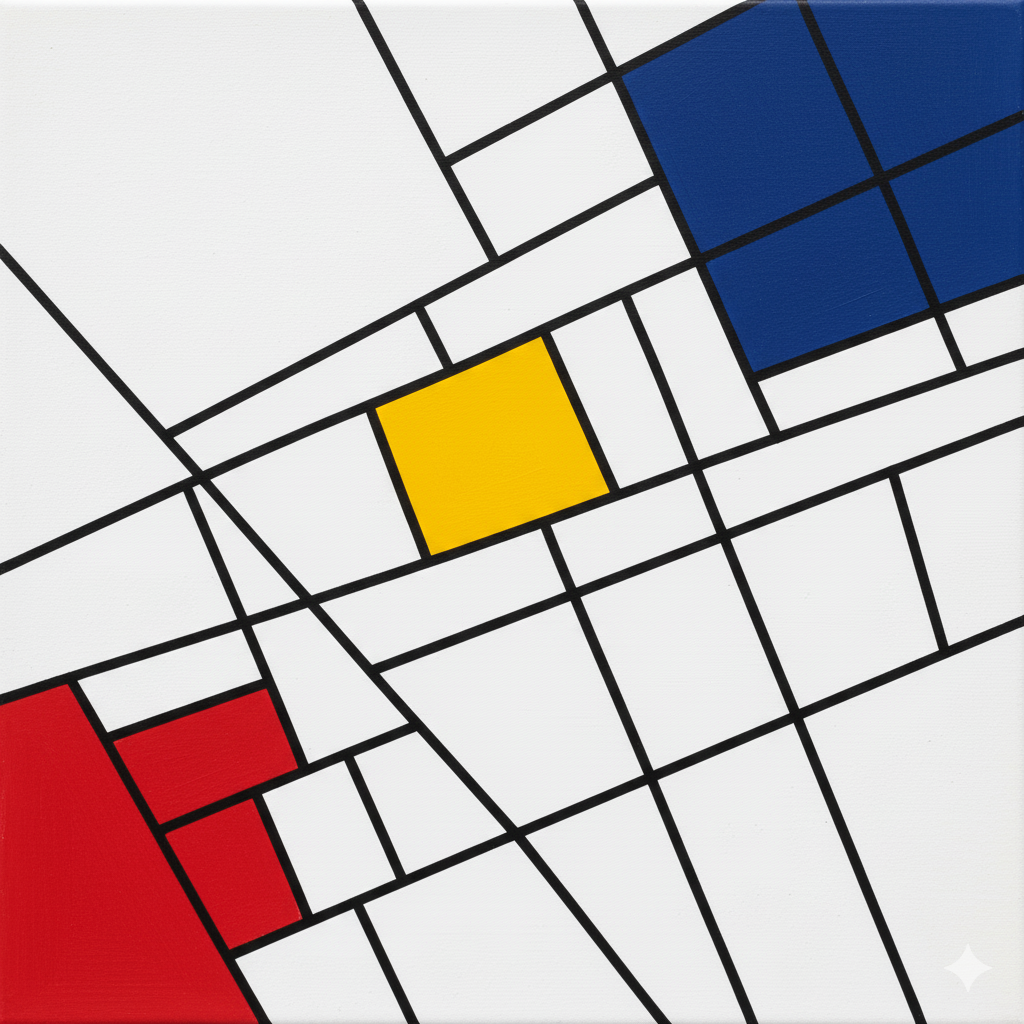
Art Prompt (Geometric Abstraction): A bright white canvas crossed by crisp, charcoal-black lines that intersect at asymmetrical angles, forming an off-kilter grid. Within select rectangles, saturate bold primary reds, luminous yellows, and deep ultramarines — each block slightly varied in size to create a rhythmic tension between calm and energy. Preserve generous negative space so the composition breathes, with edges that feel hand-balanced rather than perfectly measured. Aim for matte color fields with subtle brush texture at borders, as if paint gently met tape then feathered away. Convey equilibrium through imbalance — an elegant city map distilled to pure form, serenely modern and quietly ecstatic.
Video Prompt: Begin on an empty white field. Thin black lines snap into place with satisfying clicks, carving an uneven grid. Primary color panels fade up one by one — red, yellow, blue — pulsing softly in time as the camera glides across intersections, then tilts to reveal the asymmetry. Lines animate with slight tremors, as if hand-drawn, while color blocks slide, lock, and “breathe” with micro-parallax. Finish with a smooth pull-back revealing the full composition, lingering a beat on the serene balance before the cut.

Songs to pair with the video:
- Working for the Weekend — Loverboy
- After Dark — Mr. Kitty