
If Surrealism were a circus, André Breton would be the ringmaster with a pocketful of dream keys and a strict “no boring allowed” policy. He didn’t just lead the movement — he branded it, defined it, and, when needed, rebooted it with another manifesto and a side of friendly feuds. He’s the reason “the unconscious” went from couch therapy to gallery wall.
Who is this artist? A French poet, critic, and movement-builder, Breton co-founded Surrealism and steered it from raucous café debates to a full-blown cultural engine. He published the movement’s north star — the Manifesto of Surrealism (1924) — and later the Second Manifesto (1930), both of which read like instruction manuals for unlocking your brain’s secret passages.
What is he known for? Branding the method (automatism), recruiting the cast (from Dalí to Tanguy), and setting the games (the collaborative “Exquisite Corpse”). If you’ve ever drawn a creature with friends where each person only sees a fold and chaos ensues, that’s Surrealism’s calling card — codified by Breton and company. For a quick primer, start with Britannica’s overview of Exquisite Corpse and then peek at an actual collaborative piece with Breton’s name on it at Tate. For Breton’s own short origin note — “the old house… at 54 rue du Château” — see the entry on andrebreton.fr.
What is his style? On the page: sentences that flow like lucid-dream handrails, leaping from streetcorner to subconscious with effortless logic. His novel Nadja is the vibe in book form — Paris, chance encounters, photographs, and the unforgettable line about beauty being “convulsive.” A reliable edition is listed by the publisher here: Grove Press — Nadja. On the scene: Breton curated Surrealism’s look and feel — dream shock, found objects, juxtapositions that make your rational brain blink twice.

Who taught him? Formally, he began in medicine and served during WWI in neurological and psychiatric wards; informally, he became a devoted student of Freud, the clinic, and the mind’s mischief. He worked under the legendary neurologist Joseph Babinski at La Pitié–Salpêtrière — see the short academic summary in Brain on Breton and Babinski. The hospital corridors were where automatism (and its medical cousins) started to look like art techniques.
Does he use any special technique? Yes: surrealist automatism — writing or drawing with as little conscious control as possible. For a deeper dive into its history and afterlives, Tate Research maps the terrain in “Becoming Machine: Surrealist Automatism.” And of course, he helped popularize Exquisite Corpse — playful, communal, and gloriously unpredictable.
Who has he worked with? Think of a who’s-who of Surrealism and adjacent modernism: Paul Éluard, Max Ernst, Yves Tanguy, Marcel Duchamp, Joan Miró, and more. A crisp group-history lens (with Breton as ringleader) can be found in Artforum’s essay on the Surrealist émigrés in New York. For a peek at how Duchamp literally built doors for Breton — no metaphor — read about the glass entry to Breton’s Gradiva gallery in this detailed piece from Tout-Fait: Duchamp’s “Door for Gradiva”.
Was he wealthy? Not particularly. Breton earned his keep as a writer, editor, collector, and sometimes gallerist. A telling episode: in 1937 he directed Gradiva, a Left Bank gallery with an entrance designed by Duchamp; it was visionary but short-lived (which is a poetic way to say it didn’t pay like a hedge fund) source on Gradiva’s concept and fate.

When was he most popular? Late 1920s through the 1930s as Paris’s Surrealist HQ crystallized; then a vital wartime chapter in early-1940s New York, where exiled Surrealists cross-pollinated with the American avant-garde — see the New York chapter in Artforum.
Tell me more, please Breton wasn’t just a theorist — he was a sequence. First came the 1924 manifesto that crowned the unconscious as creative monarch. Then came Nadja (1928), where photographs and walking become a method; the publisher summary at Grove Atlantic is a clean entry, and if you want both manifestoes in one volume, there’s a commonly cited compilation at Internet Archive. By 1930, the Second Manifesto sharpened the politics and the stakes. Along the way, the cafés, the quarrels, the gallery experiments, and the exile years knitted Surrealism into a transatlantic network.
Anything else left to tell? Breton had the rare talent of making rules about how to break rules. He could argue fiercely (and did), but he kept the core idea crystalline: reality is bigger than logic, and art should take orders from dreams as seriously as from daylight.
Any other interesting tidbits? • The “party game” that changed art history — Exquisite Corpse — really was a living-room pastime before it became museum canon; there’s a breezy, recent recap of its lore here: Artnet News. • Duchamp’s door for the Gradiva gallery was so iconic that after the original was destroyed, a later version was remade from archival photos; see the note and museum details via UC Press’s Unpacking Duchamp: Door for Gradiva.

If you love walking through the dream-door yourself, browse our Surrealist pieces and videos right here on the site: check the Surrealism gallery and then tell me which image made your rational brain throw up its hands in surrender.
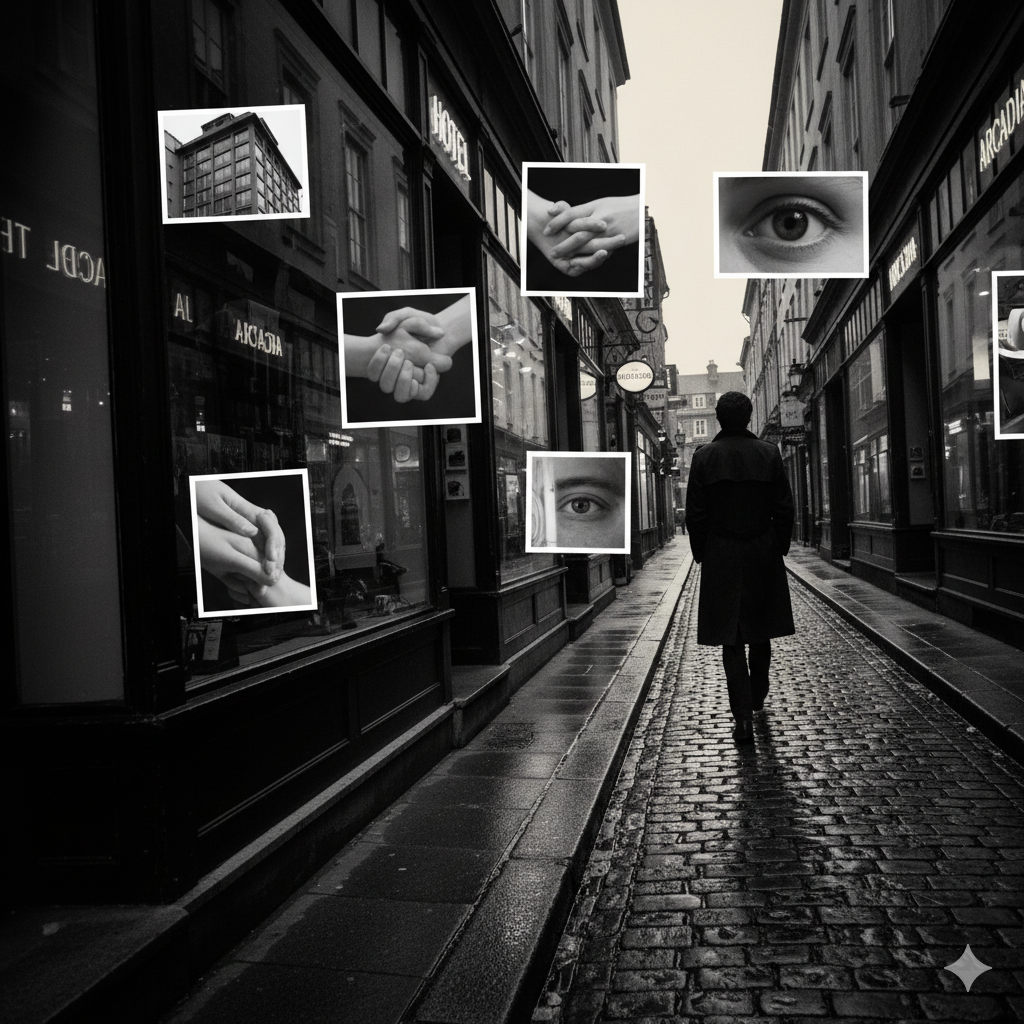
Art Prompt (surrealist prose-visual): A nocturnal city unfurls under a pale, powdery sky; narrow streets tilt just slightly off-true, as if the horizon is reconsidering itself. A lone figure in a dark coat drifts through storefront reflections and lettered signs; crisp black-and-white photographs — cropped hands, a hotel façade, a staring eye — float like captions to a dream. The palette shifts between inky shadows and paper-cream highlights, punctuated by sudden silver glints on wet cobblestones. Composition favors wandering diagonals and serendipitous overlaps, as if chance itself were editing. Mood: hushed, electric, expectant — where every corner is a door and every door is a question.
Video Prompt: Begin with a slow glide down a rain-slick street at night; text fragments and vintage storefront letters flicker into frame as overlays. Cut to rapid inserts of high-contrast photographs — hands, keys, an eye — each appearing for a heartbeat, then dissolving into reflections in puddles. Pivot the camera in gentle, drifting arcs that reveal mismatched perspectives — street signs at impossible angles, shadows stepping ahead of their owners. Let the soundtrack breathe between footsteps; on key beats, sync cuts to glimpses of a glinting key or a curtain stirring. End by pushing through a glass door silhouette into overexposed light, holding just long enough for a pulse of wonder.

Two tracks that pair beautifully with this cut:
- La Femme d’Argent — Air
- Pale Blue Eyes — The Velvet Underground
If this hit you right in the subconscious, follow for the rest of the Artist Series and drop a comment with your favorite Breton-era collaboration. And if you want more art you can actually hang, wander through the Surrealism gallery 2 and tell me what you’d put on your wall.