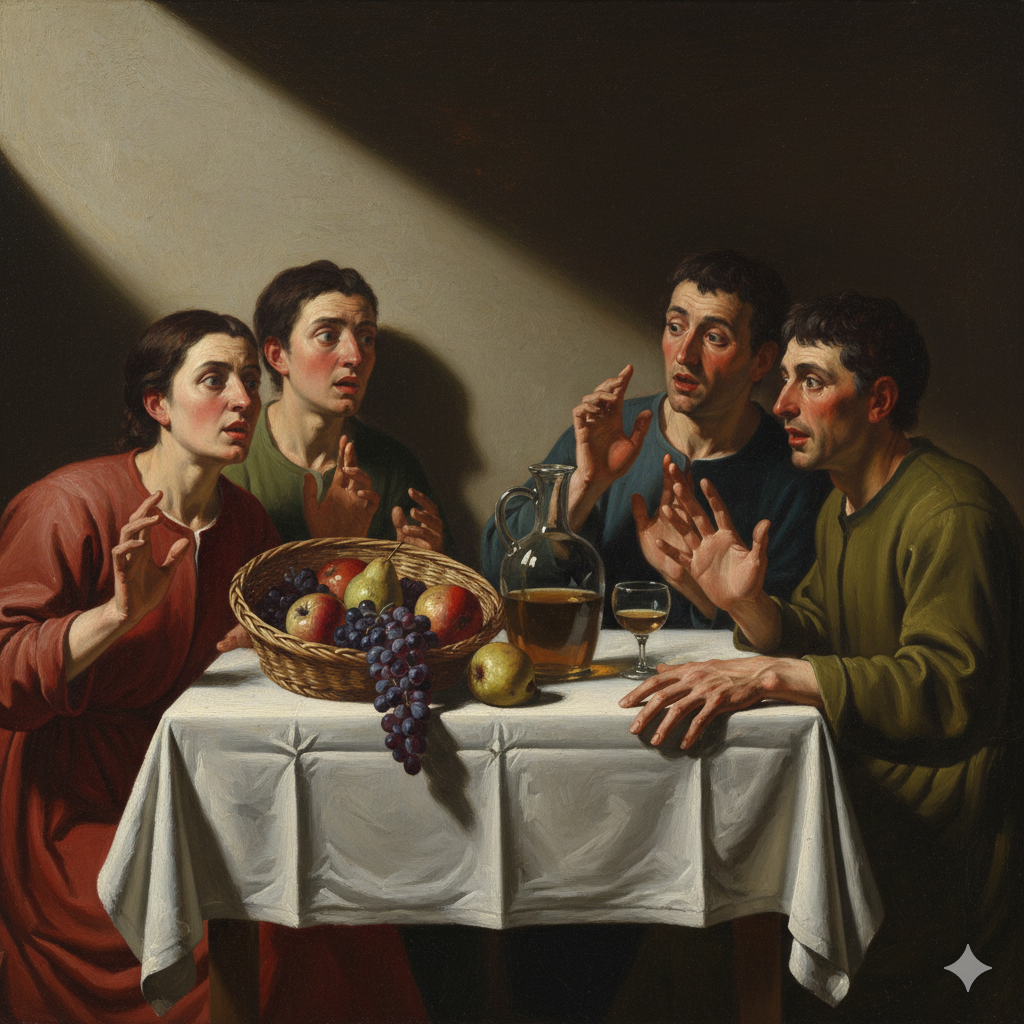

Who is this artist? Michelangelo Merisi da Caravaggio (1571–1610) was the bar-fight-magnet who jump-started Baroque painting with real people, real fruit (worms and all), and very unreal lighting. He trained in Milan, then rocketed through Rome on the strength of patrons like Cardinal del Monte and chapel-shaking church commissions before an infamous homicide sent him sprinting south. A concise, well-sourced starting point is the Britannica overview, which also documents his apprenticeship and wild career arc. Read the bio.

What is he known for? Short answer: drama. Long answer: a nuclear form of chiaroscuro called tenebrism — pitch-black backgrounds punctured by tight beams of light so your eyes go exactly where he wants them. He also painted directly from life, basing saints, sinners, and side-characters on people he knew, which was both revolutionary and, to some critics, scandalous.
What is his style? Stagecraft with a flashlight. Figures crowd the foreground; gestures hit like jump cuts; the light behaves like a character. The Met’s essay nails how he pushes forms up to the picture plane and uses light to make scenes feel immediate and uncomfortably present. Skim the Met’s take.
Who taught him? At 12, he signed on with Simone Peterzano — himself a pupil of Titian — up in Milan. It’s all in the records.
Does he use any special technique? Yes, and not just the spotlight. The National Gallery’s page on The Supper at Emmaus notes he often painted straight onto the canvas from live models, sometimes incising placement lines into the still-tacky ground and skipping preparatory drawings entirely. Extra nerd treat: for the chapels he even tuned the picture’s light to the actual chapel lighting — site-specific illumination before it was cool. Met on that bit.
Who has he worked with? Not a “studio collab” guy — more a gravity well. His world included patrons like Cardinal del Monte and the Mattei family; models such as Mario Minniti (yep, that’s him in Bacchus at the Uffizi); and a circle that overlapped with Orazio and Artemisia Gentileschi (the Uffizi even dedicates rooms to “Caravaggio and Artemisia” — see the museum’s overview here).
Was he wealthy? He had hot streaks with high-paying commissions — but “consistently rich” is not a phrase historians use. Britannica notes he struggled in the mid-1590s before patrons lifted him, and after 1606 most of his energy went into surviving exile.
When was he most popular? Peak heat: Rome circa 1600–1606 — especially after the Saint Matthew cycle detonated in the Contarelli Chapel. (For a crisp walk-through, Smarthistory’s analysis of The Calling of Saint Matthew is great.) After his death, taste swerved away for a while; the 20th century rediscovered him with a vengeance (see the Met’s essays above).
Tell me more, please Caravaggio specialized in “you are there” realism: torn sleeves, dirty fingernails, wicker baskets teetering off table edges, all lit like a crime scene. If you want a single canvas that shows the whole bag of tricks — gestures in freeze-frame, fruit so real it bruises, and that surgical beam of light — go visit The Supper at Emmaus (National Gallery, London).
Anything else left to tell? Oh, the plot twists. In 1606 he killed Ranuccio Tomassoni in a duel (source: Britannica), fled Rome, painted like mad across Naples, Malta, and Sicily, tried to secure a pardon, and died near Porto Ercole in 1610. Meanwhile, his paintings kept leading double lives: The Taking of Christ vanished for centuries and was only recognized in Dublin in 1990. The National Gallery of Ireland has the whole detective story and the painting on view.

Any other interesting tidbits? Caravaggio is still making news. In 2024, Madrid’s Prado confirmed a rediscovered Ecce Homo as an authentic Caravaggio — one of the most significant finds in years. Also: you’ll sometimes see debates about optical devices; stick with what’s documented — he painted from life, fast, and often without drawings.
If this made your art-history heart beat faster, tell me in the comments which canvas you’d time-travel to see unveiled, then hit follow for the next deep dive. Meanwhile, wander through more art experiments over at lumaiere.com (and if you’re the video type, the fifth gallery lives here).
Art Prompt (Baroque Realism): A tight, tabletop scene in a dim interior: four figures gathered around a square table, each frozen mid-gesture as if a revelation has just ricocheted through the room; a single raking light from the left carves faces out of darkness and throws a crisp shadow on a bare wall; a white tablecloth creases into sharp geometry; a wicker basket of grapes, apples, and a pear teeters over the edge, every blemish lovingly observed; glass carafe and wine reflect and refract the beam; foreshortened arms thrust toward the viewer, breaking the picture plane; earthy reds, olive greens, and warm umbers meet sudden, chalky highlights; brushwork tight on still life, looser on cloth; mood: breath-held astonishment, poised between ordinary supper and the uncanny.
Video Prompt: Start on a silent, near-black frame. A single beam of light blooms from the left to reveal a small table: fruit basket wobbling at the brink, steam lifting from a dish, hands mid-gesture. Slow push-in as faces emerge from shadow, eyes widening; micro-cuts between the glint on a wine glass, the edge of a loaf, a sleeve’s torn seam. Hold on a foreshortened arm that seems to reach past the screen, then whip-pan to the wall as the shadow snaps into perfect silhouette. End with the light flicking out, leaving only the afterglow of highlights.

Songs to score the moment
- Miserere mei, Deus — Allegri
- Spem in alium — Thomas Tallis
If you want more like this, follow and drop your favorite “wait, is that light real?” moment below.
Wow that was strange. I just wrote an extremely long comment but after I clicked submit my comment didn’t appear.
Grrrr… well I’m not writing all that over again. Anyway, just wanted to
say superb blog!
Ha! I know that feeling — when the internet eats your masterpiece just as you hit submit. Happens to the best of us.
Glad you came back anyway — really appreciate you taking the time to drop by! If you enjoyed this one, there’s a ton more art and chaos waiting over at https://lumaiere.com.
And hey, maybe this time the comment will actually stick 😉