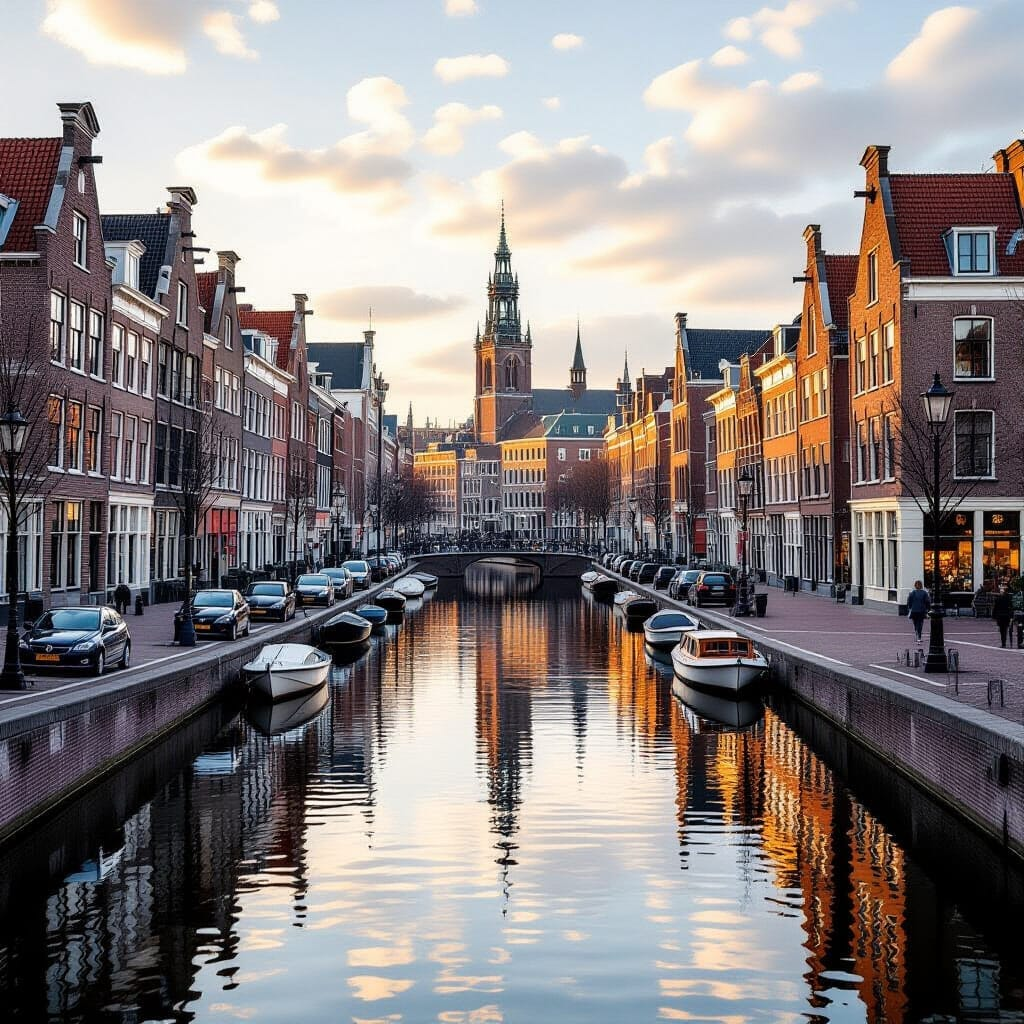

If the Dutch Golden Age were a playlist, Johannes Vermeer would be the slow-burn track that sneaks up and steals your heart at 2:17. Fewer than 40 paintings (give or take — scholars argue over the final count), centuries of mystery, and light so fresh you can practically smell the morning bread. Let’s pull up a chair by the window and talk Vermeer.
Who is this artist? Johannes Vermeer (1632–1675) was a Delft-born painter who turned quiet rooms into symphonies of light. He joined the Guild of Saint Luke in 1653 and spent most of his life working (and parenting a small army of children) in Delft. For a solid, readable overview, the National Gallery of Art’s bio is excellent, as is the Met’s primer on Vermeer and the Delft School. Read more: National Gallery of Art — Biography, The Met — Vermeer and Delft
What is he known for? Domestic interiors. Women reading letters, pouring milk, tuning virginals — ordinary moments that Vermeer turns into epic poetry. The greatest hits tour includes The Milkmaid (Rijksmuseum), Girl with a Pearl Earring (Mauritshuis), View of Delft (Mauritshuis), and Woman Holding a Balance (NGA).

What is his style? Call it Dutch Baroque with noise-cancelling headphones: radiant daylight, pearl-smooth paint surfaces, surgical composition, and color harmonies that make ultramarine and warm ochre feel like old friends. He’s also the unofficial CEO of “light coming from the left.”
Who taught him? We… don’t actually know. (Vermeer being Vermeer.) His master remains unrecorded, but influences include Delft neighbor Pieter de Hooch (hello, tiled floors) and the Utrecht Caravaggisti (for drama and optics).
Does he use any special technique? The spicy debate: Did he use a camera obscura (a dark room/device that projects an image) as a visual aid? Many scholars think the sparkling “circles of confusion” and precise optics in some works point to it; others say his eye and patience were enough. Either way, he layered fine glazes over pristine underpaintings to make light feel literal.

Who has he worked with? No documented workshop collaborations. Vermeer worked small and slow, likely supported by a key patron, Pieter van Ruijven, who purchased a significant number of his paintings — useful when your production rate is “luxury snail.” More on patronage: https://www.mauritshuis.nl/en/our-collection/our-masters/johannes-vermeer
Was he wealthy? Short answer: No. He married into better means (his mother-in-law, Maria Thins, was well-off), but the art market crash during the Franco-Dutch War hurt collectors and artists alike. When Vermeer died in 1675, he left debts; his widow petitioned for insolvency. Background: NGA — Biography
When was he most popular? Not in his own lifetime. Vermeer’s renaissance happened in the 19th century when scholars rediscovered his work. Since then — rocket ship. By the late 20th century he was an Old Master rockstar with sold-out retrospectives and long museum lines.

Tell me more, please
- Small catalog, big impact: Around three dozen paintings total. That scarcity is a feature, not a bug; each one is composed like a chess endgame.
- Color budget: Those blues aren’t cheap. Natural ultramarine (from lapis lazuli) wasn’t a “why not” kind of purchase. He used it with monk-like restraint for maximum glow.
- Stagecraft: The maps on walls, the gridded floors, the pearls — none are props. They’re characters. Vermeer is a master of painting about looking.
Anything else left to tell? Vermeer and his wife likely had 11 surviving children (out of about 15 births). Imagine trying to paint in peace with that many little critics toddling around your studio.

Any other interesting tidbits?
- Girl with a Pearl Earring isn’t a portrait in the usual sense but a tronie — a study of a head/costume, meant more as character than a specific person. Mauritshuis explainer
- View of Delft has weather so honest that meteorologists have used it to speculate about the time of day and cloud cover. Nerds (the best kind). Mauritshuis — View of Delft
- If you love the hush, the glow, and the “did someone just breathe?” vibe, browse our current art drops for kindred moods — start here: Lumaiere Gallery.
If you enjoyed this episode, tap Follow and drop a comment: What’s your favorite Vermeer moment — the glint on a pearl, the map on a wall, or those floor tiles marching into infinity? More from Dave LumAI right over here. And yes — Episode 19 is brewing.
Art Prompt (Baroque realism): A serene cityscape along a canal under a high, pearly sky; low horizon with brick facades and stepped gables reflected in still water; soft, cool daylight filtering through thin clouds; meticulous perspective and crisp architectural edges balanced by diffused atmospherics; subtle figures in muted attire, tiny strokes of white catching on windows and ripples; a restrained palette of warm ochres, lead-tin yellows, smalt-leaning blues, and quiet blacks; the entire scene composed from a slightly elevated viewpoint, inviting contemplation rather than spectacle.
Video Prompt: Begin with a slow tilt from luminous, overcast sky to a calm canal; drift forward as ripples gently disturb perfect reflections of gabled rooftops; cut to micro-moments — glinting windowpanes, a boat line tugging, a gull crossing frame; add a time-lapse pulse to clouds while the rest remains still; finish with a subtle rack-focus from brick texture to water shimmer, then loop back to the sky for a seamless, meditative cycle.

Songs to score the video:
- Gymnopédie №1 — Erik Satie
- Riverside — Agnes Obel