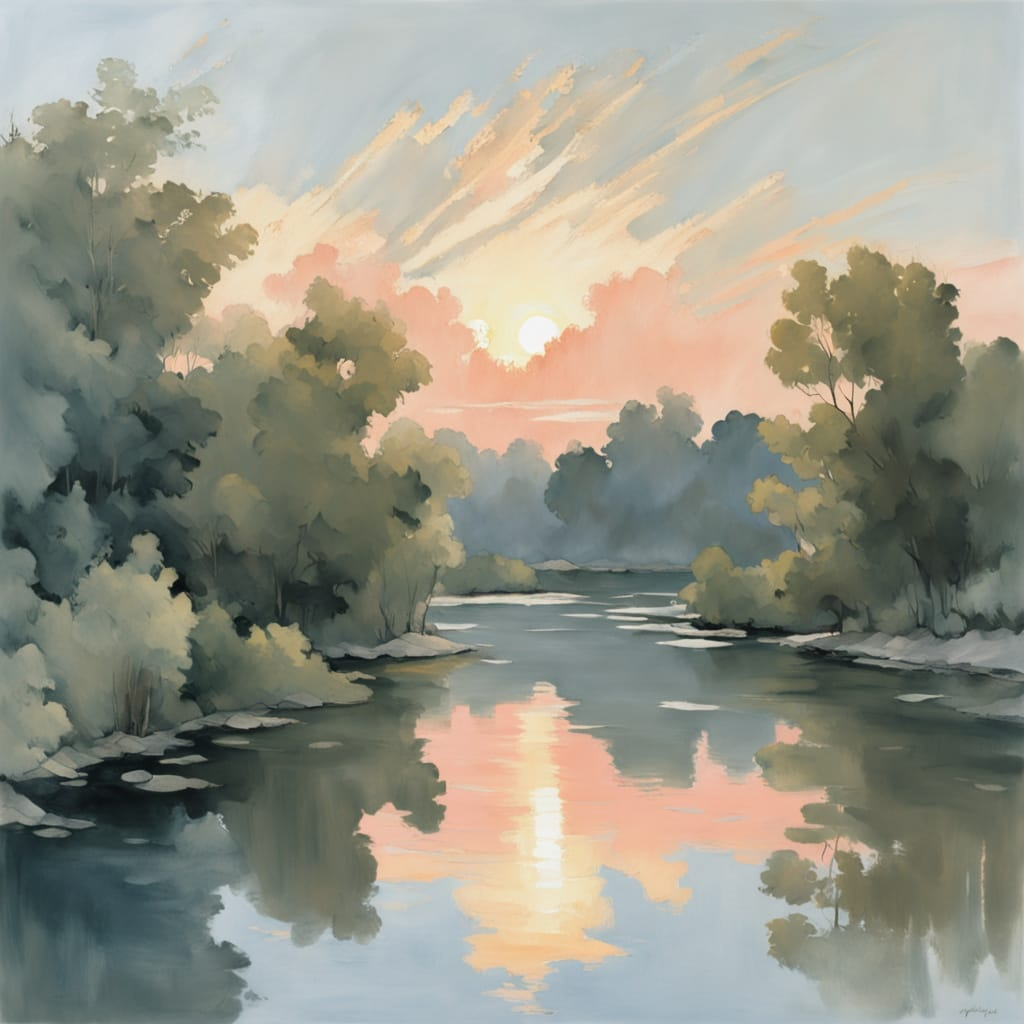

If Claude Monet is the headline grabber, Alfred Sisley is the quiet friend whose landscapes sneak up on you until you realize you’ve been breathing in his skies for five minutes. Born in Paris to British parents, he spent nearly his whole life in France yet remained a British citizen to the end — an Anglo-French Impressionist who painted rivers like they were biographies and clouds like they were main characters (Britannica, Art UK).
Who is this artist? An Impressionist landscape specialist (1839–1899) who devoted himself almost exclusively to painting outdoors — no Parisian salon dramas, no grand mythologies, just light, air, water, and the way weather changes a place from minute to minute (National Gallery, London, Wikipedia).
What is he known for? Skies that actually feel like skies; rivers that behave like rivers; and serial obsessions with specific spots — the Seine flooding at Port-Marly (multiple series in 1872 and 1876), bridges at Villeneuve-la-Garenne and Hampton Court, the streets and riverbanks of Moret-sur-Loing. If you want a starter piece, peek at the calm-after-chaos serenity in Flood at Port-Marly (collections and essays at the National Gallery of Art, Musée des Beaux-Arts de Rouen, and Museo Thyssen-Bornemisza) (NGA overview, Rouen, Thyssen, series note).
What is his style? Light-soaked, high-key color, brisk visible strokes, and a love of atmosphere. He often bands a composition horizontally — sky, shoreline, water — then lets reflections and cloud-shadow carry the drama. Museums routinely describe him as one of the purest landscape Impressionists (Tate, National Galleries of Scotland).

Who taught him? Charles (Marc-Charles-Gabriel) Gleyre — the same studio that incubated Claude Monet, Pierre-Auguste Renoir, and Frédéric Bazille. That crew ditched the studio and hauled their easels outside, co-founding what became Impressionism (National Gallery of Art on Bazille, Clark Art Institute).
Does he use any special technique? Plein-air everything; crisp, broken brushwork; and color laid side-by-side to let your eye mix shimmer on water and haze in sky. Pigment studies on specific canvases show the restrained, luminous palette behind all that calm (e.g., cobalt blue, viridian, chrome yellow in Marly scenes) (ColourLex pigment analysis). If you’re looking for textbook “make the air feel humid,” Sisley’s your workshop.
Who has he worked with? He painted alongside Monet, Renoir, and Bazille from the Gleyre days onward and showed with the Impressionists in 1874, 1876, 1877, and 1882. Dealers Paul Durand-Ruel and later Georges Petit handled and promoted his work, sometimes tug-of-war style between their galleries (Getty artist page, Met research on Georges Petit).
Was he wealthy? Early comfort, then… not. His family’s fortune collapsed around the Franco-Prussian War, and he spent much of his life scrambling — recognized by peers but not awash in francs. Ironically, appreciation (and prices) rose after his death (Britannica).
When was he most popular? Public fame lagged his peers during his lifetime; those 1870s exhibitions brought attention, but the wider “Sisley moment” bloomed posthumously as museums and collectors re-ranked the movement’s landscape poets (Art Institute of Chicago publication note, Britannica).

Tell me more, please. He loved England’s rivers almost as much as France’s. In 1874 and again in 1897 he painted the Thames around Hampton Court and Molesey — sunlight chopped into flat strokes so the water glints and slips out of the frame (National Gallery, London — Sisley in England and Wales, The Met object page). In his final decade he nested at Moret-sur-Loing, turning its bridge, church, towpaths, and poplars into a personal epic (see Moret at Sunset at the Cincinnati Art Museum) (Cincinnati Art Museum).
Anything else left to tell? A nationality plot twist: despite a life in France, he remained a British subject. He sought French citizenship late (applications in the late 1890s), but illness and bureaucratic timing meant he died English on paper in Moret-sur-Loing in 1899 (Art UK, Wikipedia).
Any other interesting tidbits? • The Port-Marly flood series is a masterclass in turning disaster into meditation — floodwater as mirror, light as subject, people as very minor supporting cast (NGA, Thyssen). • Museums often call him the “most consistent” Impressionist — code for “never got bored with landscape” and “didn’t wander off into portraits or grand allegories” (Tate). • You can browse an assortment of works and essays via The Met’s search portal; it’s a rabbit hole worth falling into (The Met search: Alfred Sisley).
Art Prompt (Impressionist landscape): A wide river town at dusk, seen from a low stone embankment; a graceful arched bridge spans mid-ground while a slender spire rises beyond. The sky breathes apricot, pearl, and pale ultramarine, with soft, feathery clouds drifting in bands. Water reflects the sky in broken ribbons — ripples rendered with quick, airy strokes that dissolve edges. Poplars and slate roofs sit in cool blue-gray shadow; a couple of tiny figures linger near the water for scale. Keep the palette luminous yet restrained — silvered blues, mossy greens, warm cream, and a blush of coral. Emphasize atmosphere: humid glow after a hot day, distant haze softening contours, gentle breeze pugging the water’s skin. Loose, confident brushwork; no hard outlines; everything held together by light.
Video Prompt: Begin on a lingering, slow pan of the apricot-to-ultramarine sky; drift down to the arched bridge as reflections tremble across the river in delicate, broken highlights. Add subtle time-lapse clouds sliding in horizontal bands; introduce a faint parallax as foreground reeds sway. Let a tiny rowboat glide once through frame, leaving a soft wake that turns the reflections into shimmering tesserae. Finish with a quiet push toward the distant spire as the color temperature cools — gold to silver — suggesting evening’s descent. Keep the motion smooth, loopable, and painterly: fine film-grain, soft vignetting at the corners, and a breath of ambient “river evening” soundscape.

Soundtrack picks to match the mood:
- Open — Rhye
- Tearing Me Up — Bob Moses
If this painted-airfield of a river town made you feel five degrees calmer, drop a comment and tell me which sky you’d live under. Want more episodes and experiments? Follow for the next deep dive, browse fresh pieces in the Art History gallery, and find more by Dave LumAI here.