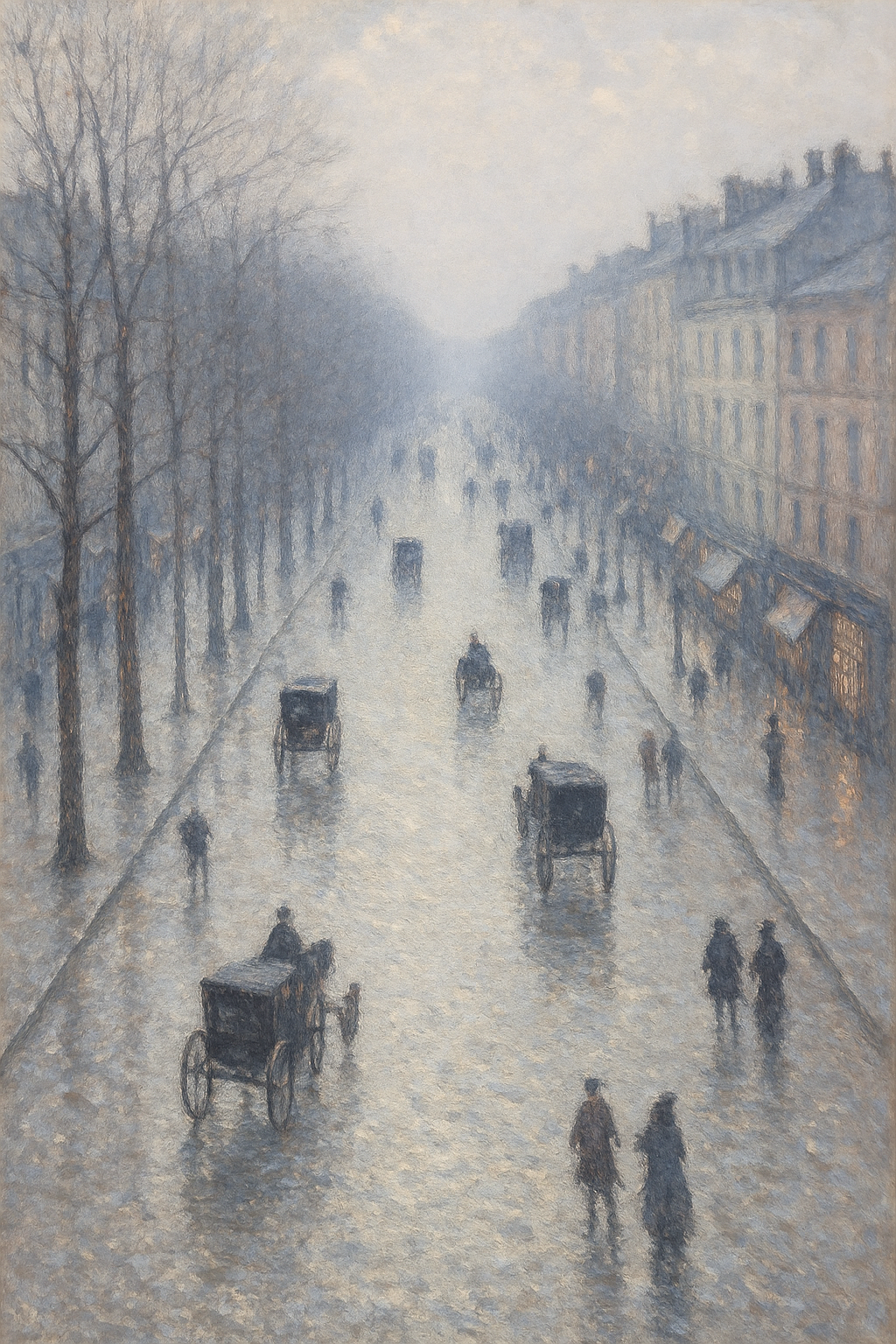

You know those friends who bring everyone together, keep the vibe calm, and still somehow push the whole group forward? That’s Camille Pissarro: the gentle engine behind Impressionism, a steady hand who nudged rebels into coherence and turned shimmering light into a lifelong study.
Who is this artist?
Born on St. Thomas in the Danish West Indies in 1830, Pissarro moved to Paris, became the Impressionists’ elder statesman, and painted until 1903. He’s the only member who showed in all eight Impressionist exhibitions (1874–1886). That’s not a footnote — it’s a flex. Read the concise overview on Britannica and you’ll see why he’s often called the movement’s backbone: britannica.com/biography/Camille-Pissarro.
What is he known for?
Light, atmosphere, and everyday life — peasant fields, market squares, and later, those glorious Paris boulevards seen from high windows. He took plein air painting seriously, then surprised everyone by pivoting to cityscapes with the same luminous logic. For a look at his late urban fireworks, see The National Gallery’s entry on The Boulevard Montmartre at Night: nationalgallery.org.uk/paintings/camille-pissarro-the-boulevard-montmartre-at-night.

What is his style?
Start with Impressionism’s core — broken strokes, vibrating color, and devotion to the moment. Then watch Pissarro keep exploring. He experiments with structure and touch without losing warmth. If you’re new to the movement he helped define, Smarthistory’s primer is a friendly on-ramp: smarthistory.org/impressionism.
Who taught him?
Pissarro studied under the great landscape painter Camille Corot, absorbing the Barbizon love of nature and direct observation. That DNA — paint what’s in front of you, honestly — never leaves him. The National Gallery’s artist page gives a tidy snapshot of influences and evolution: nationalgallery.org.uk/artists/camille-pissarro.
Does he use any special technique?
Absolutely. He was a plein air evangelist, then in the 1880s he tested Divisionism/Pointillism after meeting Georges Seurat and Paul Signac. He didn’t treat it as a gimmick; he filtered the science through feeling. Later, eye trouble and the Paris climate nudged him indoors, where he turned upper-floor windows into observatories for his boulevard series — orderly brushwork, complex light, and seasonal variations like a visual symphony.
Who has he worked with?
He encouraged Claude Monet, mentored Paul Cézanne (their Pontoise sessions are legendary), welcomed Paul Gauguin into the fold, and championed Seurat’s structural experiments. Pissarro was the studio friend everybody needed — constructive, principled, and generous with his time and critique.
Was he wealthy?
Nope — he had real financial struggles for much of his life. Large family, shaky sales, and a public that took its time catching up. Things improved in the 1890s as dealers and collectors finally realized the magic had been in front of them all along. If you’ve ever bet on the long game, you’ll feel seen.
When was he most popular?
Late career. Those Paris series — the balletic traffic, hushed snow, spring light — clicked with audiences. He didn’t just catch on; he crescendoed.

Tell me more, please
He was cosmopolitan by birth and temperament: Caribbean childhood, Venezuelan sketching adventures, and then France for the main event. He was also of Sephardic Jewish descent, which adds another layer to his status as an outsider-turned-insider. Through it all, the constant is curiosity — about light, labor, seasons, and how communities move.
Anything else left to tell?
Yes: his studio wasn’t a silo. He exchanged letters, ideas, and technical notes with younger painters; his son Lucien became an accomplished artist and printmaker; and Pissarro himself kept tinkering — oils, pastels, prints — like a scientist with paint.
Any other interesting tidbits?
He’s the glue character in the Impressionist ensemble. Remove him, and the movement looks messier, less coherent, and probably less kind. He wasn’t the loudest. He didn’t need to be.
If this got you in an art mood, take a spin through a current gallery I’m curating here — lots of luminous pieces to browse and share: lumaiere.com/?gallery=renaissance. And if you enjoy deep dives like this, drop a comment with your favorite Pissarro (or favorite cityscape in general), and hit follow so you don’t miss the next episode.
Art Prompt (Impressionism): From a high vantage, a grand tree-lined boulevard unfurls toward a hazy horizon, carriages and pedestrians flickering as specks of movement. Silvery daylight and cool shadows weave across wet cobblestones; facades in soft pearl gray, slate blue, and tea-rose mauve recede in gentle atmospheric perspective. Brushwork is lively yet restrained — short, lucid strokes that shimmer rather than shout. Bare branches stipple the sky; storefronts glint; the whole scene hums with urban calm and late-winter clarity. Keep edges soft where light dissolves form, let reflections ripple in broken dabs, and preserve a tender balance between bustle and serenity.

Video Prompt: Begin on a close-up of dappled paint “breathing” on slick cobblestones, then tilt up to reveal a lofty, tree-lined boulevard alive with tiny carriages and pedestrians. Slowly dolly forward as soft pearl-gray facades drift by; cut to a gentle time-lapse where cool shadows slide and sky light warms from pale blue to pink. Add a subtle parallax on branches, then transition into a drifting overhead glide that lingers on glints in windows and puddles. Conclude with a slow reverse pullback to the high vantage, the city reduced to luminous strokes, the scene exhaling into calm as ambient street sounds fade.
Songs to pair with the video
- Unfold — Rival Consoles
- Looped — Kiasmos
If you made it this far, say hi in the comments: Which Pissarro — rural market or city boulevard — wins your wall space? And tap follow for the next Artist Series drop!