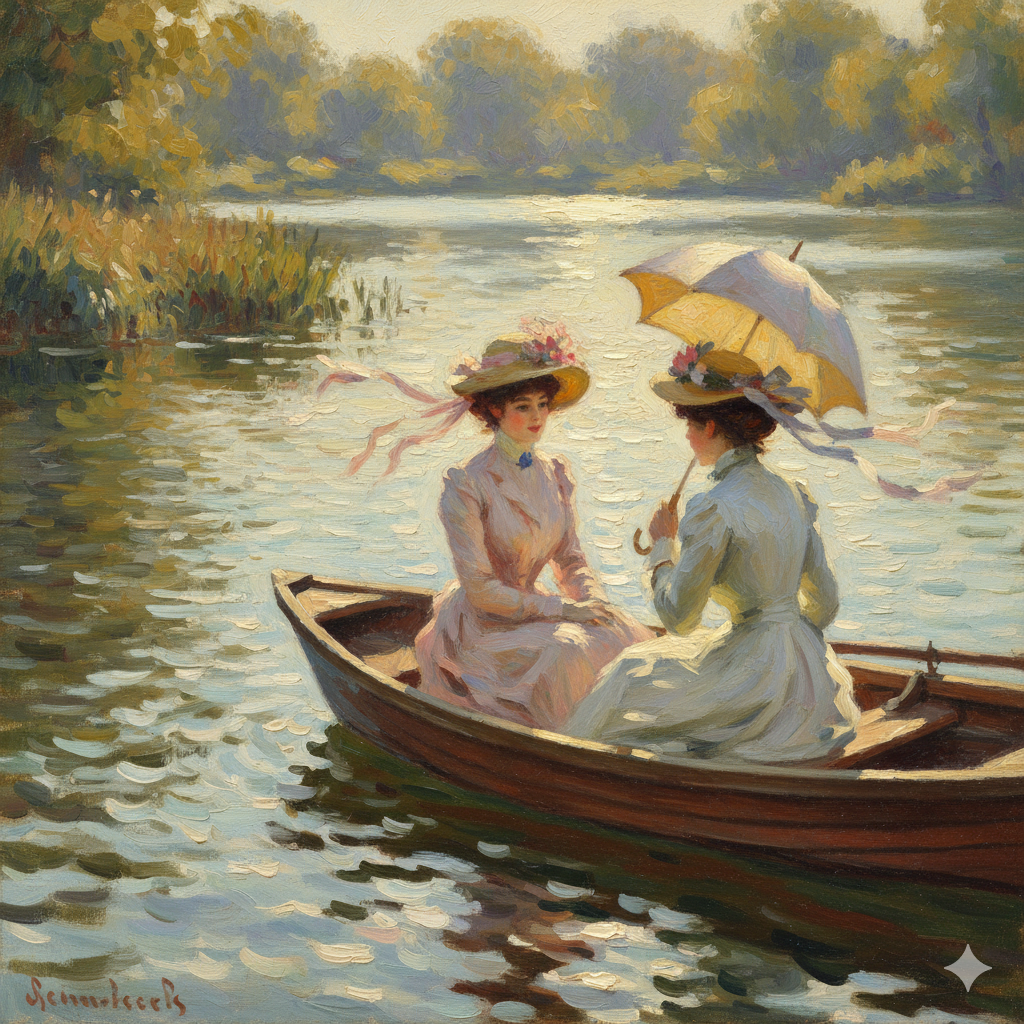

Let’s talk about the Impressionist who painted sunlight so lightly it practically hovered: Berthe Morisot. If the movement was a band, she wasn’t the “token” anything — she was a founding member who kept showing up, kept innovating, and kept making paintings that feel like fresh air.
Who is this artist?
A Paris-based painter born in 1841, Morisot helped launch Impressionism and exhibited with the group from the very first 1874 show onward (she missed only 1879). She brought a new gaze to modern life — domestic scenes, balconies, boats on lakes — rendered with brushwork that seems to exhale. You can skim her concise bio at Britannica or explore highlights from the Musée d’Orsay.
What is she known for?
For capturing fleeting light, private moments, and modern interiors/exteriors with a high-key palette and diaphanous touch. She was also the only woman in the first Impressionist exhibition of 1874, a fact that gets repeated because, frankly, it’s extraordinary. If you want one painting that bottles her vibe, look at Summer’s Day in the National Gallery, London: two women in a boat, rippling water, and brushwork that floats.

What is her style?
Think luminous, fast, and airy. Morisot’s touch is famously “allusive rather than descriptive,” favoring speed, sensation, and atmosphere over hard edges. She often leaves margins loosely painted, letting the ground peek through — what Orsay curators remind us earned her the nickname “the angel of the incomplete” (Musée d’Orsay).
Who taught her?
She studied with Joseph-Benoît Guichard, who had his students copy works in the Louvre, and then with landscape painter Jean-Baptiste-Camille Corot, who urged her into plein-air practice (The Art Story).
Does she use any special technique?
Yes: rapid, broken brushwork; high-key tonality; spare, suggestive edges; plein-air starts finished in the studio; and fluent work in watercolor and pastel. Her canvases often compress space so foliage and figures intermingle, intensifying immediacy.
Who has she worked with?
She exhibited and debated alongside Monet, Renoir, Degas, Pissarro, and Sisley. She was a close friend of Édouard Manet (and modeled for him) and later married his brother Eugène Manet. Writers like Stéphane Mallarmé also championed her.

Was she wealthy?
She came from a comfortable bourgeois background that supported the arts. That security gave her freedom to experiment. Fun fact: despite critical pushback, her work sometimes sold for more than Monet or Renoir in the early years.
When was she most popular?
Her 1870s–1880s output solidified her status. Interest surged again in the 21st century with major retrospectives such as Orsay’s 2019 show and the 150th anniversary of Impressionism in 2024, which prominently featured her (Guardian, Le Monde).
Tell me more, please
Her favorite subjects were women at mirrors, balconies, verandas, gardens, and boats — threshold spaces between public and private. She loved pearly grays, sea-glass greens, pale violets, and breathy whites, painting figures that are absorbed, poised, and quietly daydreaming.
Anything else left to tell?
She began with the official Salon in 1864, then broke away in 1874 with the independents. And yes, Summer’s Day (1879) still makes lake water look like something Parisian perfumers should bottle.
Any other interesting tidbits?
She and her sister Edma trained together, writing heartfelt letters about art, making theirs one of the most documented sister-studio dynamics in art history (Met essay). Critics once sneered at her “unfinished” look; modern curators now call it radical modernity.

Art Prompt (Impressionist): A sun-lit afternoon on a quiet park lake: two fashionably dressed women in a small rowboat drift past reed-soft banks; feather-light, broken brushstrokes create rippling water in jade, duck-egg blue, and pearly gray; soft edges let hat ribbons and parasols fuse with the breeze; the boat is cropped at the frame, figures slightly off-center; high-key palette with powdered whites and rose-tinged highlights; wet-on-wet sparkle on the surface; a whisper of canvas peeks through at the margins; the mood is unhurried, intimate, and luminous, with gentle brush strokes reminiscent of Renoir and the easy glow of late-afternoon Paris.
Video Prompt: Animate the scene as a 10–12 second vertical loop (9:16): start on a close shimmer of painted water, subtle dolly-out reveals the boat gliding; micro-ripples animate with delicate specular flicker; ribbons and parasol edge quiver in a breeze; leaves cast dappled, drifting shadows; add painterly grain and light bloom on highlights; keep soft focus falloff at the edges; natural oar creak and lake ambience optional; end by easing back to the water shimmer for a seamless loop.
Songs to pair with the video
- Horizon — Tycho
- Far Away — José González
If this made your day 12% more luminous, follow and drop a comment — what’s your favorite Morisot moment?