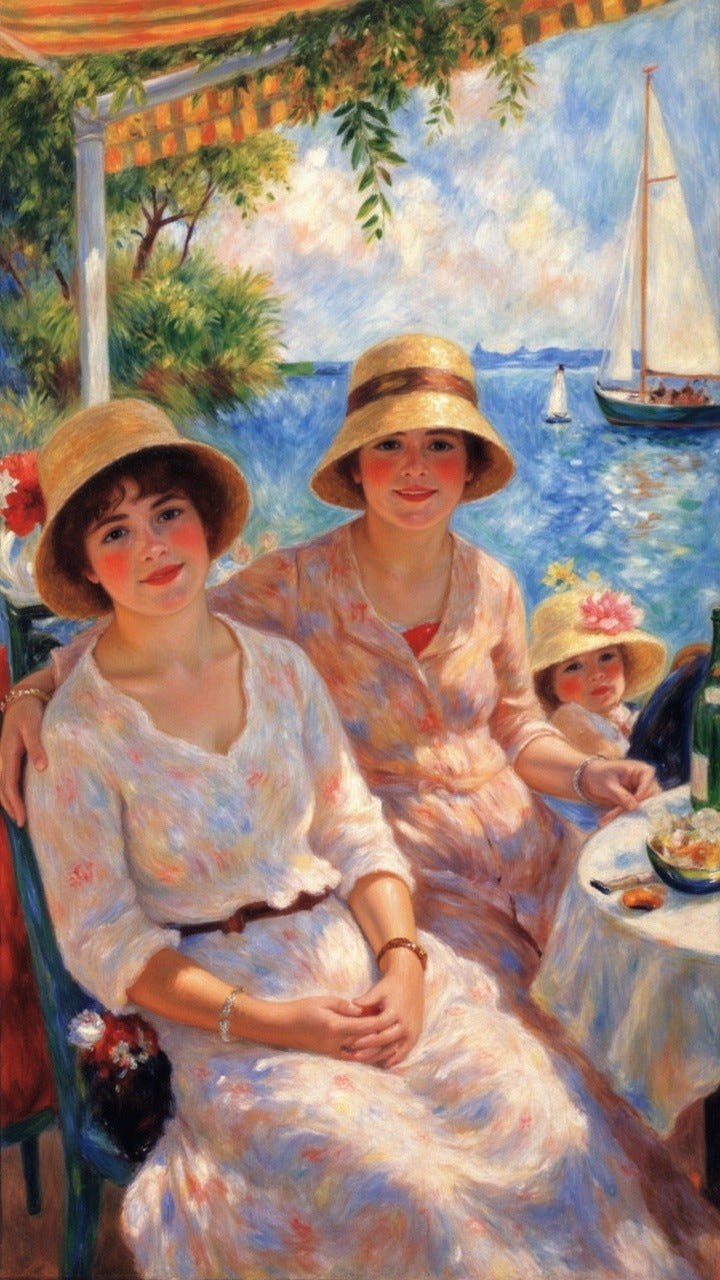

If Impressionism were a dinner party, Renoir would be the charming guest who tells a great story, pours the wine just right, and somehow leaves everyone glowing. Episode 12 lands us in the orbit of Pierre-Auguste Renoir (1841–1919), a painter who turned warmth, color, and human connection into a lifelong thesis.
Who is this artist? A French painter born in Limoges and raised in Paris, Renoir began as a porcelain decorator before diving into formal study. He copied Old Masters at the Louvre and, in 1862, trained at Charles Gleyre’s studio — where he met Monet, Sisley, and Bazille, the future co-conspirators of a movement that upset the art establishment and delighted… pretty much everyone else. Reliable bios here: Britannica, The Met, and the National Gallery (London).
What is he known for? People, parties, and the poetry of daylight. Renoir’s best-loved canvases capture modern leisure — open-air cafés, riverside afternoons, quicksilver reflections in glassware, and that shimmering skin-tone recipe only he seemed to know. If you want a single painting that explains his charm, feast your eyes on Luncheon of the Boating Party at The Phillips Collection: phillipscollection.org/collection/luncheon-boating-party (also a terrific technical peek here: Conservation study).
What is his style? Phase 1: pure Impressionist sparkle — broken color, short “buttery” strokes, dappled light. Phase 2 (mid-1880s onward): a more classical, drawn approach influenced by his Italy trip and admiration for Raphael and Ingres — smoother contours, stronger line, and a focus on the figure. Quick primers: Britannica overview and Musée d’Orsay context.
Who taught him? Charles Gleyre, whose Paris studio was a launchpad for several Impressionists. That’s where Renoir bonded with Monet, Sisley, and Bazille — then took their paints outside and chased the sun. Confirmation: The Met and National Galleries of Scotland.

Does he use any special technique? Outdoors, fast, and keyed to natural light — Renoir’s early “open air” method produced feathery edges and color that vibrates at viewing distance. He layered warm and cool touches to make skin tones radiate (peaches and roses over soft cobalt or violet shadows). Later he tightened the drawing but still glazed and scumbled to keep forms luminous. Late in life, rheumatoid arthritis forced adaptations. He worked with assistants to position canvases and place brushes in his hands; he kept painting daily even in a wheelchair. (On the RA story and the persistent “brush strapped to the hand” myth: NIH/PMC medical note, clarifying scholarship.)
Who has he worked with? He wasn’t a studio “collab” guy in the modern sense, but he did paint alongside Monet at La Grenouillère in 1869 — two friends, same motif, different magic. See the National Gallery’s note on their joint summer sessions: Monet at La Grenouillère. For sculpture, he teamed up with the younger Richard Guino (at the encouragement of dealer Ambroise Vollard). Renoir designed; Guino modeled — leading to works like Venus Victorious. Museum write-ups: Kreeger Museum and Montreal Museum of Fine Arts.
Was he wealthy? Early? Not remotely — he painted fans and did odd jobs to stay afloat. With the support of dealer Paul Durand-Ruel and rising popularity in the 1880s–1890s, prosperity arrived. By his later years (Cagnes-sur-Mer), he was successful enough to focus on monumental nudes and family portraits without fretting over rent.
When was he most popular? He gained traction after the 1870s Impressionist exhibitions, peaked with society portraits and luminous figure paintings in the 1890s–1910s, and has never really left the conversation since. Exhibitions continue to revisit his role in shaping modern life’s look and feel.

Tell me more, please Renoir adored people. He could paint lace, glass, and sunlight… but his superpower was affectionate observation. Children look like children, friends look like friends, and strangers become companions by the time you reach the lower right corner of the canvas. He also raised a filmmaker — his son Jean Renoir — so storytelling was basically the family sport.
Anything else left to tell? Yes: Renoir never stopped. Even when arthritis fought back, he adjusted and kept working. The paint is tender, but the work ethic was granite. And if you ever need proof that joy can be a rigorous aesthetic, spend five minutes in front of one of his crowd scenes and try not to smile.
Any other interesting tidbits?
- He loved Italy — Raphael helped nudge his later shift toward firmer contours.
- He and Monet often compared notes; friendly rivalry sharpened both.
- The sculpture collaboration with Guino produced around a dozen works; collectors still debate attribution nuances, but museums present them as a genuine partnership.

Art Prompt: A sun-washed riverside terrace beneath a striped awning, a lively gathering of friends in straw hats and silk dresses, dappled noon light scattering across faces and shoulders; sparkling highlights on glassware and bottles; warm peaches and roseate skin tones balanced by cool cobalt-violet shadows; quick, buttery strokes that soften edges into air; subtle sailboats drifting in the hazy distance; diagonal clusters of figures that create a gentle whirl of conversation; an atmosphere of laughter, intimacy, and summer heat suspended in time.
Video Prompt: Begin on a soft rack-focus of sunlit glassware; slow pan reveals a half-shaded terrace under a striped awning; ribbons on hats flutter as dappled light flickers across silk dresses; a gentle push-in as friends lean into conversation; brief tilt to catch glints on a bottle, then drift past smiling faces to the river where pale sails glide; loop at 12 seconds with a final shimmer over the tablecloth; keep textures creamy, edges loose, and color harmonies warm-peach and cool-cobalt; add subtle ambient clinks and a breeze-through-leaves soundscape.
Soundtrack pairing:
- La Lune — Billie Marten
- Light Through the Veins — Jon Hopkins

If this made you grin (or argue with your art teacher), drop a comment with your favorite Renoir moment and hit follow for the next episode. Want more visuals and merch? Browse the current gallery and our moving-picture experiments: Abstract Expressionism 2 • Videos 3 • Short-form clips: @davelumai