
So, you’re flipping through FM stations in your car and suddenly… two stations on 88.1? One says “HD1,” the other “HD2.” Witchcraft? Government mind control? Not quite. Welcome to the delightful, underappreciated world of HD Radio — a technology that’s cooler than its name implies, yet still manages to confuse more drivers than a roundabout in New Jersey.
Let’s demystify it, shall we?
What is HD Radio? Despite sounding like a VHS tape’s final form, HD Radio has nothing to do with high-definition television. It stands for “Hybrid Digital,” which is both accurate and aggressively vague. HD Radio allows traditional AM and FM stations to broadcast digital signals alongside their analog ones. That means better sound quality, bonus channels (HD2, HD3, etc.), and song titles that magically appear on your dashboard like a tiny karaoke machine.
Think of HD Radio like a layer cake. The bottom layer is your good ol’ analog FM. The middle is HD1, typically just a digital version of that analog feed but cleaner and less staticky. Then you’ve got HD2, HD3, and so on — extra content the station can broadcast digitally, often commercial-free or genre-specific.
Why Are There Multiple Stations on the Same Frequency? Ah yes, the mystery of “88.1 HD1” vs. “88.1 HD2.” It’s not an error; it’s your car trying to impress you with its multitasking. The main FM signal (88.1) now wears many hats. HD1 is the standard broadcast, digitally enhanced. HD2 and HD3 are bonus channels the station can run, and they can be completely different genres. You might get classical on HD1, indie rock on HD2, and NPR’s weird cousin on HD3.

But Wait, What’s the Difference Between AM and FM Anyway? AM stands for Amplitude Modulation. It’s like shouting into a wind tunnel — you’ll probably be heard, but the audio quality is, let’s say, nostalgic. FM stands for Frequency Modulation, which provides way better sound. AM is more susceptible to static but travels farther. FM sounds nicer but is clingy and prefers to stay local.
HD Radio enhances both, but let’s be honest — HD AM is like putting a tuxedo on a potato. It tries.
Which Is Better: AM, FM, or XM? It’s a bit like asking whether you prefer vinyl, CDs, or Spotify.
- AM: Good for talk radio, sports, and conspiracy theories about alien lizard people.
- FM: The gold standard for music — until you drive into a tunnel.
- HD Radio: FM’s shinier, tech-savvy sibling. More content, clearer sound.
- XM (SiriusXM): Satellite radio. Subscription-based, national coverage, endless channels, and that one Beatles station that plays nothing but Ringo deep cuts at 3 a.m.

Does HD Use the Same Tech as XM Radio? Not quite. HD Radio is terrestrial — it piggybacks on traditional FM/AM signals. XM Radio uses satellites, which means you can listen to the same channel whether you’re in San Francisco or the backroads of Arkansas. HD is free; XM is not. Choose your fighter.
Who Invented These, Anyway?
- AM: Reginald Fessenden gets credit for the first AM transmission in 1906, proving once and for all that Canadians can be loud, too.
- FM: Edwin Howard Armstrong invented FM in the 1930s. He also jumped out a window in frustration over patent lawsuits. Seriously.
- XM: Launched in the early 2000s by a gaggle of satellite nerds and car manufacturers with too many cupholders.
- HD Radio: Developed by iBiquity Digital Corporation in the early 2000s. iBiquity was later acquired by DTS, who were later acquired by Xperi, because nothing says innovation like a Russian nesting doll of acquisitions.

How Do I Program My Car Radio Without Summoning a Demon? Every car is different, but generally:
- Tune to the station frequency.
- Wait a few seconds for HD1, HD2, etc. to load.
- Use the seek/scan button to find subchannels.
- Hold down a preset button until it beeps or flashes. Boom. Preset.
- Pray to the dashboard gods that it stays saved.
Fun Tidbits and “Wait, What?” Moments
- HD Radio can include traffic and weather maps. Your FM station could be your new GPS sidekick.
- Some HD2/HD3 channels play obscure music or “deep cuts” that never make it to mainstream FM.
- Not every FM station has HD. It’s like discovering your favorite taco place doesn’t deliver — you’ll survive, but it hurts.
- And yes, your HD signal can drop if you drive under a bridge, near a microwave tower, or make eye contact with it too directly.
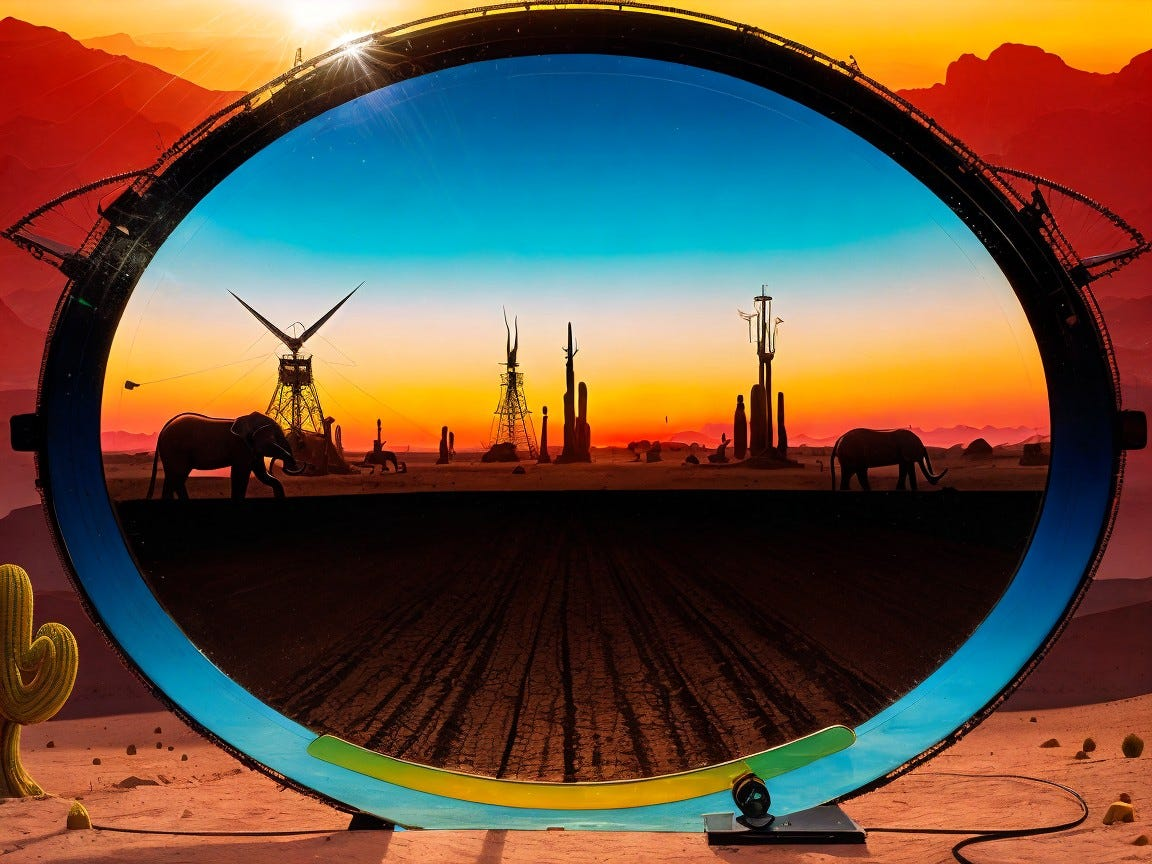
Art Prompt: A vivid Surrealist composition in the style of Salvador Dalí, inspired by “The Elephants.” Tall, impossibly thin-legged radio towers stretch across a desert landscape, each balancing antique analog radios and gleaming digital interfaces on their backs. A distant sun melts into a vinyl record on the horizon, while translucent FM waves ripple through a cracked, mirror-like sky. The palette pulses with amber, indigo, and metallic silver, evoking the tension between nostalgia and futuristic tech.

Video Prompt: Begin with close-up shots of melting analog dials and flickering frequency needles. Transition into a panoramic sweep of bizarre, spindly towers walking through a digital desert, their antennas crackling with light. Overlapping waveforms pulse across the screen as subchannels spiral out like echoing timelines. Finish with a slow zoom into a radiant sunrise formed by a glowing radio dial, as the music swells and vanishes into signal static.
Song Recommendations:
- “Ghostwriter” by RJD2
- “Weird Fishes/Arpeggi” by Radiohead
Got a funny HD radio moment? A favorite HD2 station that plays nothing but Icelandic trap music? Drop a comment and let’s talk tech quirks. Follow for more blog musings and radio mysteries — because who knew the FM dial had so many secrets?