
Let’s talk about ancient overachievers — the folks who looked at stone, clay, or sand and said, “Yeah, I can work with this.” Episode 13 takes us back — way back — to the genius of civilizations who didn’t wait around for the Renaissance to start creating beauty, order, and mind-bending feats of engineering.
First stop: Egypt. Yes, the land of dramatic eyeliner and even more dramatic architecture. Imhotep, often considered the world’s first named architect, didn’t just design Djoser’s step pyramid around 2667 BCE — he also dabbled in medicine, astronomy, and high priesting. Imagine Michelangelo but with a construction company, a hospital, and a direct line to the gods. Imhotep was revered in his lifetime and, after his death, actually became a god. Not just famous — deified. Take that, celebrity chefs.
Then there’s the anonymous genius of Egyptian artisans — those brilliant minds who built and decorated tombs like they were Instagram portfolios for eternity. We’re still deciphering their hieroglyphic captions today. No one signed their work (branding wasn’t big yet), but their mastery shaped an entire aesthetic legacy — from sarcophagi to temple reliefs.

Over in Mesopotamia (modern-day Iraq and Syria), creativity flowed with the rivers. Think of Sumerians like the ancient Steve Jobs of writing: they invented cuneiform, the world’s first written script, carved onto clay tablets like eternal Post-it Notes. We don’t know the names of these scribes, but their work allowed civilizations to record poems, taxes, and laws like Hammurabi’s Code. No biggie — just the foundation of every legal system ever.
(And if you’re looking for Enheduanna — the world’s first known author by name — we gave her the spotlight she deserved back in the Bronze Age Boom. Catch her poetic firestorm here: https://blog.lumaiere.com/the-bronze-age-boom-myth-metal-and-monumental-minds/ or on Medium: https://medium.com/@DaveLumAI/the-bronze-age-boom-myth-metal-and-monumental-minds-00c27dd3e5bb)
Meanwhile, in sub-Saharan Africa, we meet the mathematical minds behind the Ishango bone (possibly the world’s oldest calculator) and the stunning stone masons of Great Zimbabwe. Their dry-stone city walls — built without mortar — still stand. Not bad for folks with no access to Bob the Builder or cement trucks.
And let’s not forget Nubia, Egypt’s southern neighbor and sometime rival. Nubian artists and kings didn’t just mimic Egyptian aesthetics — they evolved them. The Nubians built pyramids too, more numerous than Egypt’s, often with steep angles and stunning internal decorations. They also had queens who ruled with serious flair (yes, real-life warrior queens).

These ancient creators weren’t just artists or engineers — they were civilizational glue. They built cities, recorded culture, preserved knowledge, and laid the groundwork for science, religion, and storytelling. Some were celebrated in their time; others are still having their work unearthed by wide-eyed archaeologists with dusty brushes and bigger-than-average hats.
No awards, no blue checkmarks, but their legacy is in every alphabet, archway, and algorithm we use today. Next time you pass a government building with giant columns or scroll through a list of laws longer than your Amazon order history, tip your metaphorical headdress to the OG creators of Pyramids and Papyrus.
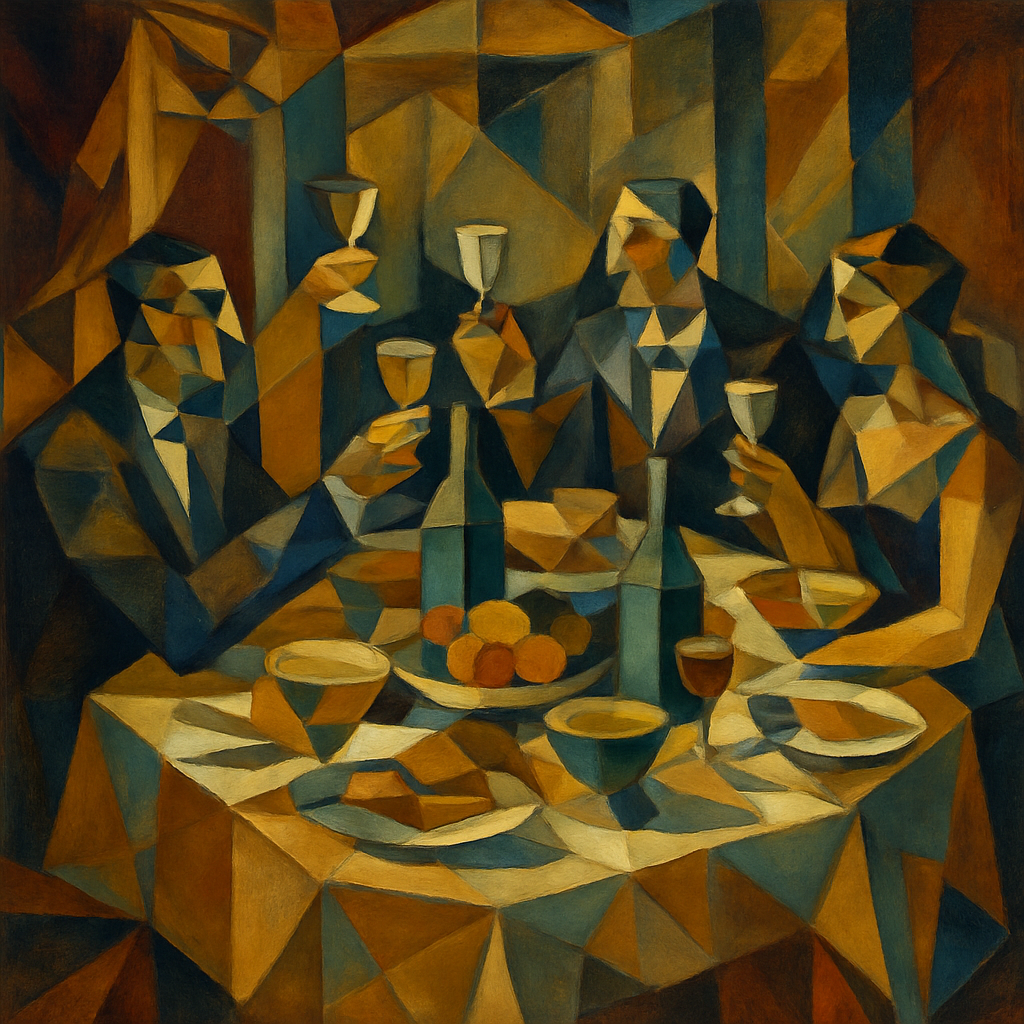
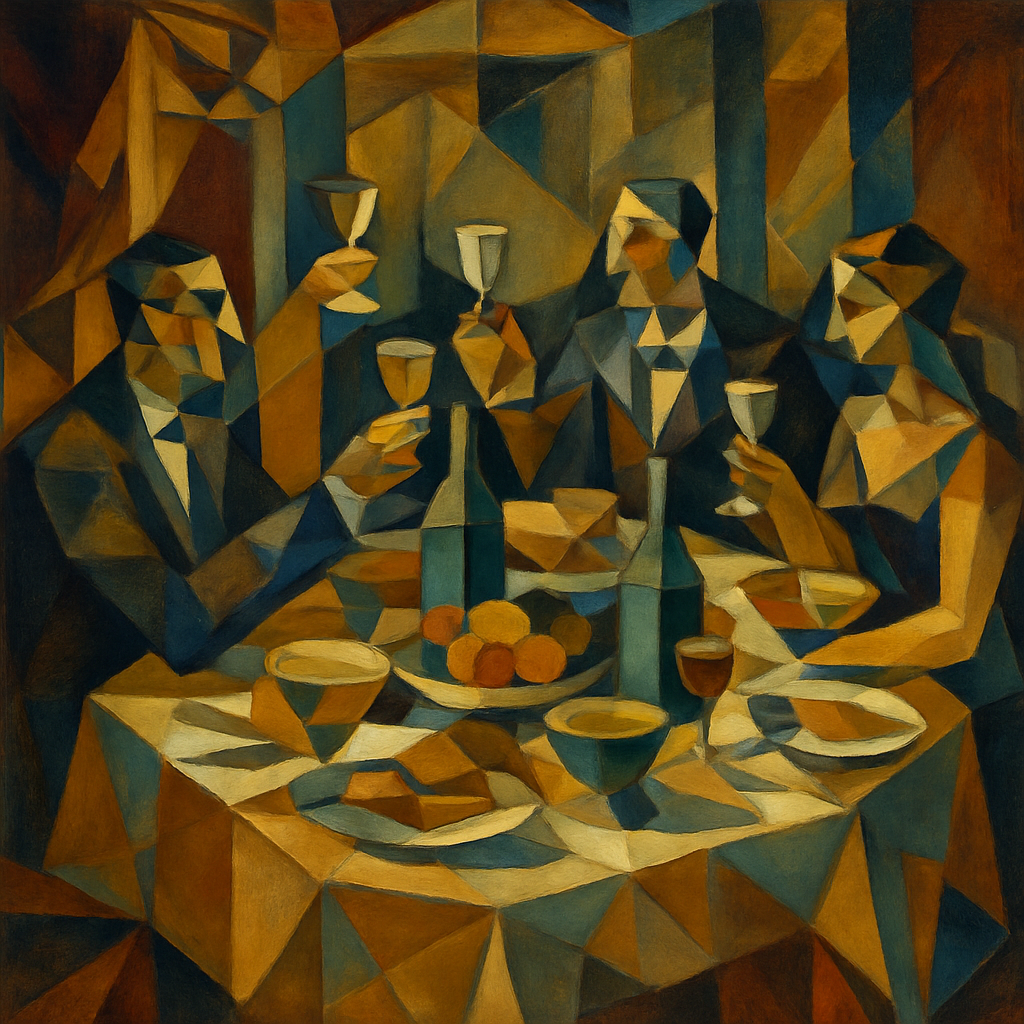
Art Prompt: A Cubist interpretation of an opulent interior scene, where fractured geometry replaces smooth lines, and the subject is a lavish banquet table. The composition uses sharp, angular forms with a fragmented sense of perspective. Rich burgundy, muted golds, and deep blues dominate the palette. The lighting casts faceted shadows, creating a mosaic of overlapping shapes. The mood is celebratory yet disjointed, with distorted figures clinking glasses and feasting in a kaleidoscope of abstraction.
Video Prompt: Zoom slowly across a Cubist banquet scene, each pan revealing new distorted angles and kaleidoscopic textures. Fragments shift and slide subtly, giving the illusion that the painting is assembling and disassembling itself. Shadows flicker like cut glass, and color tones pulse with the rhythm of abstract jazz. Let the feast feel both sophisticated and surreal — like a dream remembered in shards.
Songs to pair with this video:
- “Cantaloupe Island” by Herbie Hancock
- “Four Tet — Two Thousand and Seventeen”
If you’re joining us mid-series, make sure you don’t miss the beginning of the journey. Catch Episode 1 here: https://blog.lumaiere.com/the-creators-series-a-lightning-tour-of-historys-greatest-geniuses/ or here: https://medium.com/@DaveLumAI/the-creators-series-a-lightning-tour-of-historys-greatest-geniuses-317d81bc5532
Follow me for more time-traveling tales of creativity — and let me know in the comments which ancient genius you’d want to party with.